Creative Writing Exercises: Teaching from Image

In addition to my regular course load at my community college, I am a faculty advisor for our student run creative writing group, The Blank Page. I started the group when I was still an adjunct and students approached me looking for another venue in which they could share and improve upon their own work.

At today’s meeting I brought a series of images that I discovered via a link on the Paris Review’s Facebook page. The link contained images of haunted houses from Corrine Botz’s photography exhibition. Botz writes on her blog:

Haunted Houses provides a unique way of understanding our relationship to the spaces we inhabit, and reflects romantic and dystopian notions of the domestic realm. The notion of hauntedness activates and highlights the home, revealing the hidden narratives and possibilities of everyday life.

Botz went about taking photographs and collecting oral recitations of the ghost stories that go along with some of the photographs. You can listen to the stories here. The photographs are gorgeous and the stories are very interesting. I was even more intrigued by this project when I learned that one of the locations and stories took place in Girard, PA which is about ten minutes from Fairview, PA where my parents still live. This is the photograph from Girard:
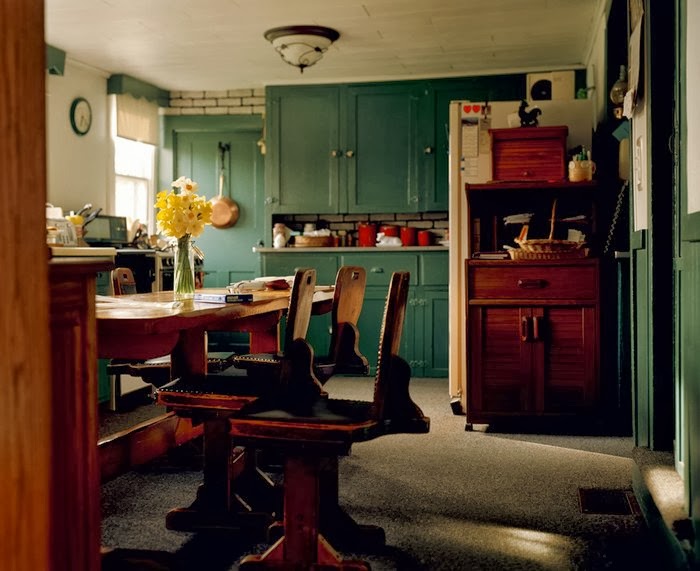
“Farmhouse, Girard, Pennsylvania” from the series Haunted Houses, 2010

Anyway. When I looked through the pictures, I thought they would make great prompts for my Blank Page students, so this afternoon we spent about half an hour free writing over selected images from Botz’s project. After we had finished writing, we debriefed a bit and the student response seemed positive. The general consensus seemed to be that the images provided specific details that the students could latch onto and use as a starting place for a poem or piece of prose. I’ve done this exercise for units on character, setting and story and I think Botz’s photographs are perfect inspirations for writers.

Also received word last night that three of my poems will be appearing in Rust + Moth.

Rejection Letters: Taking Notes on a Poem

When I was deeply immersed in my first graduate program working on my MA in creative writing, I became aware of the concept of “good” rejection letters and “bad” rejection letters. These letters (now mostly emails) were associated with the literary journals we were sending our poems out to at the time. “Good” rejection letters contained notes from the editor or readers. These notes could be just a few words of encouragement or a request to “try us again,” but the most coveted of notes contained actual comments about the poem or poems you’d sent in. Admittedly, I’ve had more of the first type of “good” rejection letter, but in the past year or two I’ve received a few notes about my actual poems. Of course this puts me in the somewhat awkward position of trying to decide whether I’m going to apply these notes or not. Case in point, I received some notes on a poem last winter that basically stated that the tone of the poem seem muddled. This particular poem had been through an extensive revision process both in and out of workshop, and I wasn’t really sure there was much more I could do to make the tone clear. I thought about it for a few months and then decided to leave it be. This poem has recently been accepted for publication.

I feel that this example of the good/bad rejection letter really just opens the conversation up to the question of when to accept to critique and when to trust your gut. I know this is a constant point of conversation in my creative writing classes, especially because many of my students are brand new to the concept of workshop. I always tell them to take what is useful and constructive and leave the rest. The worst thing that ever comes from a suggestion is that you try something that doesn’t work. At least you know you tried, and in trying, you learned something.

In other news, I learned my poem, “Vigil,” will be appearing in an upcoming issue of Grey Sparrow Journal. All good things.