BLOG POSTS

Happy Father’s Day

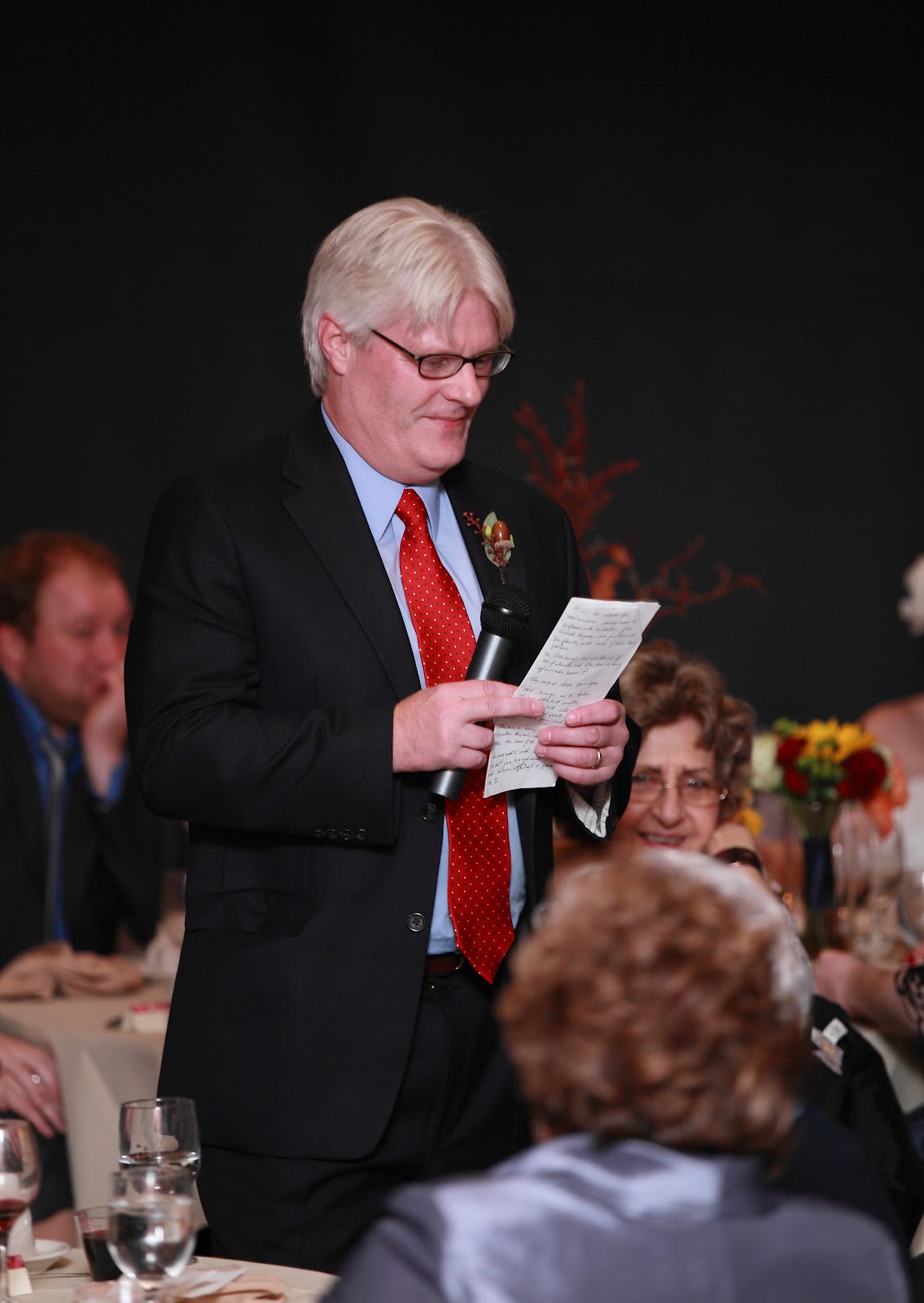
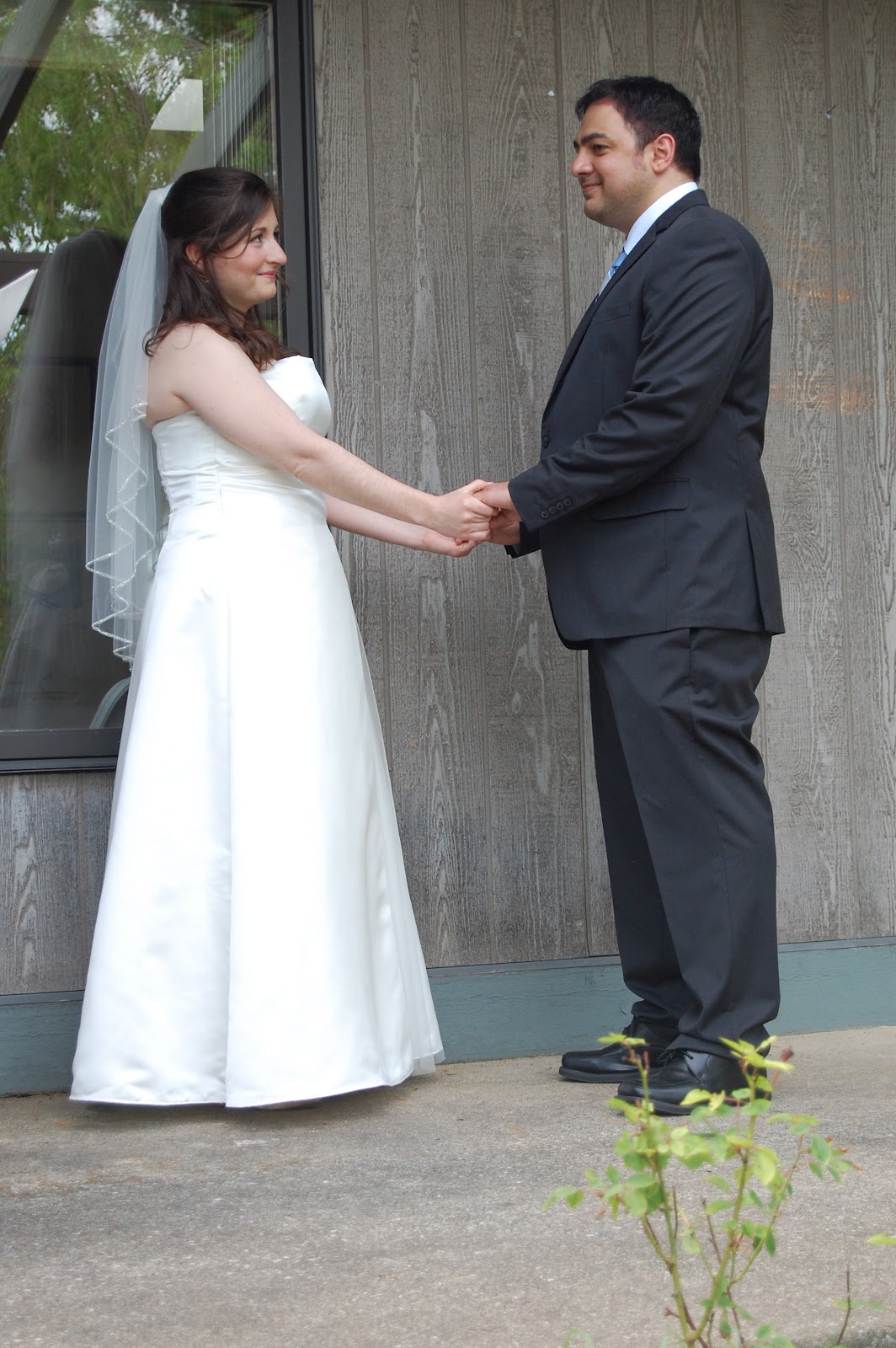
My Dad at our wedding in November. His speech was great.

This year my dad turned sixty. He’s received a wide array of gifts over the years but this year I think I screwed up. What I mean is, that for my Dad’s 60th birthday I gave him a pretty cool gift (if I don’t say so myself). I gave him “60 Years of Memories.” I wrote a memory that I had of my father for all of his sixty years, so on his birthday he received a box with 60 envelopes that contained those 60 memories. I was impressed with this idea and he really liked it. All good things, right? Wrong. How the hell does one follow up a gift like that one? The only things that came to mind were: dairy farm in Vermont, herd of pocket pigs and an antique John Deere Tractor. Clearly, none of these gifts were going to materialize for a variety of reasons. What was my response to this problem? Shit.

So for Father’s Day this year I am going to dedicate this blog post to my father and give you a list of the top five reasons why he’s kick ass:

1. He can build anything. Examples? Horse barn, wrap around porch, childhood swing set, tack box, garden house, and so on.

2. He like to play practical jokes. I give his three best:

       a.) Taking a ketchup bottle out to the garage and spreading it all over a dish towel. He then proceeds to run into the house with his hand covered in “blood” screaming to my mother that he cut his hand with a saw.
       b.) Standing in the garage, when we thought he had gone inside, and making the garage door “mysteriously” go up and down multiple times. I was convinced there were ghosts for a few minutes.
       c.) Sneaking upstairs, scooting under my bed, and grabbing my ankles when I went to get into bed. He thought it was funny. I was busy screaming.

3. He likes/loves bad pop music. Some of his favorites include Enrique Iglesias, The Backstreet Boys, Celine Dion, and wait for it, Justin Bieber.

4. He has a good sense of humor. See his yearly Christmas letter, his blog, any random comedy central stand up comedian special, and general dinnertime commentary.

5. He’s far more creative than he gives himself credit for. Examples? Freddy the Fly, Marty Martin, my science project (the one with the trees) and countless Christmas gifts (lava lamp, cypress tree, GPS).

Happy Father’s Day, Dad.

Love,
Bri

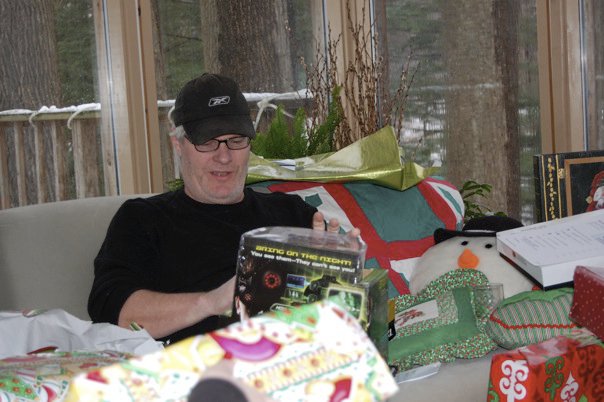
Christmas 2011.

Christmas 2011.

Christmas 2009.

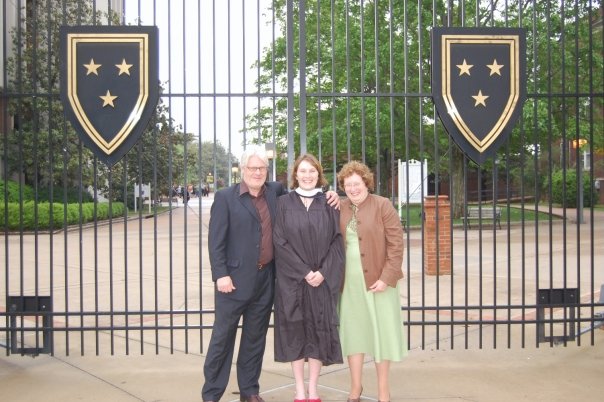
My MFA graduation 2009.

The Tiger’s Wife

In July of 2009 I posted about Tea Obreht’s short story The Tiger’s Wife. It appeared in The New Yorker’s Summer Fiction issue, so it seems only appropriate that in the summer of 2012 I am now posting about Obreht’s novel of the same name.

This is part of my original post:

The way that The Tiger’s Wife weaves a folk story into the larger conflict of war is also very impressive. For instance, in the opening of the piece when the tiger is still trapped in the citadel, the description is starkly genuine “The tiger did not know that they were bombs. He did not know anything beyond the hiss and screech of fighter plans passing overhead and the missiles falling, the bears bellowing in another part of the fortress , and the sudden silence of the birds.” Then later, ” When a stray bomb hit the south wall of the citadel, sending up clouds of smoke and ash, and shattering bits of rubble into his skin, his heart should have stopped. The toxic iridescent air; the feeling of his fur folding back like paper in the heat…”

This passage exemplifies two of the best aspects of Obreht’s novel: the interweaving of several different stories into one fluid, lyric narrative and the absolutely gorgeous language that Obreht uses to tell that story.

It was really enjoyable to see how the story of The Tiger’s Wife developed into a full length novel. The folklore that Obreht uses to give important information about characters and setting, is imaginative and compelling. I found myself completely caught up in the story of the tiger’s wife, The Deathless Man and the gypsies digging away in the vineyard in hopes of settling a restless corpse.

 This is a novel of loss. It is set against the backdrop of war and the protagonist is a doctor who finds herself struggling with the loss of her beloved grandfather. It is a poignant story and full of impeccable, tiny stories that make the characters rich and complex. What is remarkable is how skillfully Obreht links all these stories and details together so that, as a reader, you feel satisfied but at the same time there is still a little bit of mystery. I think this is no clearer then at the close of the book:

…He has forgotten the citadel, the nights of fire, his long and difficult journey to the mountain. Everything lies dead in his memory, except for the tiger’s wife, for whom, on certain nights, he goes calling, making that tight note that falls and falls. The sound is lonely, and low, and no one hears it anymore.

Words from Walt

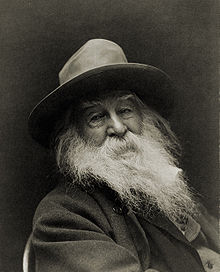
My first memories of Walt Whitman’s poetry are of when I took an American Lit class as an undergraduate. We spent the latter half of the course reading and discussing Whitman and Dickinson. I remember being underwhelmed by Dickinson (my appreciation and admiration of her work was slower to come) but I loved Whitman right from the start. I didn’t always know what was going on and I struggled through an analysis of “Scented Herbage of My Breast” for my final paper, but I loved his language, his long lines, his joy and I mean honestly, the guy had a killer look.

My favorite picture of Walt.

As I type these words, I realize that I am wrong about my memories of Whitman. When I was in sixth grade, I had to memorize “O’ Captain, My Captain” and then later I saw Dead Poets Society. I can’t recite the poem anymore. I was never good with memorization and I found that while I could memorize a poem or Shakespearean sonnet for an assignment, as soon as the pressure was off, the words vanished. However, I liked the poem and maybe that reinforced my enthusiasm nearly seven years later when we dove into Leaves of Grass in my American Lit class.

As an adult, a poet and an educator, what I love about Whitman, is that he’s still relevant. He still translates to America and he’s still pretty much got it nailed. I often tell my students that Whitman would be in love with the idea of community college because of its diversity, its opportunity and the idea that education and community are inextricably linked. Of course, they always adore him. I give them an assignment early on to go out and find Whitman in contemporary culture. They don’t have to look too hard. He’s in Levis commercials, candy boxes, interstate signs, whiskey, tobacco and the list goes on. But more important than his marketability, is the staying power of his poetry.

Another assignment I give my students is to rewrite Whitman’s “I Hear America Singing.” We look at Langston Hugh’s “I, Too, Sing America” as an example and talk about the relevance of the message that both Hughes and Whitman were trying to give voice to. They always love the poem and it always generates good discussion because it still speaks to the larger population.

 I Hear America Singing

I hear America singing, the varied carols I hear,
Those of mechanics, each one singing his as it should be blithe and strong,
The carpenter singing his as he measures his plank or beam,
The mason singing his as he makes ready for work, or leaves off work,
The boatman singing what belongs to him in his boat, the deckhand singing on the steamboat deck, The shoemaker singing as he sits on his bench, the hatter singing as he stands,
The wood-cutter’s song, the ploughboy’s on his way in the morning, or at noon intermission or at sundown, The delicious singing of the mother, or of the young wife at work, or of the girl sewing or washing, Each singing what belongs to him or her and to none else,
The day what belongs to the day—at night the party of young fellows, robust, friendly,
Singing with open mouths their strong melodious songs.

I, Too Sing America


I, too, sing America.
I am the darker brother.
They send me to eat in the kitchen
When company comes,
But I laugh,
And eat well,
And grow strong.

Tomorrow, I’ll be at the table
When company comes.
Nobody’ll dare Say to me,
“Eat in the kitchen,”
Then.
Besides, They’ll see how beautiful I am
And be ashamed–

 I, too, am America.

Happy birthday Walt. For all you said and all you continue to say.

Poetry Stuff

This afternoon I sat down to write and the first thing I wrote was a rather scathing free write addressed to myself. In this free write the words “shame,” “fraud,” “lazy,” “unfocused,” and “cowardly” came up. I didn’t realize how pissed off I was at myself until I started writing about pissed off I was. The simple truth of the matter is that I have not written anything that remotely resembles a poem in about 5 months. It’s despicable. I internalized my feelings about this lack of productivity but whenever I would stand in front of my creative writing students and  talk about revision and the only way to get better is to keep writing, well, I felt like a jerk. Because was I doing any of that? No. I was reading a lot and I did have a lot of ideas for poems floating around in my head, but who cares? Nothing was making it to paper.

It felt good to get it out on paper, and once that was out of the way, I felt renewed. I always feel better after working on a poem for a few hours, even if it isn’t any good and even if it doesn’t go anywhere, so I turned the page from my angry free write and started to draft a poem.

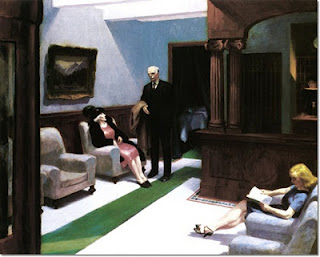
Last fall (sigh) I took my creative writing students to the IMA and found myself meditating on the painting Hotel Lobby by Edward Hopper. I blogged about the experience here, but here’s another look at the painting:

And here are the notes I made:

Oil on canvas. “Though this looks like a scene from a story, it’s not clear there really is one.” Two women and two men. Two older and two younger. Point of view seems to be from the doorway. Hopper’s paintings are always “busy” in terms of people but they are so lonely because the people always seem to be ignoring each other. Even in conversation they are lonely. Women are always young, blonde. There is a darkness in terms of color that seeps into the atmosphere as if something horrible is just below the surface. 


I’ve done a little more reading since then about Hopper and the painting:

* Robert Henri, Hopper’s mentor/teacher, once told him “It isn’t the subject that matters but how you feel about it.”

* Hopper placed his characters as if they were captured just before or just after the climax of a scene. The characters in this painting could be based on Hopper and his wife, Josephine. There is a contrast between the two older individuals in the painting and the two younger people.

I wrote out a couple of drafts of this poem and then thought about maybe working it into a villanelle but after about an hour it occurred to me that the villanelle wasn’t the form for this poem. Mostly because as Strand and Boland say in The Making of a Poem:

“…the form refuses to tell a story. It circles around and around refusing to go forward in a any kind of linear development, and so suggesting at the deepest level, powerful recurrences of mood and emotion and memory.”

My poem was trying to tell a story, so the villanelle wasn’t going to work. I’d already put myself well into the narrative. Anyway. This is what I came up with after about three hours:

Draft #5


His brown wool overcoat drapes 
heavily over his one arm, close 
enough so that the hem brushes
the green brocade armchair. She looks
up, the peacock feather on her hat whispering
against the mahogany molding at her back.


Together they arrived with their monogrammed
luggage packed with diner dress. This lobby is known
familiar in its overstuffed chairs, rich wood and shadow.


It is empty, save one golden haired girl reading
a book. She is oblivious to the young clerk, who stares
at her long legs from behind his desk.


The dining room is now dark, deserted. It is late.
The lobby cast in shadow and the young clerk’s face
illuminated by one lone lamp. 


It is 1943 and the war is on. Yet hotels still
run, guests still dine, clerks still stare at young girls
who still read. He still stands up and she still
looks to him in question. 

I’m not in love with it because it doesn’t work towards that final stanza like I want it to. As per usual, I’ve got too much going on in my brain and it didn’t quite make it all onto the page, but I think it might be worth working on it some more to see where it goes.

Happy Mother’s Day

Today is day to celebrate all the women in the world who have dedicated the larger part of their lives to raising their children, their grand-children and sometimes other people’s children. On a smaller, more personal scale, my mother spent many of her mother’s days doing one of the following:

1. Attending Allegheny College graduation x2 (my sister and I both went there as undergrads)
2. Attending the Mother’s Day Show at the Erie Hunt & Saddle Club. I’m not sure how many times she did this, but I’m going to guess it was at least five. She also gets extra points for this one because it rained at least three out of those five times.
3. Eating “breakfast” in bed at 7 AM on a Sunday because we (my sister and I) were so excited to make it for her that we couldn’t let her sleep. It also important to note that her “breakfast” consisted of toast and tea. Ash and I were not yet the culinary connoisseurs that we are today.
4. Driving around Erie County on one of my father’s epic “Sunday” drives. Hey, Ash. Need a bathroom?
5. Enjoying a Mother’s Day dinner at one of the finer dining establishments in Erie. These restaurants included Outback, Olive Garden and Chi-Chi’s (spelling?). Yeah, Erie is the the capital of chain restaurants. Luckily, as we got older, we smartened up and started to look for fine dining establishments outside of Peach Street.

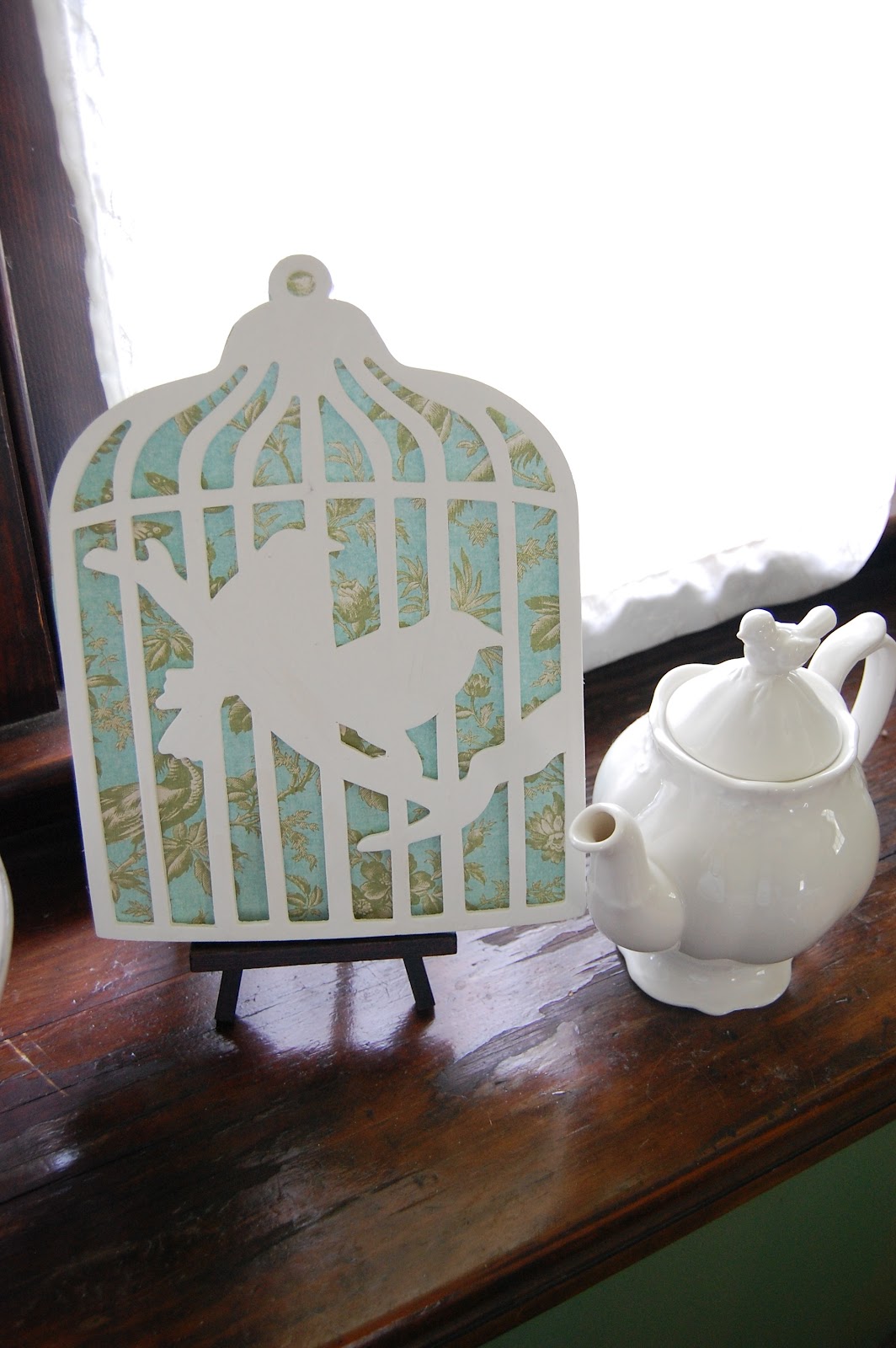
The point of this list? My mother is a good sport. She’s a very good sport, so I hope she spends today doing something she wants to do and gets a good meal out of it too. I sent her a small package that included this (I liked it so much I made one for myself):
It was a fun little project. Special thanks to Tisha for posting the link on my wall. If you’d like to make one, click on this link.

Happy Mother’s Day, mom. Love you.

There’s Something About…

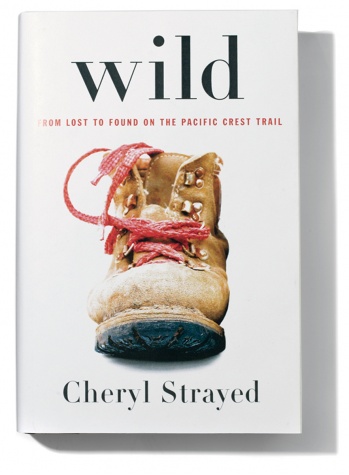
There’s something about reading difficult books. When I say “difficult,” I do mean intellectually but what I really mean is difficult subject matter. I like to read all different types of books of all different genres, but I do think it’s important to read stories that are sometimes terrifying, sometimes heart wrenching, sometimes disturbing and sometimes all three. I like to read for fun as much as the next person, but I also like to read stories that make me think differently about the world that we live in. This desire brought me to reading the novel We Need to Talk About Kevin by Lionel Shriver.

To say that this book disturbed me would be an understatement, but I don’t necessarily use “disturb” with a negative connotation. This book made me think a lot about relationships, motherhood, siblings, gender roles, and on and on and on. It disturbed me because of the content but I’m not sure I responded to it quite the way that many previous readers have. This is the part of the blog post where I’m going to say that if you haven’t read this book, you may not want to read further. Spoilers ahead.

OK? Onward.

I suppose I should back up and say that I didn’t technically read this book. I listened to it on audiobook. The book caught my attention several months ago when I saw some press for the film adaptation featuring Tilda Swinton. I had heard about Shriver on NPR and caught a few snippets of interviews with her. I was interested in her and her book, but I was afraid that if I picked up a book at that point in the semester, I would never finish it. My solution came in the form of an audiobook borrowed from the local library. Over the course of about a month, I listened to the story while driving to and from work.

The audiobook that I got on loan from the library featured an interview with Lionel Shriver at the close of the story, and I was very interested to hear her thoughts about the public reception of the book. It was this interview that made me realize that my main reaction to this book, the fact that I identified, sympathized and liked the protagonist, Eva, from the start, was a bit of a reach for most readers.

The premise of the book is Eva writing to her husband, Franklin, a series of letters detailing their lives together in the aftermath of their son, Kevin, shooting and killing several of his classmates, a teacher and a cafeteria worker. The letters chronicle Eva’s struggle through motherhood and her marriage after Kevin’s arrival and they also examine her struggle to come to terms with what her son has done. The audience is lead to believe throughout the novel that Eva and Franklin are separated but it is not until the closing pages of the book that we learn that Kevin also killed his father and his little sister, Celia the same day that he perpetrated the killings at his school.

While the chronicle of Kevin’s development (or lack thereof) from infant to teenager is chilling, what I  found the most heartbreaking was the slow disintegration of Eva and Franklin’s relationship. Eva details the beginning of their courtship in her letters and the discussions that led up to the decision to have a child. It is obvious that Eva has reservations and from the time baby Kevin comes home, it is also obvious that for Franklin, priorities have shifted. A specific scene that comes to mind is early in the book when Eva finds herself home alone with infant Kevin. She’s not feeling well with a fever and chills. Kevin has been screaming (as he’s been doing since he arrived in the apartment) for four or five hours and Eva is just about beside herself. Franklin arrives home and as per usual, the moment he walks in the door, Kevin quiets and falls into an exhausted sleep. In the meantime, Eva is feeling worse and worse and asks Franklin to take her temperature. He shrugs her off and when she finally does take it, it’s so high he accuses her of holding it beneath a lamp. It is only after he takes her temp again himself, that they realize she is running a high grade fever and he rushes her to the hospital. It is there that she is diagnosed with mastitis.

This scene bothered me immensely because it was the first time in the story (but certainly not the last) that Franklin begins to mistrust Eva’s judgment. To Shriver’s credit, she wrote the scene remarkably well, because I felt the betrayal strongly and it was in that moment, that I began to dislike Franklin. Don’t get me wrong, Eva has issues. She is arrogant, cold, snotty and hyper critical but for some reason I could forgive her those shortcomings. I could not forgive Franklin’s willingness to blame, his blind love and ultimately his love is what killed him. It is Eva’s fierce defense of her husband in the face of all his shortcomings that makes their story all the more poignant. During one visit to see Kevin, Eva shows a rare flash of emotion towards he son when he insults his dead father.

I think this is an important book to read regardless if you have children, are planning on having children or never plan to have children. It takes on issues that are not pretty or popular but they are real and Shriver has done a remarkable job of giving that reality a voice.

Summer, summer, summer time…

I took a bit of a hiatus last week from the blog world to dedicate all of my attention to the end of the semester. Today at 9:00 AM I submitted grades and put up my out of office email message. I’m on break until June 4th.

I’ve got several blog posts milling around in my head. Despite the pile of grading I found myself under at the end of April, I still managed to read three books, We Need to Talk About Kevin, Prodigal Summer and The Shining. I also discovered the joy of checking books out of the library via my new Kindle Fire (yes, I won it!).  These posts will be up and coming soon.

Today I’m cleaning my house, signing up for yoga classes for the summer, going grocery shopping, going for a long walk and maybe mowing the grass (that last one depends on how brave I feel).

Stay tuned.

Peonies from my garden.