BLOG POSTS
How to Tell You’re in The Middle of Nowhere in the Midwest
Let me preface this post by saying that I don’t have a problem with “the middle of nowhere.” In fact, I’m pretty much from the middle of nowhere and spent many of formative years frolicking through woods and streams unencumbered by neighbors or pesky traffic. That being said, “the middle of nowhere,” otherwise known as the “back woods,” or “east cambum f*ck” (it’s a family thing, so I’m not sure about spelling) largely defines itself by what part of the country it is located in.
I am very familiar with the New England version of the middle of nowhere, which is comprised of small houses/trailers on ridiculously large plots of land that may or may not have about 150 odd lawn ornaments decorating the front yard. These lawn ornaments range from sheep to flamingos to watering cans to (my personal favorite) the ever classy “bent over woman/man.” See picture below: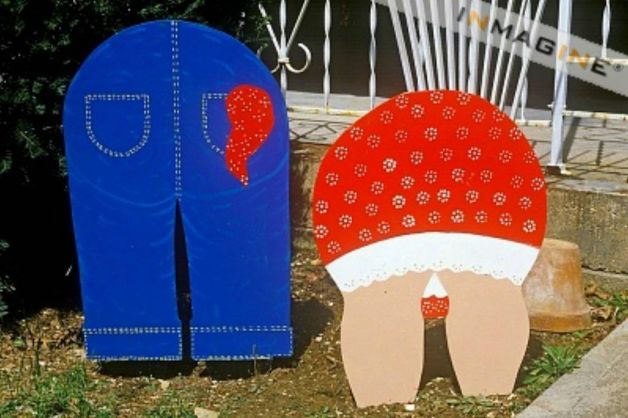 The other main defining trait of New England’s back woods is the presence of “tag sales.” What is a tag sale? Just another name for yard sale but it seems like in New England everyday is a good day for a tag sale. Of course, it is hard to decipher what is or is not for sale among all the lawn ornaments…
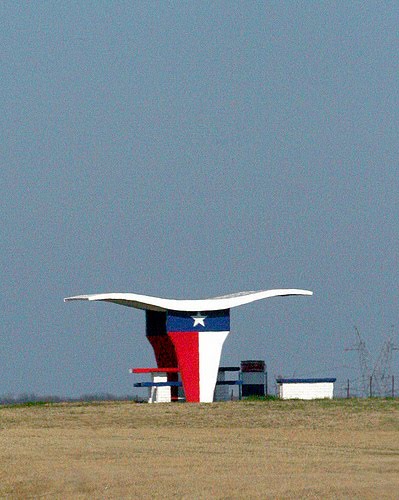
I’m also familiar with middle of the nowhere Texas which is marked by wide expanses of sky and concrete. The only thing that breaks up the monotony are the occasional cattle ranch or rest stop complete with steer horns. See below:
 I’ve also experienced the middle of nowhere in Kentucky, North Carolina and Florida. They all have their natural charms, but it seems to me that the Midwest (Ohio, Illinois, Indiana) has it’s own brand of “special.” What caused this meditation on rural America? Well, I’m in the middle of nowhere Indiana as we speak and today while driving, I started making a mental list:
1. Lots and lots and lots of churches. Methodist and Baptist mostly but when I say there was one about every 10 miles, I’m not exaggerating.
2. IGA. For those of you not familiar with the acronym, IGA stands for International Grocers Alliance and they are all but gone from the American landscape. In fact, the only other place I’ve ever seen one is in the tiny town my grandparents live in in New Hampshire.
3. Palm Readers next to law offices, dentists, tire places, etc. Yeah, I don’t know either.
4. Lots of billboards warning against a) the apocalypse b) having an abortion.
5. Random “artist studios” advertising pottery, metal sculpture or wood carving.
6. Beautiful cattle and horse farms.
7. Strip malls galore.
8. Quaint names for rivers like “Squash Blossom.”
9. Lots of chain restaurants.
10. Golf courses that pop up in the middle of places that don’t make sense. For example, you’re driving along and you pass a church, a billboard, a church, a pottery studio, a church, a horse farm, a church, and then…a golf course. Weird.
The Life and Times of an Unknown Poet…
I finished electronic submissions this past weekend and I just completed hard copy submission packets for everyone else who has yet to give into the ease of submission managers. I’ve completed 50 submissions total and I’ve already received three rejections (electronic submissions can make the rejection process a lot quicker), so I have or will soon have about 47 submissions out in the world.
I’ve encountered something during this round of submissions that I’ve never encountered before: anxiety about sending poems to people I know. The universities where I received my MA and my MFA also house two very well respected literary journals and I’m a little ashamed to admit that I’ve been avoiding sending to them. Actually, as long as I’m being honest, I’ve avoided sending to any places where I know the editors are former peers or mentors. I know this makes no logical sense and it’s not like I fear rejection or criticism (I mean I went to school for poetry for crying out loud) but maybe I do fear it from people I know and respect. This may be oversimplifying it a little bit. I just seem to feel a slight twinge when writing certain addresses on submission envelopes…
I’m reading two different books right now. One is Jonathan Franzen’s The Corrections and the other is Elizabeth Bishop and The New Yorker. In a way, it isn’t really fair that I’m reading these two books at the same time. I love Elizabeth Bishop and I’ve read just about every conceivable thing by her or about her. This recent edition from the New Yorker is delightful and where most people would find reading pages of letters tedious, I really enjoy it. I’m never going to get meet Miss. Bishop but I can hear her voice in her letters and her conversation. It’s as close to a dialogue as I’m ever going to get, so I’ll take it.
On the other hand The Corrections is challenging and the verdict is still out whether I’m enjoying the challenge or not. I found the beginning of the book intriguing but odd, but as I move further into the novel I’m having trouble deciding if I’m still intrigued or just annoyed. I know I missed the boat on this book in terms of timeliness. Most of my friends jumped on Franzen’s bandwagon along time ago, but I’m going to finish it and then I’ll comment in full.
The days are lengthening and the sun seems to be making its presence known more and more often. I noticed the tips of some green shoots pushing through the leaf beds. Spring break is just around the corner and I look forward to spending some time working on my chapbook manuscript and working through some new poems that are bumping around in my head.
Last night I didn’t sleep well. This usually happens when I have a lot going on and can’t keep my mind still. When I did finally slip off into sleep, I had dreams of poetry and lines and words. Spring brings rejuvenation in many forms.
A List to Sum Up the Past Two Weeks…
Took a break from blogging to manage a busy week or two. During those weeks the following events occurred (not in chronological order):
1. Our dog, Kweli, suffered some terrible dog plague and proceeded to throw up everywhere. Everywhere includes a pile of old sweaters in R’s closet that thankfully “were going to be donated anyway.”
2. Binoculars were purchased so I could watch the birds at my bird feeder.
3. I bought my wedding dress.
4. I became newly aware that eye glass frames are incredibly expensive.
5. I discovered that my Kindle cover caused my Kindle to reset all the time. The answer? A new Kindle cover with a reading light.
6. Elizabeth Bishop had a birthday.
7. I am going to Seattle in April for a conference.
8. My sister visited. She’s awesome.
9. I learned I am teaching all online classes this summer.
10. I went mini golfing with my colleagues in Liberal Arts & Sciences.
11. I went to a talk given by a survivor of one of the death camps in the Congo.
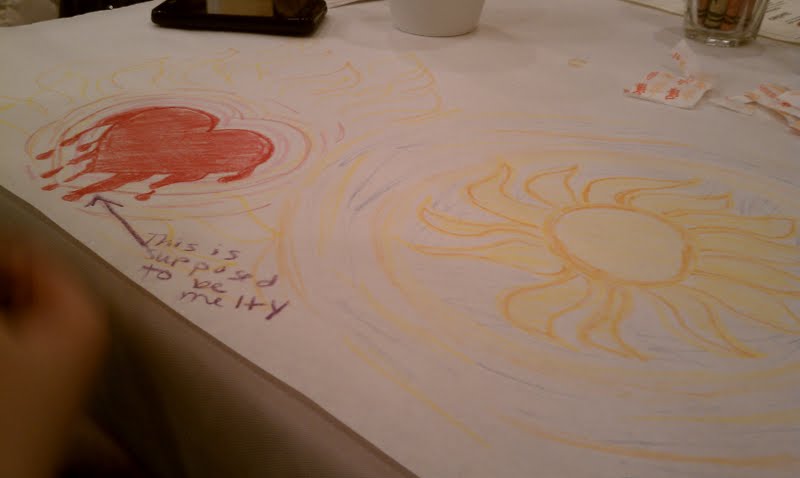
12. I ate the most amazing brunch ever at Zest & then drew all over the tables (see pics below).
13. I had a fun book club meeting where we discussed Murder on the Orient Express.
14. I attended a performance by my community college’s chapter of the Odeon Society.
15. I chatted with my best friend who I don’t talk to nearly enough.
16. I bought Elizabeth Bishop and The New Yorker.
17. I got my taxes done and almost had a heart attack when the accountant thought I owed $5000. Thankfully, she was wrong.
18. We began the registering process at Crate & Barrel.
19. I ran almost three miles at 5.3 on the treadmill.
20. I sent out more poetry submissions.
21. RJ and I celebrated Valentines Day with a trip to Santorini and Best Chocolate in Town.

AWP Highlights
I give you my highlights from AWP, although because AWP also coincided with The Great Ice Storm of 2011, my highlights actually started before I arrived at the airport.
- The great ice storm of 2011. Enough said.
- Falling off of my deck while attempting to feed the birds (this happened the morning I left).
- When RJ and I attempted to leave for the airport, we went out the back to the garage. When we got to our little wooden gate, we were able to get the latch open but there was about an inch and half of ice holding the door shut. See next item on list.
- We had to go around the front, so while RJ walked around to get the car, I had to scoot on my butt down our front steps because there was so much ice on the steps that I couldn’t walk in them.
- My flight from Indy to D.C. boarded on time. Win!
- The jetway was frozen to the ground, so we had to walk across the tarmac to board. This was tricky because everything metal (hand rails & stairs mostly) had about an inch of ice covering it.
- Descending into D.C. and seeing the capital, the Washington Monument & The Jefferson Memorial.
- My shuttle driver (who had the most beautiful African accent) asking me if it was OK if he got lost going to my hotel. I think he was kidding…
- Meeting a fellow writer/conference attendee on the shuttle and having a nice chat that resulted in receiving a business card and having a new blog to follow.
- Discovering that the hotel I’m staying at has a great gym and a killer veggie sandwich.
- Attending a really interesting first panel sponsored by Writers in the Schools.
- Meeting a group of writers from Texas and commiserating about Governor Perry.
- Hearing Katrina Vandenberg read at the Fullbright panel. If you have not read her collection, Atlas, do it. It’s an excellent book.
- Making my first pass at the book fair and seeing old friends, making new ones and picking up free copies of New Madrid & American Literary Review (publications from Murray and UNT).
- Hearing Gary Jackson, Natasha Trethewey, Rita Dove & Yusef Komunyakka read. Wow.
- Hearing Marie Howe read. What the Living Do is one of my top 10 favorite poetry collections of all time.
- Attending a fascinating panel about writers of color and their role in environmental writing. I usually write down all of the names of books I want to buy after AWP and then add them to my Amazon wish list at the end of each day because if I bought all the books I wanted to while here, I’d be broke. That being said, after this panel, I’m going to buy The Colors of Nature tomorrow.
- Listening to Jhumpa Lahiri’s keynote address.
- The bookfair. It is amazing.
- Going to a table at the bookfair of a journal that I’ve sent poems to in the past and chatting with editor only to find that not only did she remember me, she remembered my poems. Maybe I can do this poet thing for real…
- Running into old mentors and friends.
- Attending the two year college caucus.
- Attending a panel about how to approach disturbing undergraduate writing.
- Sharing a cab ride with Khaled Mattawa.
- Going for dinner with Natalie & Zach and later meeting up with Michael and other friends.
- Driving by the Lincoln Memorial at 6 am. It was all lit up and mystical looking. I think Abe would have liked to see it like this.
- Arriving back in Indy in the midst of a snowstorm. I believe the pilot’s exact words were “I just landed in a white out.”
- Returning home in one piece after a harrowing ride on the interstate.
- Finis.
Ice Storm 2011
It started Monday night and at first I thought it was just another example of how the weather forecasters here in the midwest have a tendency to overreact. Unfortunately, this was not the case. The ice started Monday night, went through Tuesday and continued through Tuesday evening/Wednesday morning.
Our backyard is a skating rink. A deadly skating rink.
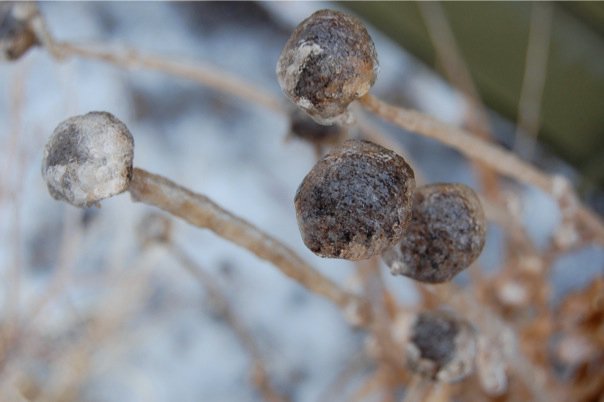 This morning, when I went out to fill the bird feeder, I fell right to my knees. There was no traction and as much as I stomped on the ice, I couldn’t break through the layers of ice and snow and more ice.
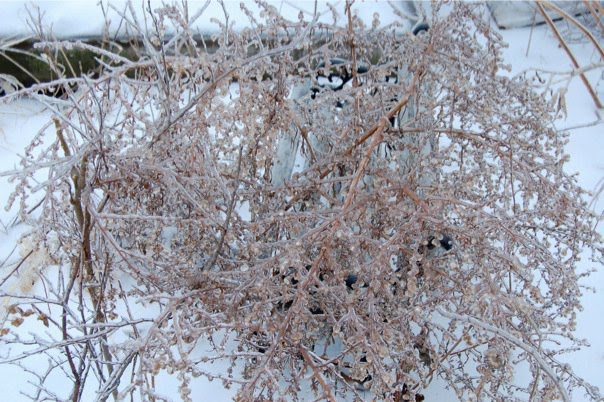
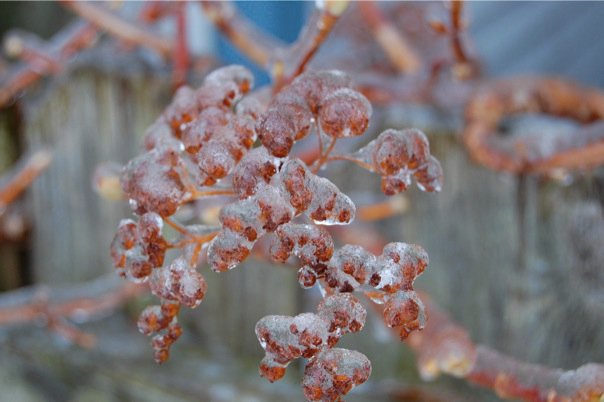
One Tuesday, I went out and took some pictures of our backyard. I thought the ice was beautiful. I mean, I didn’t have to go out in it, so why not enjoy it? Of course, that was Tuesday morning. Tuesday afternoon, I started to worry. By Tuesday night, I was angry. Why? Read below.
Normally, I could care less about inclement weather. They closed school Tuesday and Wednesday and I would have just snuggled into my couch and worked on grading, submissions or catch up on some reading. However, this weekend happens to be AWP. I’ve been looking forward to this trip for awhile for a few different reasons:
1. I like AWP (Association of Writers and Writing Programs). It’s fun, interesting and it’s always in a cool place (Chicago, Denver, Austin, etc).
2. I like getting to see friends at AWP that I don’t normally get to see. I’ve made some plans and I would like to see those plans realized.
3. I managed to convince my community college that they should cover my trip this year, so it is especially important that I make it to my destination.
4. I was really looking forward to a change of scene if only for a few days. Winter gets boring.
I’m sitting in the airport right now. As of now, my flight is still arriving on time. Apparently, the plane is here. The issue is the runways and jetways are covered in ice.
Hopefully, I’ll still get out today…
Notes from a writing life…
I spent my entire day on Sunday preparing submissions and doing research into contests. By entire day, I mean I got up, inhaled a piece of fresh bread smothered in Nutella (om nom nom), chugged some tea and settled into the couch with my lap top only to emerge about six hours later.
It is time consuming work to send poems to journals, although even in the short time I have been sending work out, I’ve noticed marked improvements in the process:
1. Electronic submission. Honestly, I’m really glad most journals have jumped on this bandwagon by either using submission managers or allowing email submissions. While it is considerably easier and less paper filled, the real reason I like it is because it is cheaper. For example, I usually send out to 30-40 places in a given period. You start adding ink, paper, postage & envelopes and it can start to get a bit pricey. I’d rather save this money for contest fees or books.
2. Lovely websites. I’ve noticed that many journals have really stepped up in terms of their websites. It’s easier to find guidelines and contact information. It’s easier to “read what the journal is looking for” when you can read back issues online instead of suffocating under a pile of hard copies. They layouts are beautiful. It’s just better. Period.
3. Simultaneous submissions. I won’t send to a journal if they don’t accept simultaneous submissions. This isn’t some snooty statement, it’s just practical fact. I’m trying to get my work out there. Not being able to send it to anyone else while a certain journal is considering it is not practical. However, if I were a poetry genius I suppose I would not mind just sending to NER or Ploughshares. I love these magazines but I think it’s a bit silly. Sorry.
4. Less pretentious all around. Let’s face it, poetry often gets a bad wrap for being pretentious and hard to understand. I’m encouraged by seeing new journals and small presses trying to carve out their own place in the poetry world. I’m also encouraged to see less annoying descriptions under the What We Want section. In the past I would not read these sections because if I heard one more editor say “We’re looking for beautiful poems that use interesting language and surprise us” I was going to scream. I mean personally, I’m looking for poems that are boring, poorly written and predictable. C’mon man.
5. New Pages. I’ve always loved this blog/website but I appreciate more and more as I work on submissions. I cannot imagine how much longer the submission process would take if there was not a comprehensive site like New Pages to organize listings of calls for submissions, contests and reviews.
All of this being said, I encounter the same feeling every time I put a new batch of submissions together. This feeling can best be described as exhiliration slowly giving way to panic. I used to worry more about it but now I just accept it and move on. As if submitting individual poems was not enough, I’ve decided to start sending out to chapbook contests. I’ve got my manuscript almost where I want it and as they say, there’s no time like the present.
Waiting for the birds…
A few weeks ago I hung a bird feeder up that my mother gave me for Christmas. It’s in the shape of a little white house with Plexiglas sides, so when you pour the black sunflower seeds inside, it looks like a little black and white cottage is hanging off our garage.
Anyway.
I waited patiently for days for the birds to arrive. I peeked out the windows at every chance. I was even quieter exiting my back door in the morning (careful not to let the screen door slam too loudly) just in case a small bird was enjoying his/her breakfast. But after several days, no birds. Upon trolling the Internet and pestering my resident avian expert (my mother) I was relieved to learn that it can take up to two months for birds to discover a feeder.
Therefore you can imagine my elation when R pointed out that there were sunflower seed shells peppering the snow beneath the feeder. Shells must mean birds, right? Wrong. I was somewhat dismayed to find several large squirrels had discovered my feeder and were gorging themselves on the seeds intended for my birds.
Admittedly, squirrels are annoying. At my parents house, my mother unwillingly feeds Fox squirrels that are bigger than most cats I’ve known. They are loud. They are fat. They are gluttons. I swear at them. I stomp my feet. I yell and I clap. They chatter and swish their squirrel tails, which I think is a the equivalent of giving the finger.
The squirrels resiliency/stupidity/ courage was truly proven earlier last week when they were confronted with a beast whose brain capacity probably rivals theirs. Yes, they came up against our dog. In fact, one of them did not survive the encounter.
It is important to note that even before the squirrels started dining regularly at my feeder, they had a antagonistic relationship with our dog. He barks at them. He attempts to chase them and he even jumps up against the fence in hopes of knocking one off. He’s not messing around. This pasts summer he managed to catch one and only dropped it when I yelled and startled, the stunned squirrel dropped from his mouth. The squirrel was easy to identify over the passing weeks because he was missing a large patch of fur from his back.
Apparently, squirrels do not have a good social network because they continue to frequent our yard, which brings us to the most recent event. Because we like to give the squirrels a fighting chance, we try to scare them off before letting Kweli (our dog) outdoors. However, Kwe is fast and agile (despite being hit by a car as a puppy) and he uses our back porch as a launch pad. All of these things combined made for squirrel carnage as R opened the door, Kweli took off, and the squirrel made a fateful mistake. Instead of making for the fence like his buddy, he scrambled back up the garage and tried to hang onto the metal hook the bird feeder is attached to. He slipped. He fell. Kwe pounced. It was over in a matter of seconds.
Some people may say, “Oh! The poor squirrel!” or “What are you doing to do?” while peering at my panting, hairy dog who is looking very pleased with himself. What am I going to do? Nothing. As you may or may not have noticed, squirrels are in abundance. More to the point, dogs kill things. Wait, scratch that. Animals kill things. My Labrador used to dig moles right out of the ground and mangle woodchucks. My childhood cat used our front doorstep to display a diverse array of noses, ears, tails, and feet (you can’t eat those parts). I’m not squeamish and if you don’t think your dog might do the same if given the opportunity, put it in a fenced yard with a squirrel sometime.
Needless to say, there are still plenty of squirrels in our yard. Also, because I am an animal lover, I do try to warn them before sending Kwe out to patrol the perimeter.
So, did the birds ever come, you ask?
Yes, they have finally discovered the feeder and when I looked out the window today, they were perched on the feeder feasting and the squirrels were cleaning up the seeds from below.
*I’m thinking of poems…
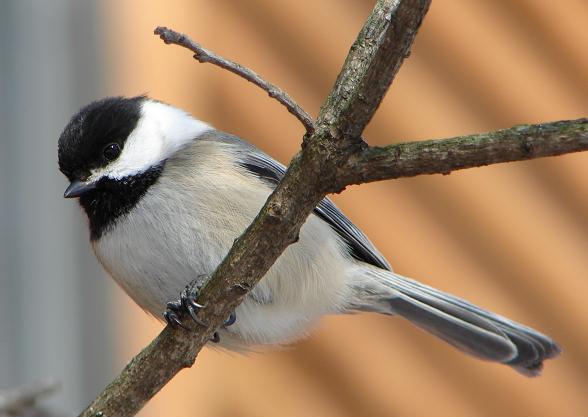
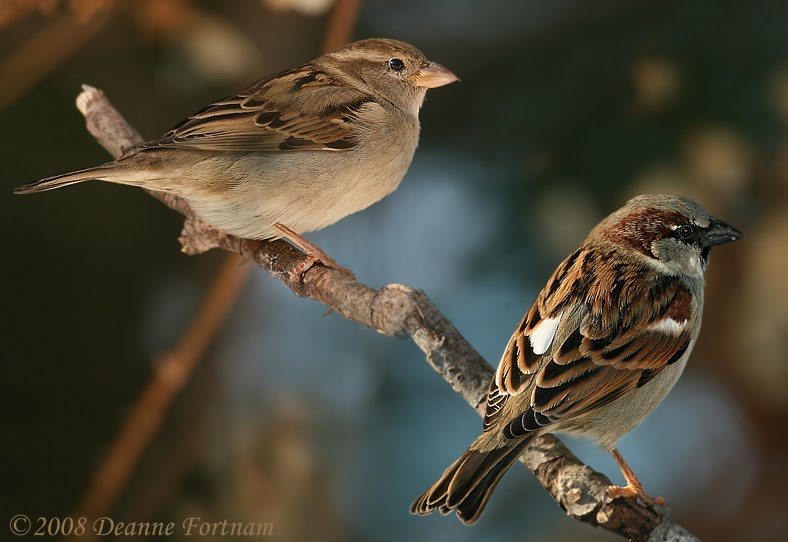
Some of the birds visiting today:

Reasons Why I’m Not a Huge Fan of Collected Poems and Other Reasons Why Poetry is Hard To Read…
I am about to admit something that may seem sacrilegious coming from a reader, writer, and admirer of poetry, but I’m going to take a deep breath and say it anyway. Ready? Poetry is really hard to read. More specifically, poetry is really hard to read in large doses.
I was sparked to this topic by Daniel Handler’s, otherwise known as Lemony Snicket, commentary in the January issue of Poetry. His short essay is titled Happy, Snappy, Sappy. My favorite part of the commentary is as follows:
“I read two or three poems by Campbell McGrath in a row, and I’m infused with joy at the enthusiasm of his breadth. I read seven or eight, and it is truly admirable that he can maintain a consistency of tone and yet always be surprising. Ten or twelve and that just might be enough Campbell McGrath for a little bit, no offense. Eighteen poems without a break and, seriously, Campbell, shut the fuck up. What to do?”
I love poetry. I love reading poetry and I will read anything that anyone recommends or lays in front of me (I used to be this way with fiction until one of my students chirped “You should read Twilight!”). However, I prefer not to read the bricks of “Collected Poems.” I know a lot of these feelings stem from my academic endeavours into poetry, which started when I was in college and later in graduate school. Get ready, all you teachers and professors and poets who teach. I’m going to give you a valuable piece of advice: When your young, innocent, doe eyed students approach you after an especially thrilling discussion of Robert Lowell or Emily Dickinson or T.S. Eliot, be kind. When they ask you, with unbridled enthusiasm practically popping out of their skinny jeans (don’t worry, I wear them too), what poems they should read by Lowell or Dickinson or Eliot, DO NOT recommend the collected works. Why? Read below.
There is nothing more daunting to a reader then to pick up Robert Lowell’s collected works. Trust me, I’m not picking on Lowell, but I associate him with this particular subject because what I’ve just advised you not to do is exactly what was done to me. Naturally as a Bishop fan, I discovered Lowell and when I asked one of my poetry mentors to recommend some poems, he just said “read the collected.” Umm, have you seen the “collected?” I know that serious readers and poets may scoff at this assertion. “Well, if she were serious about poetry she would immerse herself in Lowell. She would drink it in. She would memorize every poem. She would paper her walls with his words. She would tattoo “Skunk Hour” over her clavicle and revel in the pain.” Uh, no.
I did copy many of Lowell’s poems in my journals. I studied them. I can recall many lines. I did revel in their language, but I was almost turned off by that book. It was too big and daunting and at the time I was enrolled in a low residency program where I was teaching 6 sections of English Composition, living with my boyfriend and 4 other guys, and trying to write my own poems. Throwing the collected works of Robert Lowell on top of that was a bit of a reach.
Do your students a favor. When they come to you in love with Plath or Dove or Oliver or Frost or Wright, recommend specific poems. Hell, if you’re really feeling generous, copy a few out of your books and make them a little packet. They will thank you for this gentle introduction and when they are ready, they will take a deep breath, walk into a bookstore or library and pull that brick off the shelf.
Because it is important…
This poem arrived in my email box this morning:
September Elegies
by Randall Mann
in memory of Seth Walsh, Justin Aaberg, Billy Lucas, and Tyler Clementi
There are those who suffer in plain sight,
there are those who suffer in private.
Nothing but secondhand details:
a last shower, a request for a pen, a tall red oak.
There are those who suffer in private.
The one in Tehachapi, aged 13.
A last shower, a request for a pen, a tall red oak:
he had had enough torment, so he hanged himself.
The one in Tehachapi, aged 13;
the one in Cooks Head, aged 15:
he had had enough torment, so he hanged himself.
He was found by his mother.
The one in Cooks Head, aged 15.
The one in Greensburg, aged 15:
he was found by his mother.
“I love my horses, my club lambs. They are the world to me,”
the one in Greensburg, aged 15,
posted on his profile.
“I love my horses, my club lambs. They are the world to me.”
The words turn and turn on themselves.
Posted on his profile,
“Jumping off the gw bridge sorry”:
the words turn, and turn on themselves,
like the one in New Brunswick, aged 18.
Jumping off the gw bridge sorry.
There are those who suffer in plain sight
like the one in New Brunswick, aged 18.
Nothing but secondhand details.
 Brianna Pike
