Finding Our Way Back…

It has been a strange few weeks in my world. Just yesterday, I finished The Descendants, a novel about many things, but ultimately about the loss of a loved one. The news has been full of the death of 17 year old Trayvon Martin and not more than an hour ago I learned, via social media, that poet Adrienne Rich passed away today at the age of 82.

In 2008 I posted this poem by Adrienne Rich:

In Those Years
In those years, people will say, we lost track
of the meaning of we, of you
we found ourselves
reduced to I
and the whole thing became
silly, ironic, terrible:
we were trying to live a personal life
and, yes, that was the only life
we could bear witness to

But the great dark birds of history screamed and plunged
into our personal weather
They were headed somewhere else but their beaks and pinions drove
along the shore, through rages of fog
where we stood, saying I

This poem seems particularly poignant to me this week. The news is full of Trayvon and Tyler Clementi and Dharun Ravi. There are politicians on NPR screaming about contraception and same sex marriage and the Supreme Court is currently debating on whether or not health care is constitutional. Forgive me for a slight moment of pessimism, but perhaps we have lost track. 
I discovered Rich as an undergraduate and read “Diving into the Wreck” just like every other budding poet. I admired her poems but I think I admired her guts more. She was brave. She was political. She was unapologetic and she wrote it all down. She gave voice to difficult subjects, subjects we don’t like to look at and she made us look them right in the eye. But now, she’s gone.
As I type this post, I feel my chest tightening. It could be because I am tired and slightly bogged down in the horrors from the world this week. It could be because I am oversensitive. It could be because I see Trayvon in the faces of my students but I think it is simply because another great voice, a voice I took comfort in, has been silenced and I’m not quite sure where that leaves me. 
AWP Aftermath

Last Wednesday I boarded the Megabus in Indy with a couple dozen other writers from Ohio, Illinois and Indiana and trekked off to Chicago for AWP. What is AWP? Association for Writers and Writing Programs is what the acronym stands for and every year they hold an annual conference where writers of all kinds descend on a city for a few days. This year was the biggest AWP yet with 10,000 plus participants crowding into downtown Chicago for a few days of literary bootcamp.

I don’t use the term bootcamp lightly. AWP is a marathon of panels, readings and networking. I’ve gone the past three years (Chicago, D.C. and back to Chicago) and I always enjoy myself but I also feel at the end like I could sleep for two days straight. It is a lot to take in in short period of time.

This year I had the good fortune of being a panel with three other writers who I meant at the Two Year College Caucus meeting last year. The title of our panel was “Reconsidering/Recreating the Workshop in the Online Environment.” My particular part of the presentation focused on blogs and how they can encourage collaboration and communication in an online class, which can in turn improve group dynamics which can make for better workshops later on down the road. I think our panel went well and that we had a pretty good turn out considering they scheduled us for 10:30 AM the first day of the conference. They also put us in the Grand Ballroom at the Palmer House, so I felt very small (literally) when I got up to speak at the podium but I am grateful for the experience.

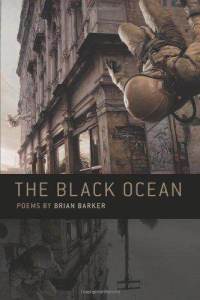
I went to two great readings while I was in Chicago. One was celebrating Carnegie Mellon Press’s 40th Birthday and Nicky Beer was among the group of poets reading. Her book, “The Diminishing House” is one of my favorites and I had the privilege of working with her while I was getting my MFA at Murray. I also went to a reading about apocalyptic literature and listened to Nicky’s husband, and my former mentor, Brian Barker, read from his book “Black Ocean.” These two readings were by far some the best events I attended during the week.

Honestly, my favorite part about AWP is getting to see friends that I don’t normally get to see. It’s fun to walk through the crowd and see a familiar face. I find that just as inspiring as any panel that I could attend.

As a final note, the bookfair was crazy as per usual. I know next year, in Boston, they are going to have it in a convention center so it won’t be so confusing to navigate but I don’t think it’s the layout that makes the bookfair daunting. I feel like the fair is just sensory overload. There are hundreds of journals and small presses doing really wonderful things with their publications and they all want to tell you about it. That can be a tad overwhelming after you’ve walked around for an hour and not even seen a quarter of what the fair has to offer. That being said, I meant some neat people this year and picked up some interesting journals to read.

I came home from AWP exhausted and carrying a stack of books, which means it was a good conference. Till next year…

The Poet & Technology

There are many ways that technology makes the life of a poet better and more interesting. Such as:

  • Writing blogs & reading blogs about poetry
  • Poetry websites
  • Instant access to inspiration whether it is art, music or other writers
  • Instant sharing of positive poetry news (a friend gets published, a new book comes out or someone wins a prize)
  • Drafting poems is often helped by word processing
  • Loosing work is less likely as long long as you remember to back up said work on a variety of devices
  • Electronic submission managers cut down on the cost of postage and the response time is faster
  • It is easier to read a sampling of journals online because of the archive system
  • More new journals are coming onboard using the internet as their platform
  • More poetry gets out to a broader audience via the internet
  • It’s easier to collaborate with other writers
  • Procuring an MFA is easier than it used to be in terms of scheduling because of low residency programs with an online component

I’m sure there are other benefits that I have not listed, but I think these hit on most of the main points. So three cheers for technology, right?

Well…

I think the downfall of all this great technology for the poet is that I constantly feel like I’m not doing enough. I’m a slow writer to start with and I also teach five classes a semester. This is not a dig at people who do not work, or who have a 3/4 load, or whatever your situation might be but this is my reality and I find my reality frustrating in terms of the writing life. This is especially the case when it comes to bullet point #4.

I revel in other poet’s success because it’s not only good for them, it’s good for poetry in general. Whenever someone wins a prize or a grant or gets a poem published or finishes a book, that means that there is an audience out there reading, thinking and supporting poetry. I find this very encouraging. On the flip side, sometimes it can be discouraging when you are sending out work constantly and not getting a response. This probably sounds whiny, and it isn’t meant to be but I think it is probably how the majority of writers feel most of the time. I won’t lie and say that this rant wasn’t prompted by a recent round of submissions I sent out. I received some of the fastest rejections I’ve ever gotten and that always kind of sucks. This is another downfall of technology, the submission process it much more streamlined than it used to be so sometimes you can send a few poems out and three days later there is an email in your inbox wishing you better luck next time.

None of this information is anything new. Submitting is frustrating and that’s just how it is. Why keep doing it? Well, I believe I’ve written some good poems and I’d like people to read them because I think they could get something out of them. How does that make me different than every other poet on the planet? It doesn’t but I’m going to keep trying.

For Basil

A Dog Has Died

My dog has died.
I buried him in the garden
next to a rusted old machine.

Some day I’ll join him right there,
but now he’s gone with his shaggy coat,
his bad manners and his cold nose,
and I, the materialist, who never believed
in any promised heaven in the sky
for any human being,
I believe in a heaven I’ll never enter.
Yes, I believe in a heaven for all dogdom
where my dog waits for my arrival
waving his fan-like tail in friendship.

Ai, I’ll not speak of sadness here on earth,
of having lost a companion
who was never servile.
His friendship for me, like that of a porcupine
withholding its authority,
was the friendship of a star, aloof,
with no more intimacy than was called for,
with no exaggerations:
he never climbed all over my clothes
filling me full of his hair or his mange,
he never rubbed up against my knee
like other dogs obsessed with sex.

No, my dog used to gaze at me,
paying me the attention I need,
the attention required
to make a vain person like me understand
that, being a dog, he was wasting time,
but, with those eyes so much purer than mine,
he’d keep on gazing at me
with a look that reserved for me alone
all his sweet and shaggy life,
always near me, never troubling me,
and asking nothing.

Ai, how many times have I envied his tail
as we walked together on the shores of the sea
in the lonely winter of Isla Negra
where the wintering birds filled the sky
and my hairy dog was jumping about
full of the voltage of the sea’s movement:
my wandering dog, sniffing away
with his golden tail held high,
face to face with the ocean’s spray.

Joyful, joyful, joyful,
as only dogs know how to be happy
with only the autonomy
of their shameless spirit.

There are no good-byes for my dog who has died,
and we don’t now and never did lie to each other.

So now he’s gone and I buried him,
and that’s all there is to it.

~Pablo Neruda


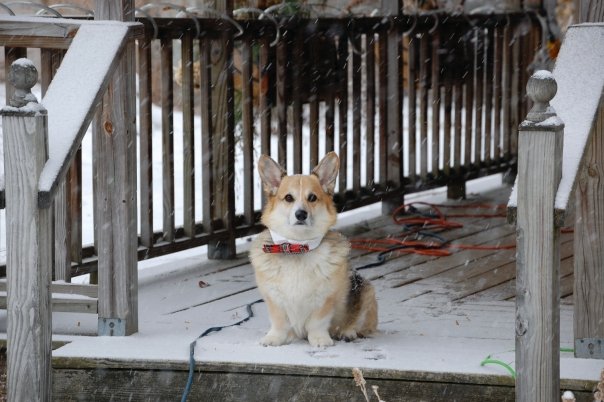
Basil during Christmas 2008. 


Pomegranates

On Monday I made these centerpieces using some hurricane jars we received for our wedding:

Easy, cheap & very pretty.

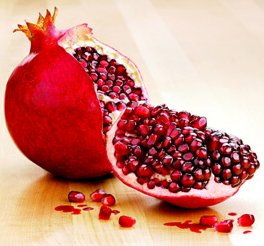
As you can see, I used all sorts of fruit. I was only planning on using cranberries, lemons & limes, but when I went to the grocery store, they had pomegranates on sale four for five dollars. They’re pretty fruits cut or uncut, so I thought I’d give it a shot. While cutting the pomegranates for the centerpieces, it dawned on me that a). I’ve never eaten pomegranate b). I had no clue how to eat a pomegranate. So what did I do? What every American does when faced with a problem. I googled it.

It turns out that with pomegranates you eat the seeds, and let me tell you, they are delicious. Now, I have never met a fruit I didn’t like but when I popped a handful of pomegranate seeds into my mouth, I was amazed. They are so good!

Anyway. This got me to thinking. One of my favorite poems of all time is called ” The Pomegranate” by Eavan Boland.

 The Pomegranate
 
The only legend I have ever loved is
the story of a daughter lost in hell.
And found and rescued there.
Love and blackmail are the gist of it.
Ceres and Persephone the names.
And the best thing about the legend is
I can enter it anywhere. And have.
As a child in exile in
a city of fogs and strange consonants,
I read it first and at first I was
an exiled child in the crackling dusk of
the underworld, the stars blighted. Later
I walked out in a summer twilight
searching for my daughter at bed-time.
When she came running I was ready
to make any bargain to keep her.
I carried her back past whitebeams
and wasps and honey-scented buddleias.
But I was Ceres then and I knew
winter was in store for every leaf
on every tree on that road.
Was inescapable for each one we passed.
And for me.
It is winter
and the stars are hidden.
I climb the stairs and stand where I can see
my child asleep beside her teen magazines,
her can of Coke, her plate of uncut fruit.
The pomegranate! How did I forget it?
She could have come home and been safe
and ended the story and all
our heart-broken searching but she reached
out a hand and plucked a pomegranate.
She put out her hand and pulled down
the French sound for apple and
the noise of stone and the proof
that even in the place of death,
at the heart of legend, in the midst
of rocks full of unshed tears
ready to be diamonds by the time
the story was told, a child can be
hungry. I could warn her. There is still a chance.
The rain is cold. The road is flint-coloured.
The suburb has cars and cable television.
The veiled stars are above ground.
It is another world. But what else
can a mother give her daughter but such
beautiful rifts in time?
If I defer the grief I will diminish the gift.
The legend will be hers as well as mine.
She will enter it. As I have.
She will wake up. She will hold
the papery flushed skin in her hand.
And to her lips. I will say nothing.
 
~Eavan Boland


*A Few Interesting Facts About Pomegranates: 
 
1. The name "pomegranate" derives from mead evil Latin pōmum "apple" and grānātum "seeded." 
2. Loaded with vitamins and antioxidants. 
3. Pomegranates are native to Iran.
4. The pomegranate has been traced back as far as 3,000 B.C. 
5. King Tut was buried with pomegranates in hopes of a second life. 
6. Pomegranates are mentioned in Homer's Odyssey, and Juliet tells
Romeo the night is young since it is the nightingale — and not the lark
— that is "singing in yon pomegranate tree." 
 
* I got this info from Pomegranates: Jewels In The Fruit Crown.  

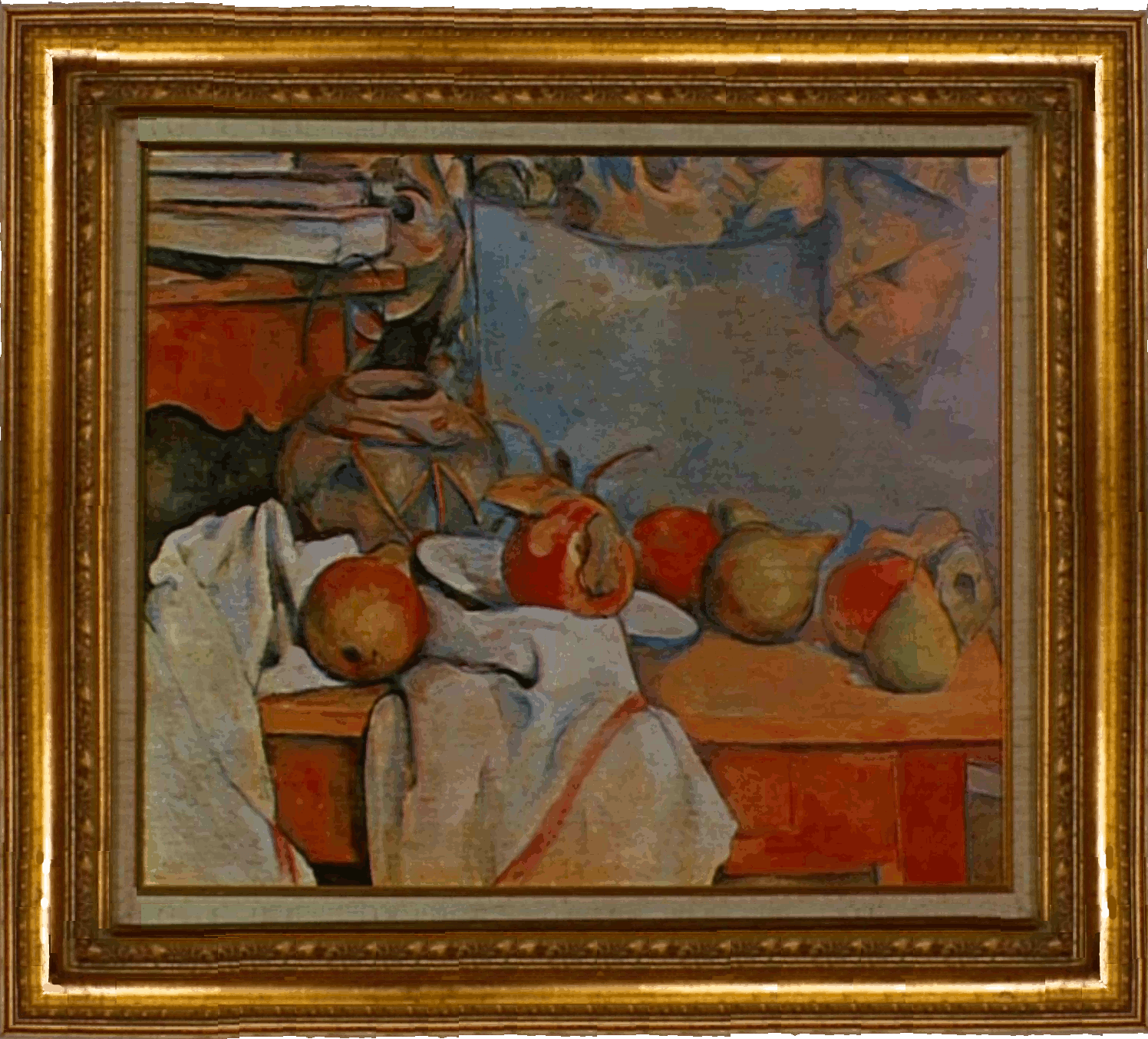
Still Life with Pears and Pomegranates by Paul Cezanne.


A Night At the Art Museum

In Indianapolis we have the pleasure of a wonderful art museum that is free to get into. The Indianapolis Museum of Art (IMA) is amazing on many levels but I think what I like most about it is it a good museum to just hang out in. There are plenty of places to sit and sketch or take notes or just zone out. It is a very people friendly museum and I think that is an underestimated characteristic when it comes to public space in general.

I took my creative writing class to the museum to do some writing and while they looked for art that inspired them, I got to walk around and look at my leisure. Here are two paintings I wrote about in my journal:

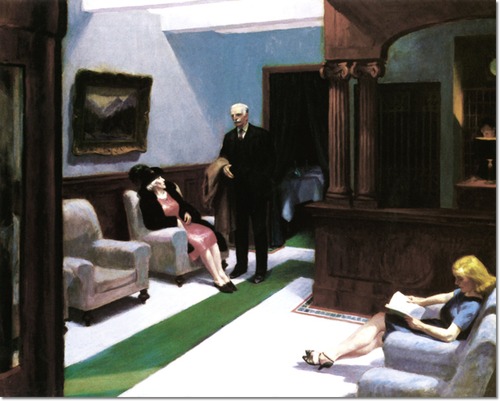
Hotel Lobby by Edward Hopper

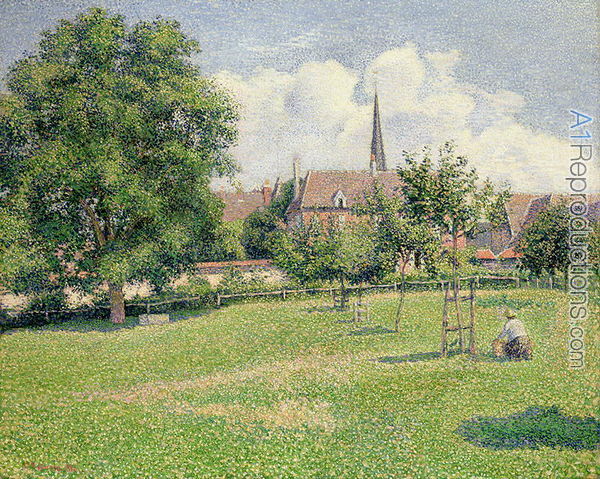
The House of the Deaf Woman and the Belfry at Erangy by Camille Pissarro

These are the journal entries about the two paintings. They’re pretty fragmented, but I think there are some poems brewing in there somewhere. From The House:

1886, Camille Pissarro, oil on canvas. When I think of Pissarro, I think of green. All different hues of green: yellow green, forest green, spring green, light (almost white) green & blue green. In this painting, green dominates. It is clearly the point. Trees, grass, shrubs, very few flowers. The woman is small, deaf to the rustling of all this green. Hunched over, knees deep in green, hands hidden. Weeding? It would be pleasant to feel if you could not hear. Could you feel young, new, sun, grass, green? Could you feel green? There is a belfry and a belfry equals  bells but she cannot hear. When she lost sound, she lost God? Is she trying to find God again in the green? Is she trying to find life? She seems so far away from the church. Isolated in this field of green.

From Hotel Lobby:

Oil on canvas. “Though this looks like a scene from a story, it’s not clear there really is one.” Two women and two men. Two older and two younger. Point of view seems to be from the doorway. Hopper’s paintings are always “busy” in terms of people but they are so lonely because the people always seem to be ignoring each other. Even in conversation they are lonely. Women are always young, blonde. There is a darkness in terms of color that seeps into the atmosphere as if something horrible is just below the surface. 


My Curiosity Jar

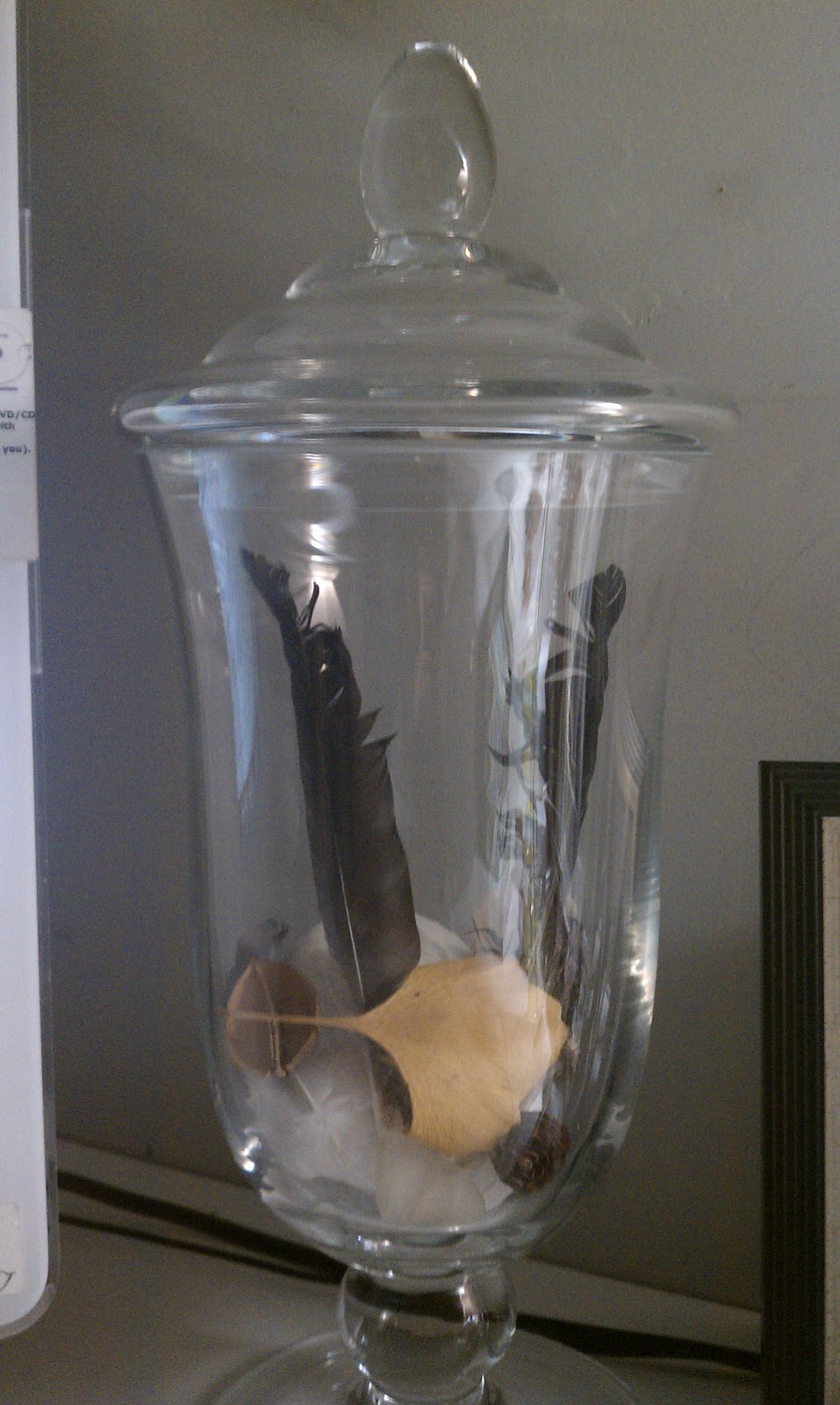
I like to collect weird little things from the outdoors. I picked this quirk up from my mother who (if I remember the story correctly) kept mice in a shoe box under her bed when she was a kid. Where my my mother and I differ, is that I don’t collect live things. However, since the age of about seven I’ve collected up rocks, feathers, shells, leaves, husks of seeds, etc. and kept them in various jars & boxes. This habit happens to drive my husband bat sh*t crazy. He doesn’t like much of anything about nature. He will tolerate it for the sake of a game of golf or perhaps a barbeque but otherwise, he’d rather stay inside the safety of our home reclining in front of the television. In the spring and summer I like to sit out on our back porch to work, blog or read and when he comes out to say hello, he squints against the sun in pain and the scurries inside like some sort of overgrown mole. It’s charming really.

Anyway. He finds it odd that I collect these little treasures from the outdoors and  tonight when he came upstairs to check on me*, he looked over and said “Are you building a curiosity jar?” The tone of this question was a mix of amusement and disdain as he peered at an apothecary jar that happens to be sitting on the far right corner of my desk.  My response to his query was a withering look and then I returned to the project I was working on before he busted in.

My curiosity jar

I must admit that I didn’t purposely “build a curiosity jar” but I like the idea of it (I don’t think this was my husband’s goal) and I will continue to add to it. I simply wanted a way to display some of the cool stuff I had found outside this fall, so I thought jar would be perfect. I also read recently that my favorite poet of all time, Elizabeth Bishop, also collected little pieces of interest from the outdoors. This furthers my theory that we would have been great friends if we would have lived during the same time period. Great minds…

 *When I say “check on me,” I mean he comes upstairs to procrastinate from writing his law school paper.

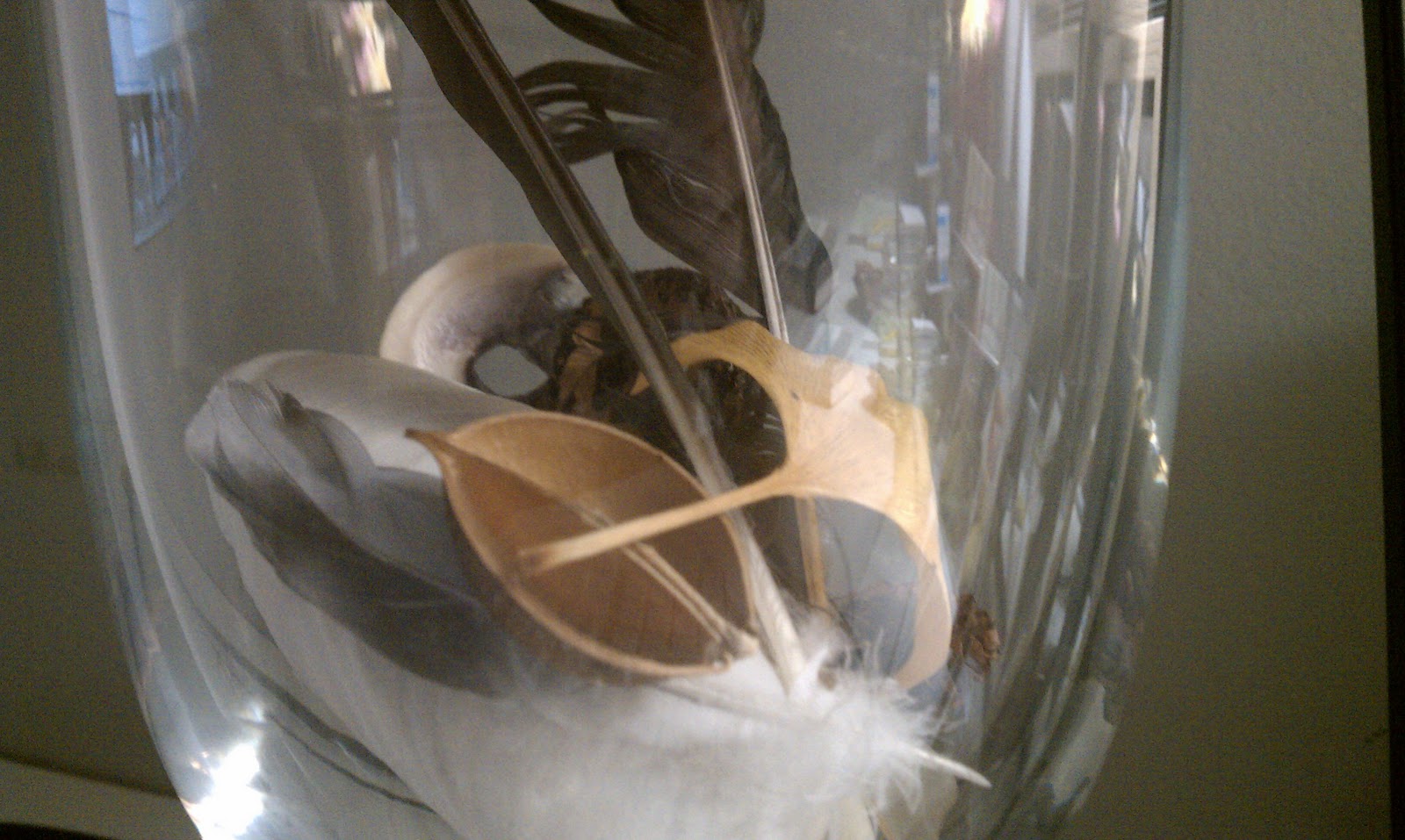
 A nut shell, a ginkgo leaf, a clam shell & a few crow feathers.

The Life and Times of an Unknown Poet…

I finished electronic submissions this past weekend and I just completed hard copy submission packets for everyone else who has yet to give into the ease of submission managers. I’ve completed 50 submissions total and I’ve already received three rejections (electronic submissions can make the rejection process a lot quicker), so I have or will soon have about 47 submissions out in the world.

I’ve encountered something during this round of submissions that I’ve never encountered before: anxiety about sending poems to people I know. The universities where I received my MA and my MFA also house two very well respected literary journals and I’m a little ashamed to admit that I’ve been avoiding sending to them. Actually, as long as I’m being honest, I’ve avoided sending to any places where I know the editors are former peers or mentors. I know this makes no logical sense and it’s not like I fear rejection or criticism (I mean I went to school for poetry for crying out loud) but maybe I do fear it from people I know and respect. This may be oversimplifying it a little bit. I just seem to feel a slight twinge when writing certain addresses on submission envelopes…

I’m reading two different books right now. One is Jonathan Franzen’s The Corrections and the other is Elizabeth Bishop and The New Yorker. In a way, it isn’t really fair that I’m reading these two books at the same time. I love Elizabeth Bishop and I’ve read just about every conceivable thing by her or about her. This recent edition from the New Yorker is delightful and where most people would find reading pages of letters tedious, I really enjoy it. I’m never going to get meet Miss. Bishop but I can hear her voice in her letters and her conversation. It’s as close to a dialogue as I’m ever going to get, so I’ll take it.

On the other hand The Corrections is challenging and the verdict is still out whether I’m enjoying the challenge or not. I found the beginning of the book intriguing but odd, but as I move further into the novel I’m having trouble deciding if I’m still intrigued or just annoyed. I know I missed the boat on this book in terms of timeliness. Most of my friends jumped on Franzen’s bandwagon along time ago, but I’m going to finish it and then I’ll comment in full.

The days are lengthening and the sun seems to be making its presence known more and more often. I noticed the tips of some green shoots pushing through the leaf beds. Spring break is just around the corner and I look forward to spending some time working on my chapbook manuscript and working through some new poems that are bumping around in my head.

Last night I didn’t sleep well. This usually happens when I have a lot going on and can’t keep my mind still. When I did finally slip off into sleep, I had dreams of poetry and lines and words. Spring brings rejuvenation in many forms.

AWP Highlights

I give you my highlights from AWP, although because AWP also coincided with The Great Ice Storm of 2011, my highlights actually started before I arrived at the airport.

  1. The great ice storm of 2011. Enough said.
  2. Falling off of my deck while attempting to feed the birds (this happened the morning I left).
  3. When RJ and I attempted to leave for the airport, we went out the back to the garage. When we got to our little wooden gate, we were able to get the latch open but there was about an inch and half of ice holding the door shut. See next item on list.
  4. We had to go around the front, so while RJ walked around to get the car, I had to scoot on my butt down our front steps because there was so much ice on the steps that I couldn’t walk in them.
  5. My flight from Indy to D.C. boarded on time. Win!
  6. The jetway was frozen to the ground, so we had to walk across the tarmac to board. This was tricky because everything metal (hand rails & stairs mostly) had about an inch of ice covering it.
  7. Descending into D.C. and seeing the capital, the Washington Monument & The Jefferson Memorial.
  8. My shuttle driver (who had the most beautiful African accent) asking me if it was OK if he got lost going to my hotel. I think he was kidding…
  9. Meeting a fellow writer/conference attendee on the shuttle and having a nice chat that resulted in receiving a business card and having a new blog to follow.
  10. Discovering that the hotel I’m staying at has a great gym and a killer veggie sandwich.
  11. Attending a really interesting first panel sponsored by Writers in the Schools.
  12. Meeting a group of writers from Texas and commiserating about Governor Perry.
  13. Hearing Katrina Vandenberg read at the Fullbright panel. If you have not read her collection, Atlas, do it. It’s an excellent book.
  14. Making my first pass at the book fair and seeing old friends, making new ones and picking up free copies of New Madrid & American Literary Review (publications from Murray and UNT).
  15. Hearing Gary Jackson, Natasha Trethewey, Rita Dove & Yusef Komunyakka read. Wow.
  16. Hearing Marie Howe read. What the Living Do is one of my top 10 favorite poetry collections of all time.
  17. Attending a fascinating panel about writers of color and their role in environmental writing. I usually write down all of the names of books I want to buy after AWP and then add them to my Amazon wish list at the end of each day because if I bought all the books I wanted to while here, I’d be broke. That being said, after this panel, I’m going to buy The Colors of Nature tomorrow.
  18. Listening to Jhumpa Lahiri’s keynote address.
  19. The bookfair. It is amazing.
  20. Going to a table at the bookfair of a journal that I’ve sent poems to in the past and chatting with editor only to find that not only did she remember me, she remembered my poems. Maybe I can do this poet thing for real…
  21. Running into old mentors and friends.
  22. Attending the two year college caucus.
  23. Attending a panel about how to approach disturbing undergraduate writing.
  24. Sharing a cab ride with Khaled Mattawa.
  25. Going for dinner with Natalie & Zach and later meeting up with Michael and other friends.
  26. Driving by the Lincoln Memorial at 6 am. It was all lit up and mystical looking. I think Abe would have liked to see it like this.
  27. Arriving back in Indy in the midst of a snowstorm. I believe the pilot’s exact words were “I just landed in a white out.”
  28. Returning home in one piece after a harrowing ride on the interstate.
  29. Finis.

Notes from a writing life…

I spent my entire day on Sunday preparing submissions and doing research into contests. By entire day, I mean I got up, inhaled a piece of fresh bread smothered in Nutella (om nom nom), chugged some tea and settled into the couch with my lap top only to emerge about six hours later.

It is time consuming work to send poems to journals, although even in the short time I have been sending work out, I’ve noticed marked improvements in the process:

1. Electronic submission. Honestly, I’m really glad most journals have jumped on this bandwagon by either using submission managers or allowing email submissions. While it is considerably easier and less paper filled, the real reason I like it is because it is cheaper. For example, I usually send out to 30-40 places in a given period. You start adding ink, paper, postage & envelopes and it can start to get a bit pricey. I’d rather save this money for contest fees or books.

2. Lovely websites. I’ve noticed that many journals have really stepped up in terms of their websites. It’s easier to find guidelines and contact information. It’s easier to “read what the journal is looking for” when you can read back issues online instead of suffocating under a pile of hard copies. They layouts are beautiful. It’s just better. Period.

3. Simultaneous submissions. I won’t send to a journal if they don’t accept simultaneous submissions. This isn’t some snooty statement, it’s just practical fact. I’m trying to get my work out there. Not being able to send it to anyone else while a certain journal is considering it is not practical. However, if I were a poetry genius I suppose I would not mind just sending to NER or Ploughshares. I love these magazines but I think it’s a bit silly. Sorry.

4. Less pretentious all around. Let’s face it, poetry often gets a bad wrap for being pretentious and hard to understand. I’m encouraged by seeing new journals and small presses trying to carve out their own place in the poetry world. I’m also encouraged to see less annoying descriptions under the What We Want section. In the past I would not read these sections because if I heard one more editor say “We’re looking for beautiful poems that use interesting language and surprise us” I was going to scream. I mean personally, I’m looking for poems that are boring, poorly written and predictable. C’mon man.

5. New Pages. I’ve always loved this blog/website but I appreciate more and more as I work on submissions. I cannot imagine how much longer the submission process would take if there was not a comprehensive site like New Pages to organize listings of calls for submissions, contests and reviews.

All of this being said, I encounter the same feeling every time I put a new batch of submissions together. This feeling can best be described as exhiliration slowly giving way to panic. I used to worry more about it but now I just accept it and move on. As if submitting individual poems was not enough, I’ve decided to start sending out to chapbook contests. I’ve got my manuscript almost where I want it and as they say, there’s no time like the present.