Poetry Summer Reading List Book #5: The Well Speaks of Its Own Poison

Book: The Well Speaks of Its Own Poison 
Poet: Maggie Smith
Publisher/Date: Tupelo Press, 2015
Why I bought the book: I read Maggie Smith’s poem “The Fortune Teller to the Woodsman” back in January. I don’t remember how I found my way to the poem, but I loved it immediately and started following her on Twitter. In following her I realized her second book, The Well Speaks of Its Own Poison, was coming out shortly  (including “The Fortune Teller to the Woodsman).  All of this  coincided with AWP,  so it was perfect timing to meet Maggie and buy her book. Have I mentioned I love the internet?

What I admire about this collection: I really admire the way that way The Well Speaks of Its Own Poison works as a collection of poems. I like the way Maggie uses apologues throughout the book to tie poems and ideas together. I wasn’t familiar with the term “apologue” before reading this book, so it was fascinating to learn about them while reading these beaunnamedutiful poems.
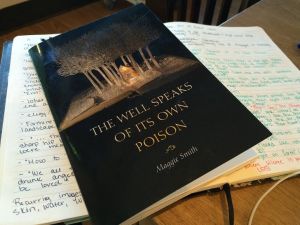
I also really respond to the content of this collection. I love folk tales and fairy tales and I use them a lot in my intro creative writing class as prompts. Often I ask my students to reimagine a fairy tale; to make it their own or to reveal a new angle on a story that an audience might already have read. I like how the poems in The Well Speaks of Its Own Poison feel fresh and new but also personal. There’s a careful, thoughtful poignancy in many of these poems. Each time you read one of these poems, something new pops up. It’s a brilliant read.

Favorite lines: “It is blacker there than in the gut. From far off, her life/rings like a thrown voice. Let it not be a fable for others” (3). “It’s an installation: Wrens pinned like brooches/to the trees, singing, their eyes like glass beads” (5). “Listen/as bird songs repeat, records skipping:/ Ohio, Ohio, Ohio. Each persistent melody chips away at the air, shaving/the sky into tissue-thin curls that float/down like leaves” (9). “Ultimately, all revisions of her life collapse into one…” (28). “Swans floated like votives” and ” feathers like wicks” (30).

Favorite poems: “The Well Speaks of Its Own Poison,” “Last Night on Earth,” “First Son,” “The Shepherd’s Horn” & “Ohio.”

Links: While reading A Well Speaks of Its Own Poison, I was reminded of other poems about folk/fairy tales that I’ve used in my classes before. Two that came to mind were “Gretel in Darkness” by Louise Gluck and “Cinderella” by Anne Sexton.

Previous: A Sweeter Water by Sara Henning

Next: The Last Two Seconds by Mary Jo Bang 
Poetry Books: A Summer Reading List

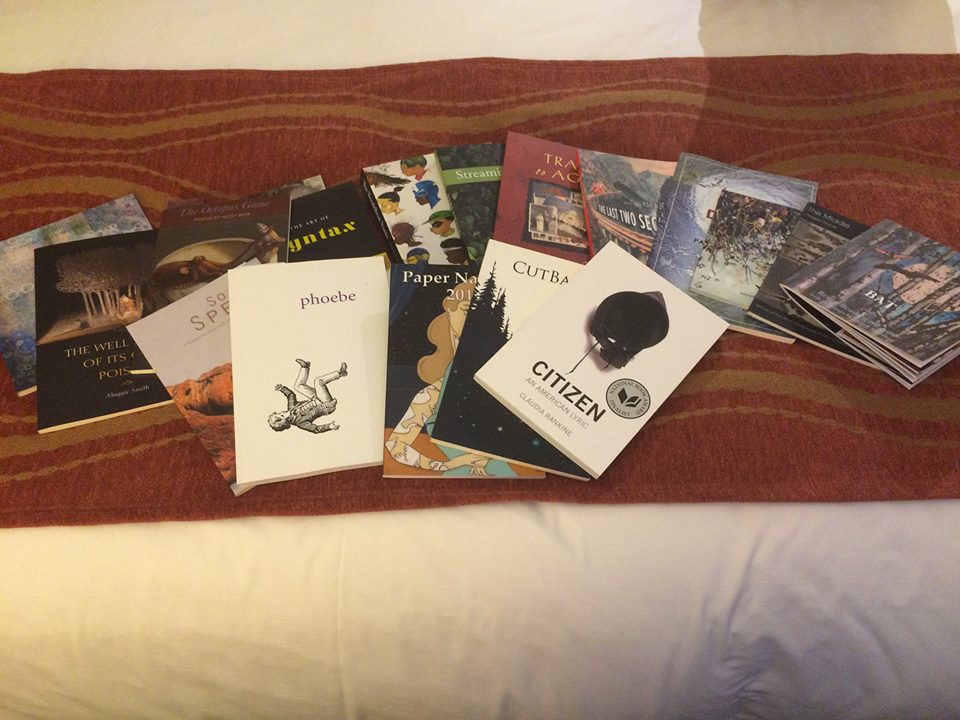
I came back from AWP with a massive amount of poetry collections. When it comes to books, I have poor impulse control (understatement of the year) but there were a lot of poets at AWP that “I knew” either through previous interactions (MA, MFA, readings, etc.) or who “I met” through Twitter, FB and Binders, so again, I had to buy their books and get them signed. I had to.

My intentions after returning from AWP were good. I would finish out the spring semester and then bury myself in the lovely pile of books that I stacked on my dining room table. Guess what? It’s June 17th and the pile is still there. Untouched. The major reason for this literary neglect is that I thought I had a solid three weeks of reading time from the end of the spring term, May 11th, to June 4th when my son, Cameron, was supposed to be born.

Let me reiterate: his due date was June 4th. When did he show up? May 16th.

So, yeah.

Anyway. I’ve found that mornings, after Cam eats and goes back to sleep, are prime time for poem drafting/ revising/reading, so I am finally prepared to tackle that stack of books that is taunting me from across the room. I’ll be posting about each book (I’m hoping to average a book/chapbook a week) because I know that most of the time I come to poetry collections through recommendations from other poets.

Stay tuned.

11149352_10153149134695791_7562234780810747246_n