 |
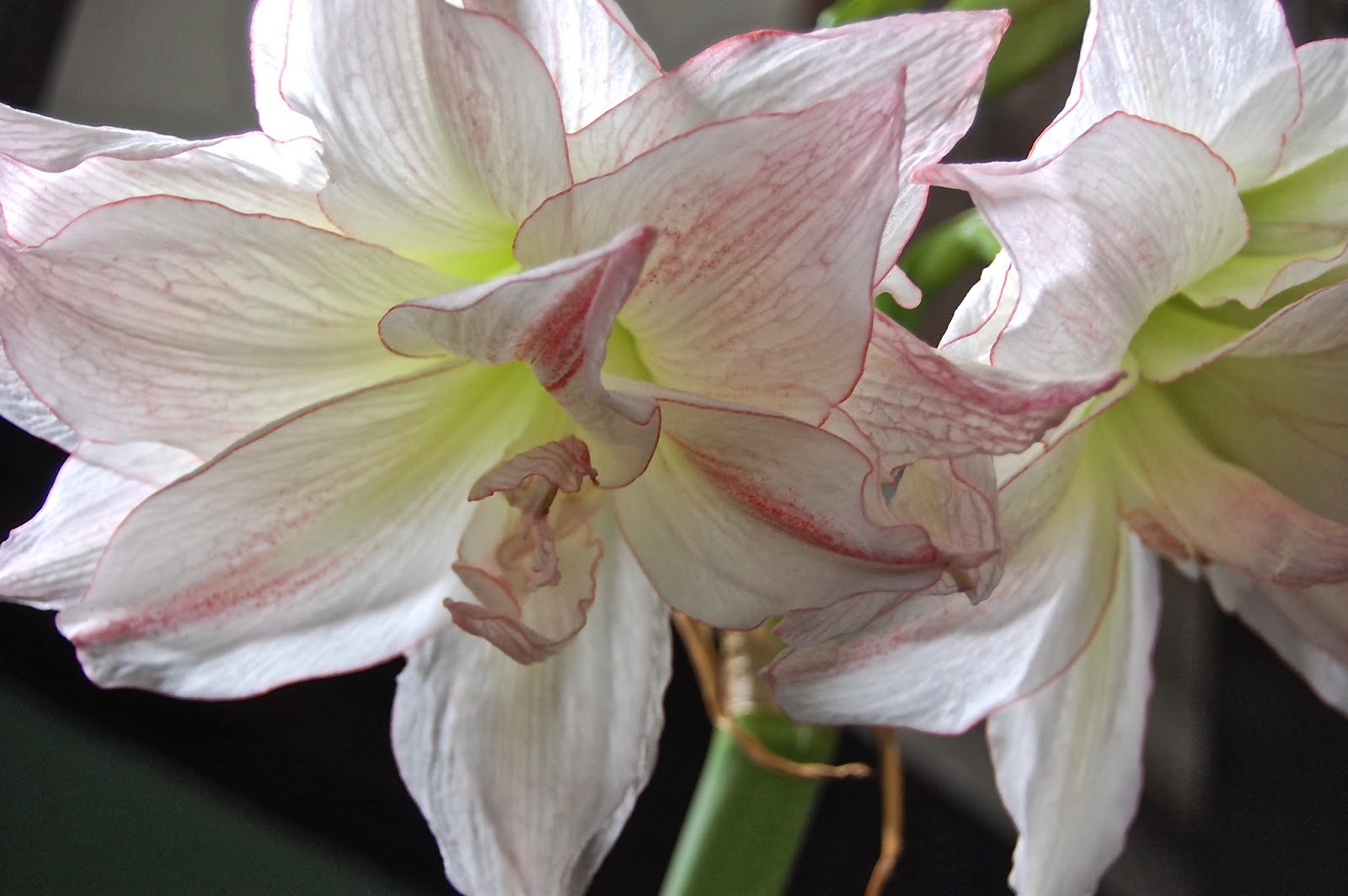
| Aphrodite Amaryllis. |
Month: January 2014
Rediscovering Sylvia Among the Tulips
In the January 2014 issue of Poetry there is a poem entitled “Sylvia Plath’s Elegy for Sylvia Plath” by Sina Queyras I don’t know why the poem hit me so hard. It might be because Plath died at the age of thirty and this March I’ll be thirty-three. It might be because by the time she died she had two children, a book of poems and was embroiled in a tumultuous marriage with Ted Hughes. It might be because as I read Sina Queyras’s beautiful poem I was immediately, shockingly sad. The sadness was heavy. It pressed on my chest as I sat at my desk in my office at school. It pressed so hard that I felt my eyes water for a woman who has been dead for over fifty years.
I have always found Plath’s story heartbreaking. Partially it is because we will never know the poems she could have written. Also, as a thirty some year old woman who is thinking about starting a family and who is also a poet and a professor, I find myself empathizing with her loneliness and her isolation. It is upsetting that that she couldn’t overcome her illness and I suppose now I find myself identifying with her more as a woman rather than an enigma. She was not just this brilliant, tragic poet. She was, as it turns out, a woman made of blood and bone.
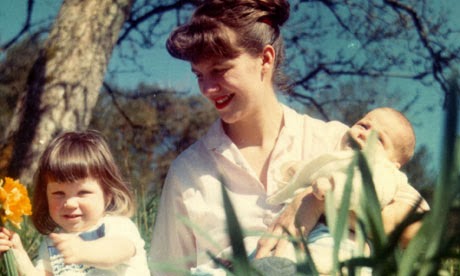 |
| Sylvia Plath with her two children, Nicolas and Frieda, in 1963. |
Immediately upon finishing this elegy I went back and read the poem “Tulips.” and was reminded of how gorgeous and devastating that poem truly is. There is such isolation: “There smiles catch onto my skin, little smiling hooks. Even love hurts. What must it be like to live this way? That flowers give you pain and that health is a far away place you know you cannot reach. At the same time, the poem is so beautiful and carefully rendered. So precise in it’s language. That such beauty can come from such pain is hopeful. I just wish it could have kept her alive.
After reading “Tulips,” I wanted to revisit more of Plath’s work, so I pulled out my copy of Ariel. My copy is the restored version which contains a foreword by Plath’s daughter, Frieda. This edition also contains notes and drafts that Plath left behind after her death. I had forgotten, until I opened the book, that it was a gift from a friend. At the time I was given this edition of Ariel, my friend was studying Philosophy and I was studying English at Allegheny College. My friend had a flare for the dramatic and included two quotes at the front of the book: “All, everything that I understand, I only understand because I love” ~Leo Tolstoy & “One word frees us of all the weight and pain of life; that word is love.”~Sophocles.
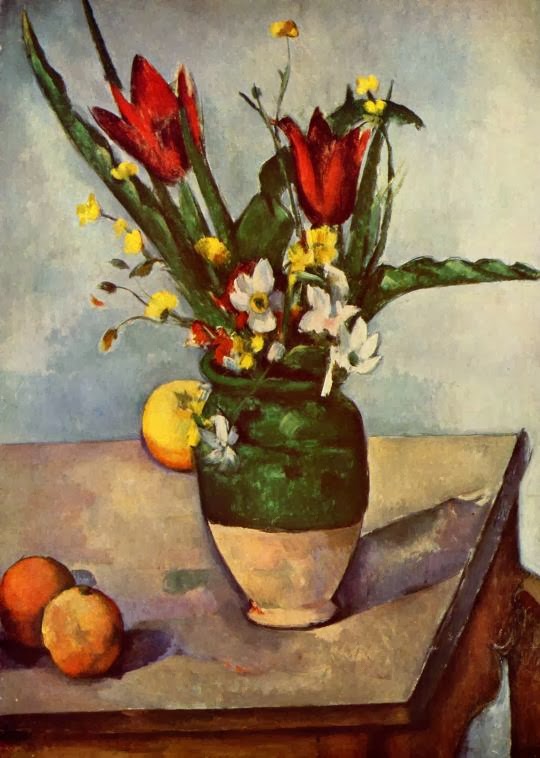 |
| Still life with flowers by Paul Cezanne. |
Unfortunately, my friend and I are no longer in contact. I don’t know why.
And yet as I read his inscription, I am briefly sad about our lost friendship but the sadness is quickly replaced by anger. These quotes have no business in this book. Love couldn’t free Plath. Love fought bravely, but in the end her disease was stronger. This is especially arresting given that Ariel is dedicated to Plath’s two children, Nicholas & Frieda, and Nicholas Hughes committed suicide in 2009. It is difficult because love gave us so many of Plath’s wonderful poems but so did despair.
I feel like there’s probably a poem in here somewhere. Maybe several poems.
Teaching Lessons: Teaching World Lit to Fourteen Faces
This semester I am teaching a world literature class for our brand new honors program. I’ve taught the course face to face twice but this semester brings a new format to the table. The company that my community college is currently contracted with uses the concept of a flipped classroom where most of the work done online and supplemental instruction is done in once or twice a week synchronous sessions in Adobe Connect. I spent the last semester developing the course with a course designer which involved taking my course content and translating it into this new format.
This is brand new venture for me and I’ll be posting more about it as the course progresses. There are some positives and negatives about this new format but right now I’m just trying to take in the new experience and see what I can learn from it. I’m not convinced that this new format is the “wave of the future in education” but I think there are some valuable things that can be learned from using the technology for both students and professors, but I’ll be writing about those thoughts at a later date.
For now I’m still digesting meeting with students once a week in a session that essentially entails me talking to a screen of fourteen faces. Think the Brady Bunch screen and you begin to get the idea. This screen shot demonstrates what I see:

Every Wednesday afternoon I sit in my dining room and talk about world literature with my class of fourteen for about an hour and twenty minutes. It is a somewhat odd experience to be sitting in your house teaching a course, but so far I’ve enjoyed the experience. Granted, I’ve only met with my students for two sessions, but they seem comfortable with the technology and today’s discussion about Gilgamesh went much like discussions I’ve had in my traditional face to face classes. I am also lucky in the respect that many of these students took classes in this format last semester, so the technology is familiar to them at this point.
What I like the most about this format and online education in general is that I have students who are taking this class in Fort Wayne, Muncie & Lafayette in addition to Indianapolis. They may not have access to the course otherwise, especially if it were in a face to face format because their campus may not have offered it or their schedules may not have permitted it even if it was offered.
I still prefer teaching a face to face class, but I’m always open to trying something new and I think that this experience will ultimately be valuable.
The Art of Losing…
I’ve been keeping journals since I was about eight or nine years old. When I was younger, through my teenage years, I was fairly consistent in starting a journal, writing in it until it was full and then moving onto the next set of empty pages. However, especially as I got older and my writing became a bit more focused and I started to mine it for poems, I started to keep better track of these little books full of scribbling. I didn’t seem to have trouble hanging onto them until fairly recently.
I wouldn’t say I’m a forgetful person and I don’t think I really fall into the “scatterbrain” category either. I’m relatively organized and I don’t lose things easily, but in the last couple of years I seem to be constantly losing journals. For example, a few semesters ago I started writing in a yellow, faux leather journal that my sister gave me for Christmas. I really liked the size of the journal, the bright yellow cover and the strip of leather on the front that buckled to keep the journal closed. I wrote in it all semester and then one day, I couldn’t find it. I tore my house apart. I looked in my office and in the lost and found at school. I couldn’t find it. I was annoyed. Mostly because I liked the journal and also, who knows what was in there that I could potentially have used for a poem or two?
Today I have the day off and I’ve finally had some time to sit and think about some ideas I had for poems over the holidays. However, when I went up to my office space to look for my writing journal, I couldn’t find it. I have looked all over my house and it doesn’t seem to be here. Now it is possible it’s at work, seeing as how I often take my journal to work if I have a spare moment or two and think of something I want to write down. However, if it doesn’t turn out to be in a desk drawer at school, well, I don’t have the first clue where it might be.
This idea of losing potential ideas for poems or even drafts of poems themselves, reminds me of a story I heard once when I was an undergraduate. A visiting writer came to campus to give a reading and I’m sorry to say, I can’t remember who it was but I do remember he was a fiction writer and he primarily wrote short stories. He was in his fifties and this was probably somewhere around 2000 or 2001. He was talking about how he used to only keep one type written copy of all his drafts/stories but one days his car was broken into and they took everything in it, including the folio that contained all of his work. After this incident, he started keeping multiple copies. He also started using a computer in addition to his type writer.
Of course anyone who uses computers and has suffered through the loss of a hard drive or external hard drive, knows that technology does not completely solve this “art of losing.” In fact, I suffered this exact problem a few months ago when our external hard drive failed and all my poetry was lost. Luckily, my husband who is a determined and brilliant soul, was able to recover the data, but now we both consistently use Dropbox.
While it is frustrating to lose these journals and the material that they hold, there is also something freeing about it. Also, while I seem to become slightly forgetful in the material sense, I’m still lucky to have a good memory, so if an idea or image or line for a poem is particularly interesting to me I am often able to circle back around to it at some point.
All this being said, I’m still going to be on the look out for that journal…
Poetry in Print & The Beginning of Spring
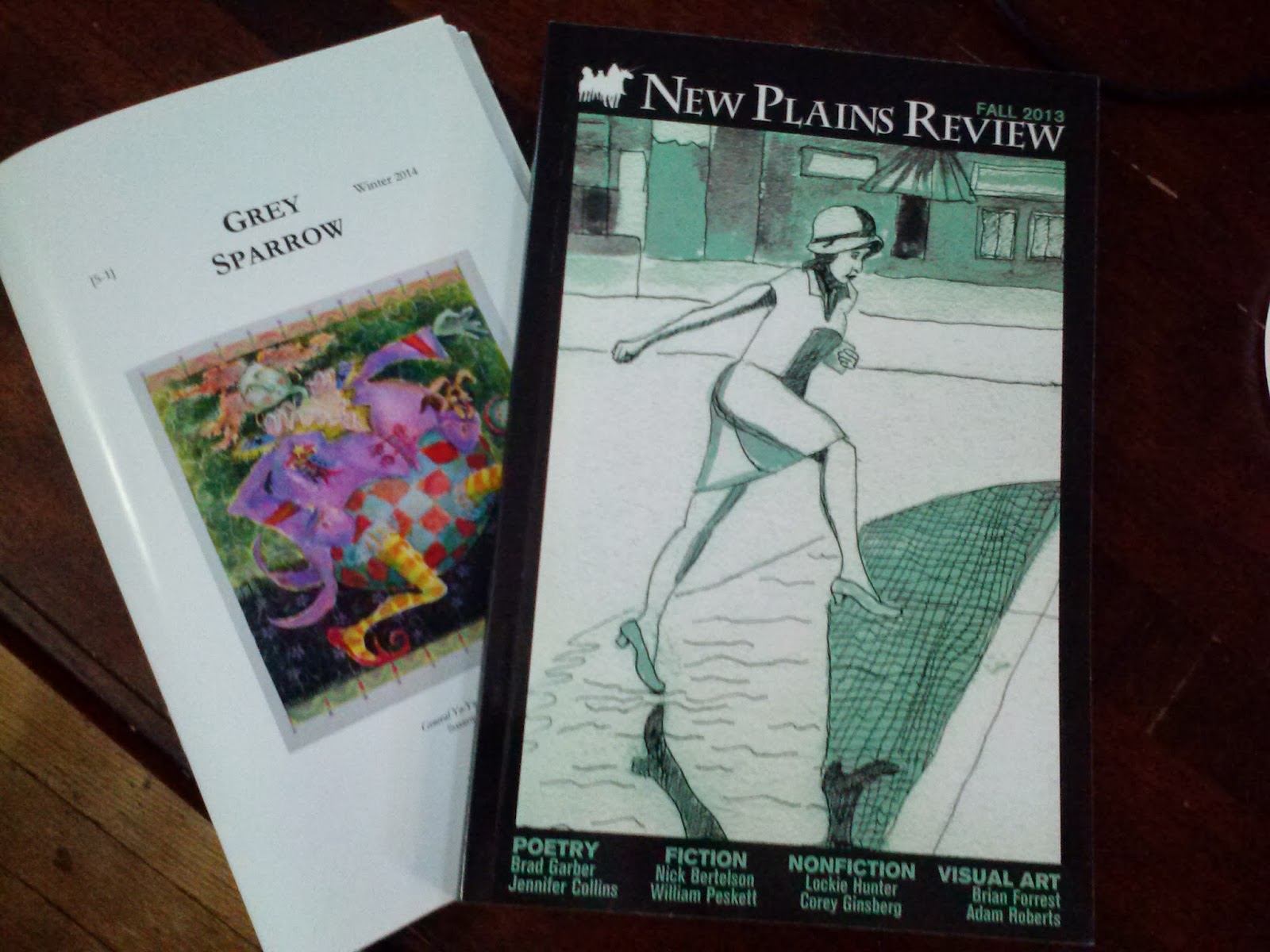
Three of my poems, “Song,” “Seed” and “Stargazer” appeared in the Fall 2013 issue of Rust + Moth and now that issue is available in print.
My physical copies of New Plains Review & Grey Sparrow arrived this week.
After surviving the polar vortex, classes began this week with rain and milder temperatures. I met with my creative writing class yesterday and out of twenty-five enrolled students, twenty-two showed up. I am am still somewhat surprised by these numbers even though they been steadily rising for several semesters now. When I first started teach this class, I was lucky to have ten students enrolled.
I’m embarking on a few new teaching adventures this semester, including working with some new technology and teaching a new section of World Literature for our fledgling Honors College.
I took some time off of writing over the holidays, which isn’t abnormal. I still journal and write down ideas, but I didn’t have a chance to formally draft anything as we were traveling for much of our holiday. I am looking forward to sitting down to write some new poems and start revising some work from last fall.
 Brianna Pike