Pomegranates

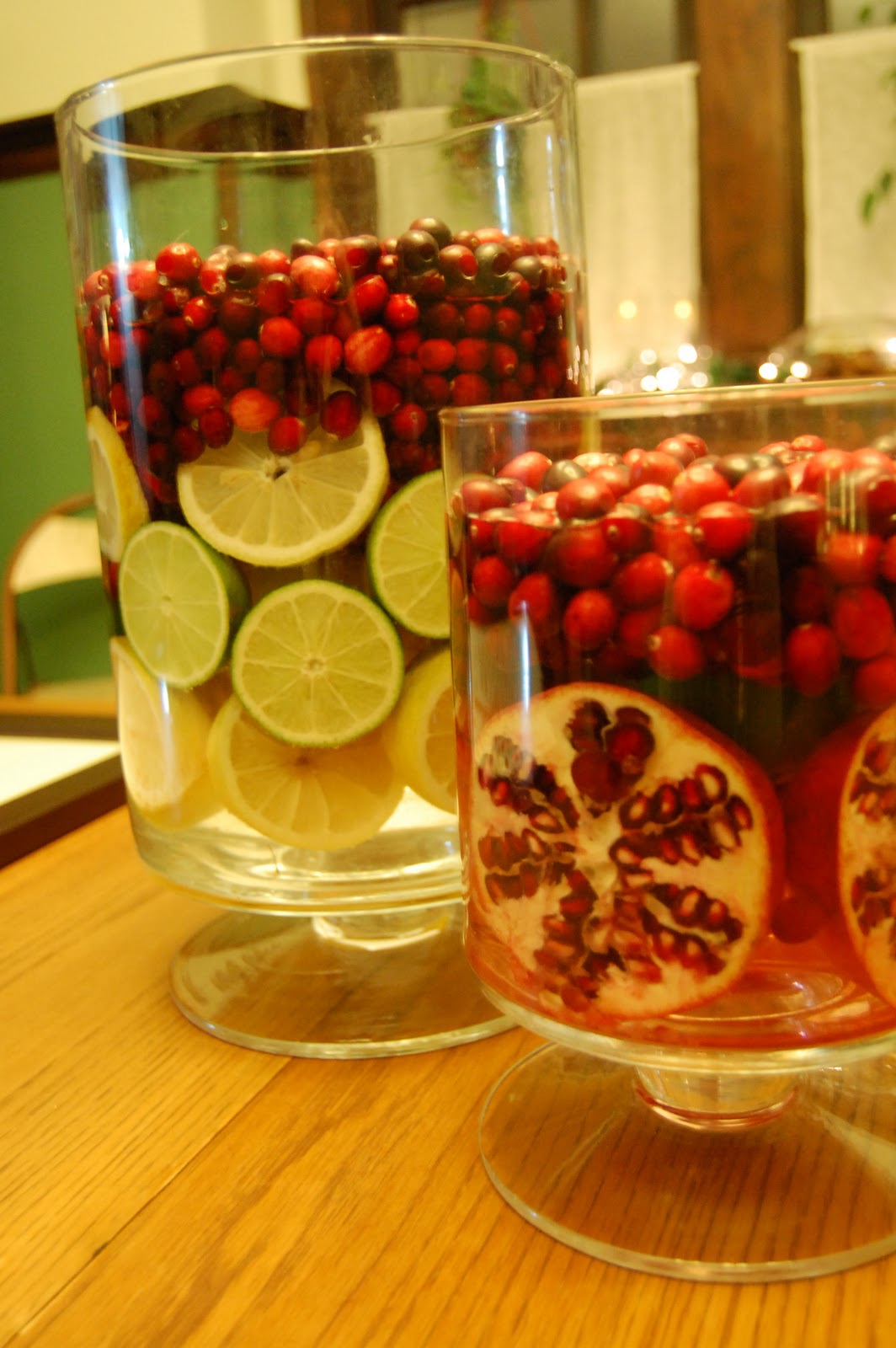
On Monday I made these centerpieces using some hurricane jars we received for our wedding:

Easy, cheap & very pretty.

As you can see, I used all sorts of fruit. I was only planning on using cranberries, lemons & limes, but when I went to the grocery store, they had pomegranates on sale four for five dollars. They’re pretty fruits cut or uncut, so I thought I’d give it a shot. While cutting the pomegranates for the centerpieces, it dawned on me that a). I’ve never eaten pomegranate b). I had no clue how to eat a pomegranate. So what did I do? What every American does when faced with a problem. I googled it.

It turns out that with pomegranates you eat the seeds, and let me tell you, they are delicious. Now, I have never met a fruit I didn’t like but when I popped a handful of pomegranate seeds into my mouth, I was amazed. They are so good!

Anyway. This got me to thinking. One of my favorite poems of all time is called ” The Pomegranate” by Eavan Boland.

 The Pomegranate
 
The only legend I have ever loved is
the story of a daughter lost in hell.
And found and rescued there.
Love and blackmail are the gist of it.
Ceres and Persephone the names.
And the best thing about the legend is
I can enter it anywhere. And have.
As a child in exile in
a city of fogs and strange consonants,
I read it first and at first I was
an exiled child in the crackling dusk of
the underworld, the stars blighted. Later
I walked out in a summer twilight
searching for my daughter at bed-time.
When she came running I was ready
to make any bargain to keep her.
I carried her back past whitebeams
and wasps and honey-scented buddleias.
But I was Ceres then and I knew
winter was in store for every leaf
on every tree on that road.
Was inescapable for each one we passed.
And for me.
It is winter
and the stars are hidden.
I climb the stairs and stand where I can see
my child asleep beside her teen magazines,
her can of Coke, her plate of uncut fruit.
The pomegranate! How did I forget it?
She could have come home and been safe
and ended the story and all
our heart-broken searching but she reached
out a hand and plucked a pomegranate.
She put out her hand and pulled down
the French sound for apple and
the noise of stone and the proof
that even in the place of death,
at the heart of legend, in the midst
of rocks full of unshed tears
ready to be diamonds by the time
the story was told, a child can be
hungry. I could warn her. There is still a chance.
The rain is cold. The road is flint-coloured.
The suburb has cars and cable television.
The veiled stars are above ground.
It is another world. But what else
can a mother give her daughter but such
beautiful rifts in time?
If I defer the grief I will diminish the gift.
The legend will be hers as well as mine.
She will enter it. As I have.
She will wake up. She will hold
the papery flushed skin in her hand.
And to her lips. I will say nothing.
 
~Eavan Boland


*A Few Interesting Facts About Pomegranates: 
 
1. The name "pomegranate" derives from mead evil Latin pōmum "apple" and grānātum "seeded." 
2. Loaded with vitamins and antioxidants. 
3. Pomegranates are native to Iran.
4. The pomegranate has been traced back as far as 3,000 B.C. 
5. King Tut was buried with pomegranates in hopes of a second life. 
6. Pomegranates are mentioned in Homer's Odyssey, and Juliet tells
Romeo the night is young since it is the nightingale — and not the lark
— that is "singing in yon pomegranate tree." 
 
* I got this info from Pomegranates: Jewels In The Fruit Crown.  

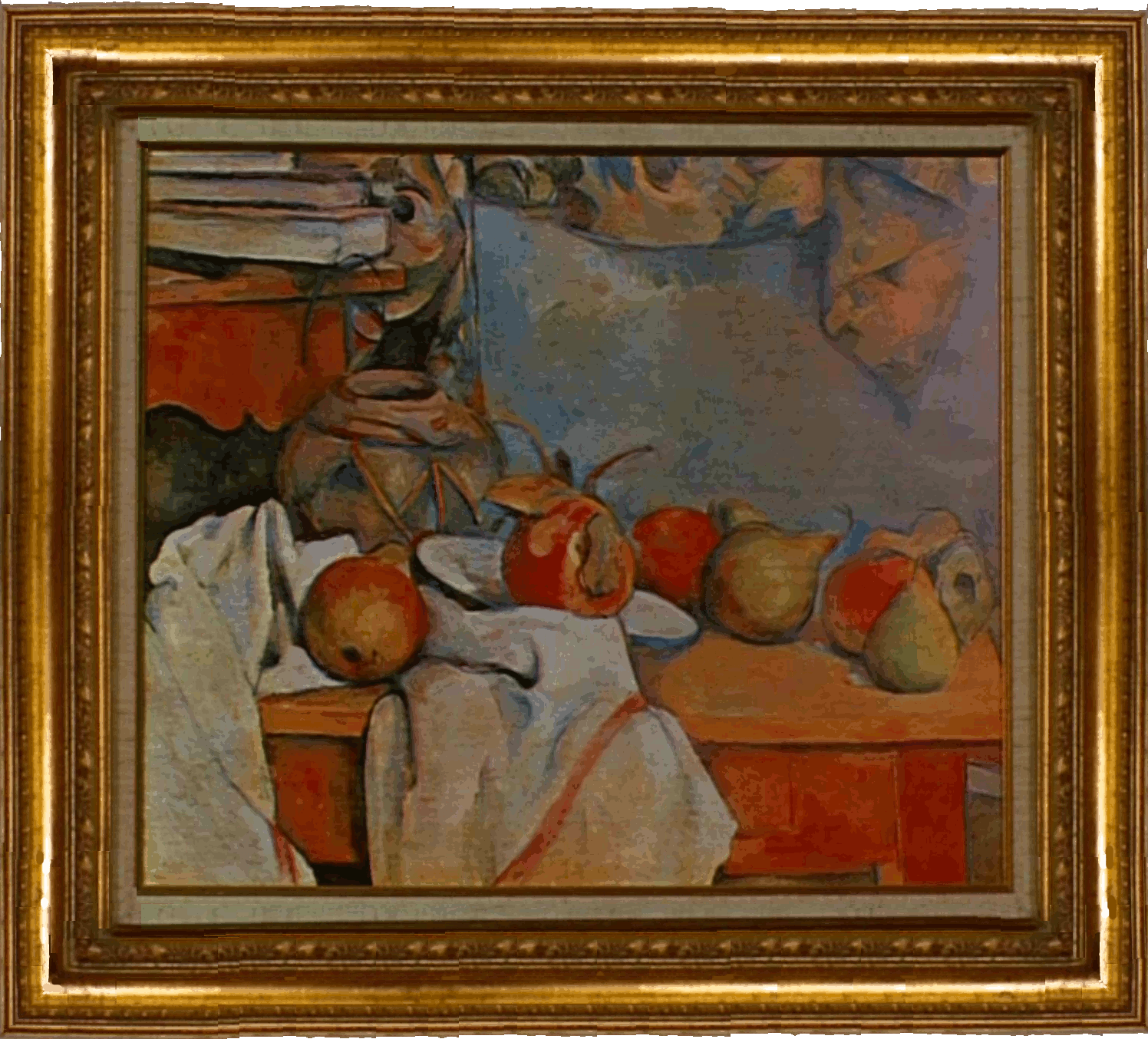
Still Life with Pears and Pomegranates by Paul Cezanne.


The Mermaid Chair

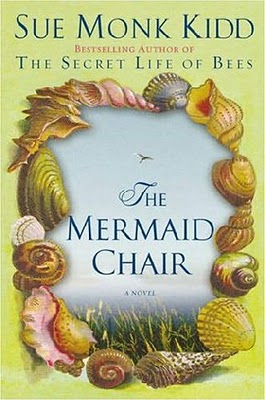
Over the summer my mom and her friends threw me a shower. The theme was a literary tea, and it was awesome. As favors, we got to pick a book to take home. I picked up The Mermaid Chair by Sue Monk Kidd. The books were all donated, so I don’t know whose book this was, but once again I was intrigued by the art on the cover*.

I also have a thing for mermaids. When the Disney version of The Little Mermaid came out, my mom took my sister and I to see it twice. I knew all the words to “Under the Sea” and “Kiss the Girl” and Ursula scared the living hell out of me. When I got older, I read Hans Christian Andersen’s original version, and I cried. When my family and I go to the Outer Banks in North Carolina on vacation, I always pause over the mermaid knick knacks. I even bought a beautiful handmade card with a mermaid on it. I still haven’t sent it to anyone. Needless to say, it is not surprising that a book titled The Mermaid Chair caught my attention.
For those of you who read my posts about Juliet, Naked and The Girl in the Garden, you probably think I’m starting to sound like a broken record, but yes, friends, I liked this book too. Once again, we have a strong female lead and once again, she is flawed and confused. She is really confused. This is also a love story. There is a love triangle between the main female character, Jessie, her husband, and Jessie’s lover, Brother Thomas. That’s right, he’s a monk. That is the first twist of a few that come in the story.

Admittedly, the plot is laid out neat and clean for us right from the beginning as Jessie narrates in the prologue:

In the middle of my marriage, when I was above all Hugh’s wife and Dee’s mother, one of those unambiguous women with no desire to disturb the universe, I fell in love with a Benedictine monk.

I always admire when novelists pull this trick out of the hat early on in a story, because when you reveal your main conflict this early, you have to have some pretty stellar writing stashed up your sleeve to maintain the reader’s interest. Kidd does a good job of filling in careful, necessary details about Jessie, her husband Hugh, and a string of other important characters, including Brother Thomas. She also sets the story in the lush, ethereal albeit fictional, Egret Island. If you’ve spent anytime in North or South Carolina, you’re going to feel at a sense of familiarity immediately. If you have not spent anytime in North or South Carolina, you’re going to want to go immediately upon finishing the novel.

The main conflict in this book is really the internal turmoil that Jessie feels. What Kidd does so well is she gives words to a fear that I think a lot of women feel once they’ve settled comfortably into their lives and I think that’s the fear of losing oneself. We all spend a lot of time when we’re teenagers standing in front of the mirror and asking “who am I?” This continues into college when we stand in front of the same mirror, although this time we’re inebriated on cheap beer or box wine. I don’t think this question ever goes away, but we learn to avoid it or even scarier, we talk ourselves into the fact that we’ve figured it all out. Jessie thinks she knows who she is until something happens that just blows that identity all to hell. I found myself relating to her early and at the same time thinking, dear lord, how do I keep that from happening to me? But therein lies the rub because you can’t prevent it, so you might as well try to learn something from it, which is exactly what Jessie does.

This is the part of the blog post where I wave at my new husband and say “Don’t worry, honey. I’m not going to run off with a monk!” I mean, this isn’t the Thornbirds. However, it did get me to thinking about other books that I’ve read where something similar has happened to a female character. The first one that comes to mind is the mother in the novel The Lovely Bones (another good book). After the death of her daughter, the mother seemingly abandons her family for a period of time. However, I think the term “abandon” is a cynical term. She does leave her husband and two surviving children but not because of malice, but because of guilt. She failed to protect her daughter and that failure haunts her for the better part of the story. You could say that Jessie abandons her daughter and husband as well, but I guess what Kidd points out, and this is true of all stories fictional or not, is that it is never that simple.

What I also liked about The Mermaid Chair, is that it examines the idea of grief. There is a lot of loss, new and old, in this book and all the characters are grieving and recovering at their own pace. Healing is a long process and this book demonstrates just how long it can take someone to forgive not only another person, but also to forgive themselves.

Add The Mermaid Chair to your reading list. It’s a provoking and engaging story and it will make you think.
Why Are Poems About Winter So Grim?

I like to peruse the websites of The Academy of American Poets & The Poetry Foundation on a semi-regular basis. A lot of the times I just click on random links and read whatever pops up.  Sometimes these are familiar poems but often I stumble upon something new.

Lately, I’ve been thinking about the impending winter season. Almost all of the leaves are off the trees, Thanksgiving has come and gone and the squirrels are burying their bounty in my backyard, so when I looked at the above mentioned websites this morning, I clicked on poems about winter. After reading several older and contemporary poems, I came to an important realization: winter poems are depressing. Now I know that symbolically speaking at its best winter is associated with sleep/hibernation and at its worst it is about death/decay. Pair these themes with Season Affective Disorder (SAD) and well, I can see why the poets have trouble working up any enthusiasm. I thought if maybe I narrowed my search to “Christmas” or “holiday,” things might perk up. Realization #2, poet’s have a harder time with Christmas than they do with winter in general. The reasons for this seem obvious and understandable, to me at least. Christmas is the land of cliche and materialism. In a sea of Hallmark cards, what self respecting “poet” is going to try and pen a few verses about the joy of evergreen trees or hanging Christmas lights or basting a turkey? Don’t get me wrong. I love Christmas. But write a poem about it? No way in hell.

Anyway, I did discover a few winter poems I really liked:

Winter Twilight 

On a clear winter's evening
The crescent moon

And the round squirrels' nest
In the bare oak

Are equal planets.
 
~Anne Porter 
 

Winter Trees
 

All the complicated details
of the attiring and
the disattiring are completed!
A liquid moon
moves gently among
the long branches.
Thus having prepared their buds
against a sure winter
the wise trees
stand sleeping in the cold.

~William Carlos Williams

Toward the Winter Solstice

Although the roof is just a story high,
It dizzies me a little to look down.
I lariat-twirl the cord of Christmas lights
And cast it to the weeping birch’s crown;
A dowel into which I’ve screwed a hook
Enables me to reach, lift, drape, and twine
The cord among the boughs so that the bulbs
Will accent the tree’s elegant design.

Friends, passing home from work or shopping, pause
And call up commendations or critiques.
I make adjustments. Though a potpourri
Of Muslims, Christians, Buddhists, Jews, and Sikhs,
We all are conscious of the time of year;
We all enjoy its colorful displays
And keep some festival that mitigates
The dwindling warmth and compass of the days.

Some say that L.A. doesn’t suit the Yule,
But UPS vans now like magi make
Their present-laden rounds, while fallen leaves
Are gaily resurrected in their wake;
The desert lifts a full moon from the east
And issues a dry Santa Ana breeze,
And valets at chic restaurants will soon
Be tending flocks of cars and SUVs.

And as the neighborhoods sink into dusk
The fan palms scattered all across town stand
More calmly prominent, and this place seems
A vast oasis in the Holy Land.
This house might be a caravansary,
The tree a kind of cordial fountainhead
Of welcome, looped and decked with necklaces
And ceintures of green, yellow, blue, and red.

Some wonder if the star of Bethlehem
Occurred when Jupiter and Saturn crossed;
It’s comforting to look up from this roof
And feel that, while all changes, nothing’s lost,
To recollect that in antiquity
The winter solstice fell in Capricorn
And that, in the Orion Nebula,
From swirling gas, new stars are being born.
 
~Timothy Steele 

Snowflakes (1st stanza)

Out of the bosom of the Air,
      Out of the cloud-folds of her garments shaken,
Over the woodlands brown and bare,
      Over the harvest-fields forsaken,
            Silent, and soft, and slow
            Descends the snow. 
~Henry Wadsworth Longfellow

A List Of Reasons Why You Should Take Walks Outdoors

If you read my earlier post about my curiosity jar, then you know I like to take walks outdoors. As the weather begins to turn, I have to remind myself why it’s good to get out of the house, even if it’s cold and snowy.  Below are the reasons I like to walk outside no matter the season.

1. Fresh air. Winter brings the return of closed windows and the furnace. This is all well and good, as I like a toasty home as much as the next person. However, it also brings stale air and dust.

2. Exercise. I, like most red blooded Americans, have a hard time resisting the urge to take up residence on my couch, under a fleece blanket with a box of cookies and call it good until April. The hibernation instinct is strong when it gets dark at 5 PM.

3. Good conversation. I’ve had some of the best conversations of my life while walking.

4. Inspiration. For better or worse, I’m a writer. I like to write about the outdoors but not exclusively. I get ideas while walking (I had one today). It’s good for my brain.

5. Treasures. See the curiosity jar post.

6. Stay up with the neighborhood. You get to see whose raked their yard, who put up their Christmas lights way too early and just who the hell decided that “electric blue” was a good color to paint their house.

7. It’s quiet. This may seem odd to some people who know that I live in an urban environment. However, especially in the winter months, snow acts as a good muffler and I’m always struck by how quiet it is after a significant snowfall.

8. It’s scenic.

9. You meet your neighbors. They know you’re out and about. You chat about your gutters or pesky squirrels. It’s social, people.

10. It keeps you in the moment. If walking does anything for me, it’s that it gives me an opportunity to stop and just take in my surroundings for a half hour. Again, good for the brain.

The Girl in the Garden

I don’t usually pick books by their covers because that’s no way to pick a good book. There are plenty of  compelling tales that don’t have particularly interesting covers. Catcher in the Rye, The Bell Jar, Beloved & Breakfast of Champions are a few of my own books that come to mind. Great stories but the covers (at least on my editions) are not that exciting. However, when Borders announced that it was going out of business and started to close stores in Indy, my husband and I began to circle the shelves with all the other book vultures. We made several trips to several different Borders in the city and the result of one of those trips was a hard cover copy of The Girl in the Garden.

As I type this post, I just am now realizing that when I bought this book, I was listening to Florence and The Machine’s album “Lungs” pretty much non-stop. My favorite track on the album is #12 “Blinding,” which contains the lyric “No more dreaming of the dead as if death itself was undone/
No more calling like a crow for a boy, for a body in the garden.” I know that this is not exactly the title of the book, The Girl in the Garden, but that might have had something to do with the purchase. The second reason was the cover:

Peacocks are lovely. 

The third reason is that the book is set in India and is written by an Indian author. I happen to have read every word Jhumpa Lahiri has ever written and I went and listened to her when she gave the keynote address at AWP last year. I love her beautiful descriptions and her interweaving of Indian culture into her stories, so I thought I might like Kamala Nair’s debut novel.

At the risk of sounding cliche, I couldn’t put this book down. I started it Thursday night around 8:30 and I finished it Friday night around 9:00. The imagery is gorgeous and if you’re a sucker for that kind of writing, which I am, you’re going to eat this up. Trust me. From the beginning of Chapter 4 when our narrator, Rakhee, and her mother arrive in India:


I stayed close to her side as we wove through the sweaty throng to identify our baggage so it could be transported to our connecting flight. Children darted by swift as multicolored arrows. Unsuppressed body odor invaded my nostrils. All around us, barefoot women dressed in identical saris swept the dusty floors, stopping over their long bristled brooms like agile, purple winged insects.

And later, when Rakhee and her mother arrive at the family home, Ashoka:

Rough weeds rose from the earth and encircled my bare ankles as I tumbled over the wall and landed on the other side. I brushed the dirt from my knees and got to my feet. It was not so scary now, in broad daylight. The trees and bushes shone an electric green. I glanced up. The branches of the tallest trees bowed under the weight of their leaves, forming an arched ceiling above the forest floor, and I felt as if I had entered a church. Through the intricate, screenlike pattern of leaves I could see patches of bold blue sky with not a cloud in sight.

The story is also intriguing. There are a lot of characters to keep track of and at first that can be a little overwhelming, but Nair does a good job of balancing narrative with all of this beautiful imagery. As our protagonist, Rakhee is compelling and we are immediately endeared to her brave, wise character. She is smart and perceptive and incredibly frustrated with the adults in the story. This is a plot built around secrets and they reveal themselves slowly, so it makes it extra hard being a child narrator. However, the story is not all doom and gloom either. This is a story about love, specifically about the love between families and how it has not only the power to destroy relationships, but also the power to heal them.

It’s a beautifully written book and a fast read. If you like stories about families and strong female characters, check it out. And it has a great cover.

From Shabby to Shabby Chic

I come from a line of painters, fixer upers & crafters. I enjoy a good do it yourself project as much as the next person, but I have my limits. For example, I don’t mind painting a bookcase or even a room but I draw the line at knocking out walls or ripping up floors. I like to think that my attitude is the healthy medium between my father, who likes do rip up and demolish (he is an engineer) and my mother, who likes to paint and decorate. When we bought our house, I was specific that I wanted something “old” with “character” but not something we were going to have to spend every weekend working on. I think our house is the perfect balance.

So back to the painted furniture. A few years ago (two maybe?) we helped two good friends of ours move from one apartment to another. As is the case with moves, when you are faced with moving furniture you start to do some serious reevaluation. The “awesome deal” that you got on that “wood” entertainment center at Big Lots seems less impressive when faced with actually lifting the damn thing. Therefore, after we had moved said friends into their shiny new apartment we found ourselves with a new/old dresser and bookcase. I looked at these two pieces of furniture and saw potential for painting and refinishing. The bookcase underwent it’s makeover fairly quickly. This was mostly because, if you know us, you know we have about 1 million books, so it was more necessity than anything else. It is sitting proudly in our dining room doing its job:

This color is called Barn Red from The Mark Twain Collection. Seems appropriate.

The other piece of furniture, a dresser, stayed down in our basement for about a year. I would go down and look at it sometimes but I couldn’t decide what I wanted to do with it and so it sat. And sat. And sat. After the wedding, I took on the job of cleaning my closets and discovered that I would need some more storage space. That’s all the motivation I needed. Over the next few days I researched painting techniques and made several trips to Ace Hardware. This is is the finished product:

 
Not too shabby!

I painted the entire piece with Krylon spray paint (glossy white) and then I bought some glaze at Lowes. The glaze was heavily tinted with black, so it makes it look worn and old. I think it turned out remarkably well considering I didn’t know what I was doing. It’s amazing what one can accomplish when properly motivated.

Gobble, gobble, gobble…

This is the second Thanksgiving that RJ and I are spending together but not with our respective families. The first took place in Texas in November 2003. I was attending grad school and RJ was driving all over hell for his consulting job. We sat in my little studio apartment eating steak and drinking beer. Eight years later we will be spending Thanksgiving with other friends in Indy who have families in distant states like New York, Pennsylvania and yes, Texas.

This morning I will be participating int this event:

I feel a 2.5 mile run justifies the food I will consume later on.

To Autumn

Season of mists and mellow fruitfulness, 
Close bosom-friend of the maturing sun;
Conspiring with him how to load and bless
With fruit the vines that round the thatch-eves run;
To bend with apples the moss'd cottage-trees,
And fill all fruit with ripeness to the core;
To swell the gourd, and plump the hazel shells
With a sweet kernel; to set budding more,
And still more, later flowers for the bees,
Until they think warm days will never cease,
For summer has o'er-brimm'd their clammy cells.

Who hath not seen thee oft amid thy store?
Sometimes whoever seeks abroad may find
Thee sitting careless on a granary floor,
Thy hair soft-lifted by the winnowing wind;
Or on a half-reap'd furrow sound asleep,
Drowsed with the fume of poppies, while thy hook
Spares the next swath and all its twined flowers:
And sometimes like a gleaner thou dost keep
Steady thy laden head across a brook;
Or by a cider-press, with patient look,
Thou watchest the last oozings, hours by hours.

Where are the songs of Spring? Ay, where are they?
Think not of them, thou hast thy music too,--
While barred clouds bloom the soft-dying day,
And touch the stubble-plains with rosy hue;
Then in a wailful choir the small gnats mourn
Among the river sallows, borne aloft
Or sinking as the light wind lives or dies;
And full-grown lambs loud bleat from hilly bourn;
Hedge-crickets sing; and now with treble soft
The redbreast whistles from a garden-croft,
And gathering swallows twitter in the skies.
 
~John Keats 


Finally, I would like to take this opportunity to officially say goodbye to autumn. I always feel that after Thanksgiving winter is whistling in the eaves and I can already feel the temperature dropping. Fall is my favorite season and this fall was especially lovely, so a few images to send fall out on a good note. See you in 2012.

Squash blossoms.

Pumpkins at the orchard.

Goldenrod on a walk in our neighborhood.

Ashley likes cider. Also, you should read her blog.

Juliet, Naked

I like it when people give me books to read. I especially like it when said book proves to be as enjoyable/inspiring/well written as the recommender has promised. I’ve become a bit weary of recommendations as of late just because I’ve had a few duds. However, last night I finished reading Juliet, Naked by Nick Hornby and I think it has restored my faith in book recommendations.

My sister* lent me this book and inside she wrote the following note “Washed up musicians and quirky British characters. One of my favorites.” Have I also mentioned I like it when people write notes in books? It’s neat. This is why I like buying books from second hand bookstores but I digress.

Most people are familiar with Nick Hornby because of the movies that have been made from his books. These include High Fidelity and About a Boy. I enjoyed both of these films and I’ve read a couple of other of Hornby’s pieces, so admittedly I had some expectations.

Cool covers are a plus.

I’m like most readers in the respect that I like characters I can relate to. I also like smart, funny writing. I think Hornby succeeds in both these areas in Juliet, Naked. I was immediately endeared to the main protagonist, Annie, when a few pages into a description of Annie’s long term relationship, we get this nugget:

The decision not to have children had never been made, and nor had there been any discussion resulting in a postponement of the decision. It wasn’t that kind of sleepover. Annie could imagine herself as a mother, but Duncan was nobody’s idea of a father, and anyway, neither of them would have felt comfortable applying cement to the relationship in that way. That wasn’t what they were for. 

I like the frankness of Hornby’s writing and I like when author’s write about flawed relationships in a way that doesn’t make the reader cringe, but instead makes them want to read more. While it is true that there is a fair dose of melancholy in this passage, there is also some irony. They don’t want to cement their relationship? They’ve been together for fifteen years. At this point was isn’t left to cement? Well, it turns out quite a lot as the story goes on.

I also love smart, humorous writing. I tell my creative writing students that humor is the most underrated tool among authors. Everyone wants to be so serious all the time and talk about “what does it all mean?” You are certainly allowed to do that and Hornby tackles some tough issues in this book: motherhood, romantic relationships, dysfunctional families, deadbeat dads & alcoholism just to name a few. However, all of these issues are surrounded by a hilarious, obsessive narrative about a washed up rock star. The book opens with Annie and Duncan taking a pilgrimage to honor this “star,” Tucker Crowe. The opening scene begins with:

They had flown from England to Minneapolis to look at a toilet. The simple truth of this only struck Annie when they were actually inside it: apart from the graffiti on the walls, some of which made some kind of reference to the toilet’s importance in musical history, it was dank, dark, smelly and entirely unremarkable. Americans were very good at making the most of their heritage, but there wasn’t much even they could do here.  


As an American who spent about six months in England, I also appreciate the slight jabs that Hornby makes at our great nation. They’re not mean spirited but the fact that the biggest f*ck up in the book is American is amusing in and of itself. Then there are just the little gems that make me snicker out loud. This was one of my favorites:

The night before, Duncan had come home late and smelling of drink; he was monosyllabic, curt even, when she’d asked him about his day. He’d fallen asleep quickly, but she had lain awake, listening to him snoring and not liking him. Everyone disliked their partners at some time or another, she knew that. But she’d spent hours in the dark wondering whether she’d ever liked him. 

Does it get much more relatable? This story is interesting and quirky and the characters are kind of hopeless but their story is not. Despite all of their hangups, and believe me there are a lot of hangups, you will laugh with them, you will sigh for them and ultimately you will hope for them.

*Thanks Ash!

A Night At the Art Museum

In Indianapolis we have the pleasure of a wonderful art museum that is free to get into. The Indianapolis Museum of Art (IMA) is amazing on many levels but I think what I like most about it is it a good museum to just hang out in. There are plenty of places to sit and sketch or take notes or just zone out. It is a very people friendly museum and I think that is an underestimated characteristic when it comes to public space in general.

I took my creative writing class to the museum to do some writing and while they looked for art that inspired them, I got to walk around and look at my leisure. Here are two paintings I wrote about in my journal:

Hotel Lobby by Edward Hopper

The House of the Deaf Woman and the Belfry at Erangy by Camille Pissarro

These are the journal entries about the two paintings. They’re pretty fragmented, but I think there are some poems brewing in there somewhere. From The House:

1886, Camille Pissarro, oil on canvas. When I think of Pissarro, I think of green. All different hues of green: yellow green, forest green, spring green, light (almost white) green & blue green. In this painting, green dominates. It is clearly the point. Trees, grass, shrubs, very few flowers. The woman is small, deaf to the rustling of all this green. Hunched over, knees deep in green, hands hidden. Weeding? It would be pleasant to feel if you could not hear. Could you feel young, new, sun, grass, green? Could you feel green? There is a belfry and a belfry equals  bells but she cannot hear. When she lost sound, she lost God? Is she trying to find God again in the green? Is she trying to find life? She seems so far away from the church. Isolated in this field of green.

From Hotel Lobby:

Oil on canvas. “Though this looks like a scene from a story, it’s not clear there really is one.” Two women and two men. Two older and two younger. Point of view seems to be from the doorway. Hopper’s paintings are always “busy” in terms of people but they are so lonely because the people always seem to be ignoring each other. Even in conversation they are lonely. Women are always young, blonde. There is a darkness in terms of color that seeps into the atmosphere as if something horrible is just below the surface.