Thursday (Last Day of Classes) Musings

This is the last class day of my spring semester. I’m handing papers back this morning. Tonight, my creative writing students are preforming their 10 minute plays. Friday morning we head to Murray, KY for my graduation and to spend Mother’s Day with my parents.

No Sign of Poet Lost in Japan

The Japanese police said that a weeklong search had not turned up any details on the whereabouts of Craig Arnold, an American poet who has been missing on a Japanese island since last week.
_____________________________________________________________________

How a Simile Works

The drizzle-slicked cobblestone alleys
of some city;
and the brickwork back
of the lumbering Galapagos tortoise
they’d set me astride, at the “petting zoo”….

The taste of our squabble still in my mouth
the next day;
and the brackish puddles sectioning
the street one morning after a storm….

So poetry configures its comparisons.

My wife and I have been arguing; now
I’m telling her a childhood reminiscence,
stroking her back, her naked back that was
the particles in the heart of a star and will be
again, and is hers, and is like nothing
else, and is like the components of everything.

Albert Goldbarth
__________________________________________________________________

Wednesday (More Rain and Marie Howe)

I read all of Kingdom of Ordinary Time yesterday afternoon. I was sitting in my office and it was on my desk. I couldn’t help myself and before I knew it a good hour and half had passed and I had to leave. Of course, this was the first reading and I’ll go back through the book many times, but this is my favorite poem so far.

Reading Ovid

The thing about the Greeks and Romans is that
at least mythologically,

they could get mad. If the man broke your heart, if he
fucked your sister speechless

then real true hell broke loose:
“You know that stew you just ate for dinner, honey—

It was your son.”
That’s Ovid for you.

A guy who knows how to tell a story about people who
really don’t believe the Golden Rule.

Sometimes I fantasize saying to the man I married, “You know
that hamburger you just

gobbled down with relish and mustard? It was
your truck.”

If only to watch understanding take his face
like the swan-god took the girl.

But rage makes for more rage–nothing to do then but run.
And because rage is a story that has

no ending, we’d both have to transform into birds or fish:
constellations forever fixed

in the starry heavens, forever separated,
forever attached.

Remember the story of Athens and Sparta?
That boy held the fox under his cloak

and didn’t flinch. A cab driver told me the part
I couldn’t remember this morning–

in Sparta he said it was permissible to steal
but not get caught.

The fox bit and scratched; the kid didn’t talk,
and he was a hero.

Do unto others as you would have them do unto you,
Jesus said. He said The kingdom of heaven

is within you.
And the spiked wheel ploughed through the living centuries

minute by minute, soul by soul. Ploughs still. That’s the good news
and the bad news, isn’t it?

Marie Howe
______________________________________________________________________
Tuesday (Storms) Musings

This is a day for sleep and hot tea.

I received two poetry collections yesterday, Kingdom of Ordinary Time by Marie Howe and Origami Bridges by Diane Ackerman. I can’t wait to start reading them.

I’m also putting together a few more poetry submissions before summer hits. Let the rejections roll.
____________________________________________________________________
History of Hurricanes

Because we cannot know—

we plant crops, make love in the light of our not-knowing

A Minuteman prods cows from the Green with his musket,
his waxed paper windows snapping in the wind,
stiletto stalks in the herb garden upright—Now

blown sideways—Now weighted down in genuflection,

not toward,

And a frail man holding an Imari teacup paces at daybreak
in his courtyard in Kyoto

a cherry tree petaling the stones pink and slippery
in the weeks he lay feverish

waiting for word from the doctor, checking for signs—Now

in the season of earthenware sturdiness and dependency
it must begin, the season of his recovery

No whirling dervish on the radar, no radar, no brackets
no voices warning—no Voice—fugue of trees, lightning

Because we cannot know, we imagine

What will happen to me without you?

I know some things I remember—

the Delaware River two stories high inside the brick houses
cars floating past Trenton like a regiment on display
brown water climbing our basement stairs two at a time

Like months of remission—
the eye shifts

the waxed paper windows
burst behind the flapping shutters—

and how could he save his child after that calm,
a man who’d never seen a roof sheared off?

Across town the ninth graders in their cutoffs:
Science sucks, they grouse. Stupid history of hurricanes.

No one can remember one;

velocity, storm surge—
abstractions
the earth churns as Isabel rips through Buzzard’s Bay

A hurricane, as one meaning has it:
a large crowded assembly of fashionable people at a private house

The river cannot remember its flooding—

I worry you will forget to check
the watermarks in time

An echo of feet on stone is all the neighbors
knew of their neighbor,
a lover of cherry trees

and of his wife who prayed for him at the shrine,
her hair swept up in his favorite onyx comb

Teresa Cader

Monday (A Quiet Office in the Morning) Musings

This weekend was beautiful. The temperature was about 80 degrees and the sun was out in full force. We had a nice weekend with lots of social engagements with friends. I think the highlight was Saturday night when we had a true “call of the wild” moment in our friends backyard. We took Kweli over to run around in their fenced in backyard while we fired up the grill. About 9:30, I see Kwe bolt from one corner of the yard to other. I didn’t think much of it at first because he can’t really see anything and we all know he’s a touch neurotic. However, when my eyes caught up with what he had seen, I realized that it wasn’t a shadow or a tree branch. It was a oppossum. Kweli managed to grab it by the neck and drag it out to the middle of the yard before we could call him off. I figured the animal was dead. To be on the safe side, we took the dogs inside and watched the seemingly dead corpse from the dining room window. About 5 minutes later, it lifts its head, slowly as if coming out of a deep sleep, stood up, shook itself, and took off under the fence.

I’ve never see a opossum play dead. The few encounters I’ve had with them they’ve always been on the move, so I was impressed with this show of survival.
__________________________________________________________________
In Knowledge of Young Boys

i knew you before you had a mother,
when you were newtlike, swimming,
a horrible brain in water.
i knew you when your connections
belonged only to yourself,
when you had no history
to hook on to,
barnacle,
when you had no sustenance of metal
when you had no boat to travel
when you stayed in the same
place, treading the question;
i knew you when you were all
eyes and a cocktail,
blank as the sky of a mind,
a root, neither ground nor placental;
not yet
red with the cut nor astonished
by pain, one terrible eye
open in the center of your head
to night, turning, and the stars
blinked like a cat. we swam
in the last trickle of champagne
before we knew breastmilk—we
shared the night of the closet,
the parasitic
closing on our thumbprint,
we were smudged in a yellow book.

son, we were oak without
mouth, uncut, we were
brave before memory.

Toi Derricotte

Ozymandias

I met a traveller from an antique land
Who said: “Two vast and trunkless legs of stone
Stand in the desert . . . Near them, on the sand,
Half sunk, a shattered visage lies, whose frown,
And wrinkled lip, and sneer of cold command,
Tell that its sculptor well those passions read
Which yet survive, stamped on these lifeless things,
The hand that mocked them, and the heart that fed:
And on the pedestal these words appear:
‘My name is Ozymandias, king of kings:
Look on my works, ye Mighty, and despair!’
Nothing beside remains. Round the decay
Of that colossal Wreck, boundless and bare
The lone and level sands stretch far away.”

Percy Bysshe Shelley
__________________________________________________________________
I read The Year of Magical Thinking last year and it broke my heart:

When it was announced in the winter of 2005 that “Magical Thinking” — the very model of an internal piece of emotional art — was going to be adapted for the stage, a lot of people thought that was a very bad idea, and Ms. Didion was one of them.

Tuesday (Seasonal Relapse) Musings

It is April 21 and we’re expecting light snow flurries today and temperatures in the 40s. Spring is a tease, especially here in Indiana. This weekend it was 70 and sunny, so who knows. I’m hoping in another week the nice weather will come to stay.
_____________________________________________________________________
The Luxury of Hesitation (excerpt from The Proof from Motion)

things
forgotten
I could

burn in hell forever

set the glass
down, our
emotion’s moment

eyes vs sunlight

how removed
here, from
here

towards the unfamiliar and

frankincense forests
against the discerning light

everybody
sudden

frightful indeed, the sound of
traffic and
no appetite

the crowd

I would like to be
beautiful when
written

Keith Waldrop

*Courtesy of the Academy of American Poetry for National Poetry Month.

The final two lines of this poem are why I decided to post it. Wonderful.
___________________________________________________________________
Monday Musings

Transit of Venus

The actors mill about the party saying rhubarb
because other words do not sound like conversation.
In the kitchen, always, one who’s just discovered
beauty, his mouth full of whiskey and strawberries.
He practices the texture of her hair with his tongue;
in her, five billion electrons pop their atoms. Rhubarb
in electromagnetic loops, rhubarb, rhubarb, the din increases.

Lyrae Van Clief-Stefanon
*Courtesy of the Academy of American Poetry for National Poetry Month
__________________________________________________________________
I’m in the process of putting an book order in on Amazon. I know. I don’t need anymore books, but I’ve almost made my way through the “shelf” that was gathering dust, so I feel it is time to replenish. I just added The Writer’s Notebook put out by Tin House that is featured in this article in the NY Times:

One of the biggest growth areas in higher education these days is creative writing. In 1975, there were 52 degree-granting writing programs in American colleges and universities, and in 2004 there were more than 300. In his new book, “The Program Era: Postwar Fiction and the Rise of Creative Writing,” Mark McGurl, an associate professor of English at the University of California, Los Angeles, suggests that for this to happen in an era when American education has generally become more practical and vocational is not quite as odd as it seems.

____________________________________________________________________
Collage


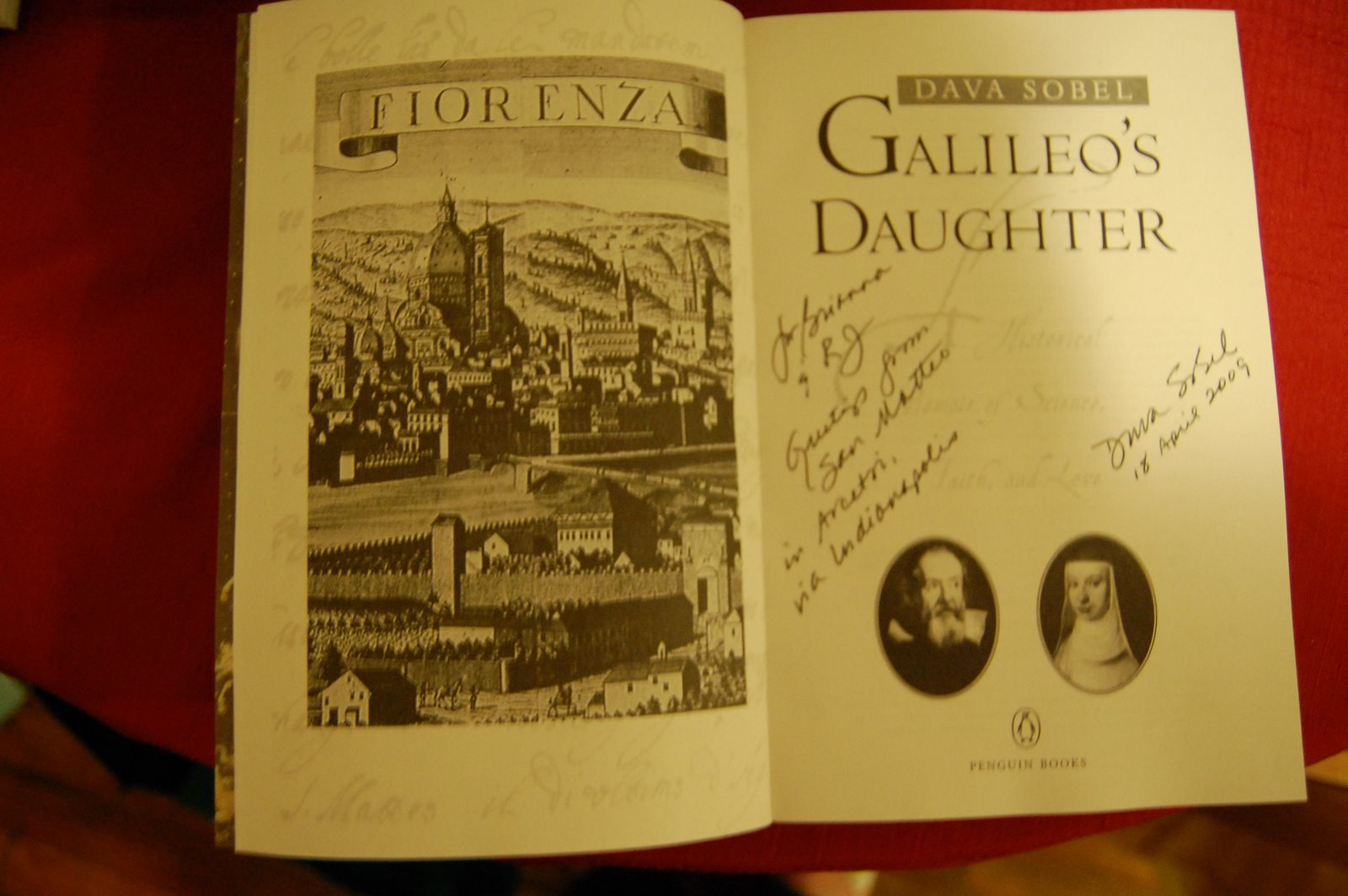
Galileo’s Daughter signed by Dava Sobel


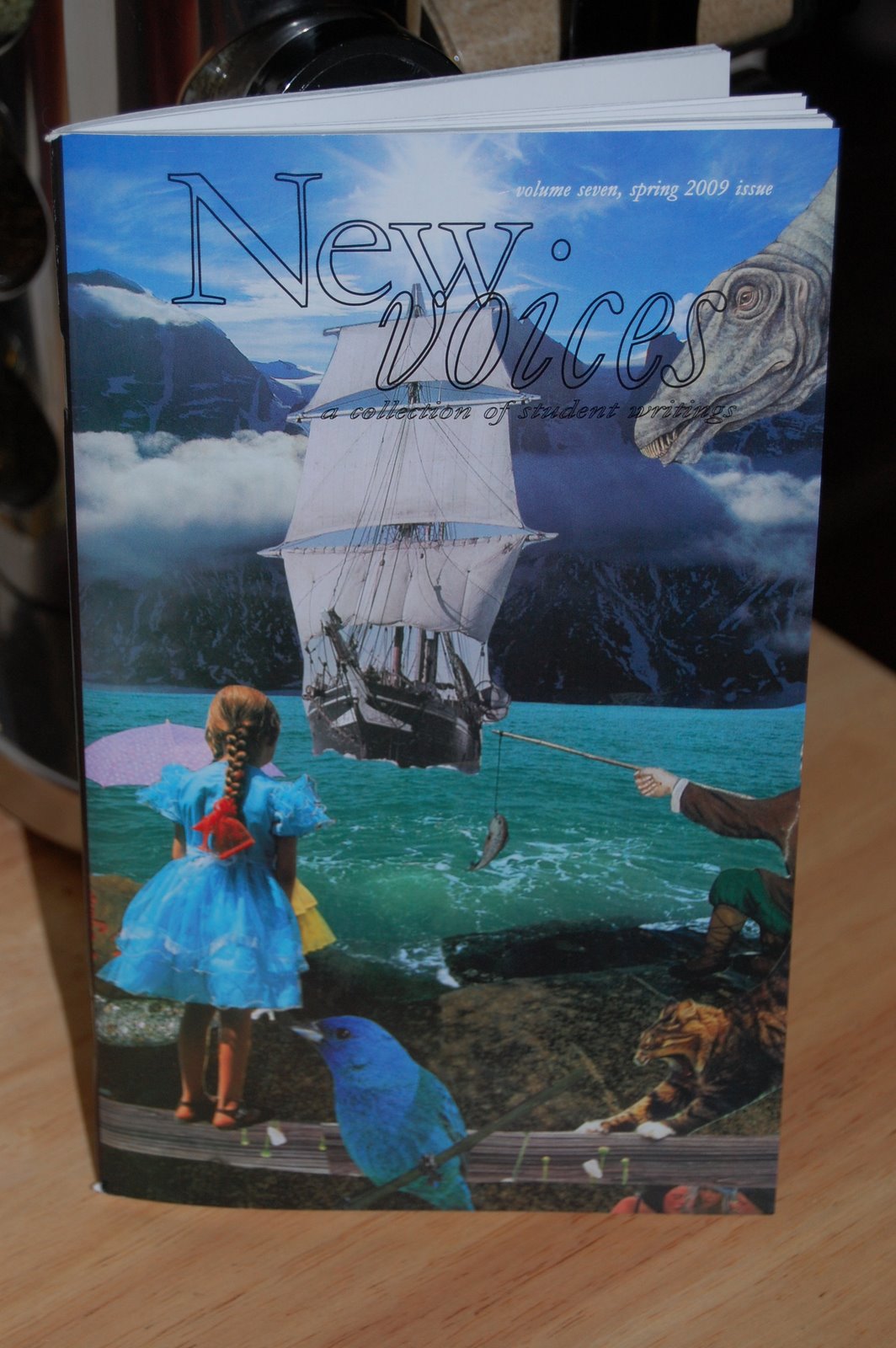
The 2009 issue of New Voices. This is the yearly literary magazine put out by my community college, and I helped copy edit the final proofs.


Illinoise by Sufjan Stevens. I bought it today at out local independent music store, Luna. Today celebrated independent music stores across the country.


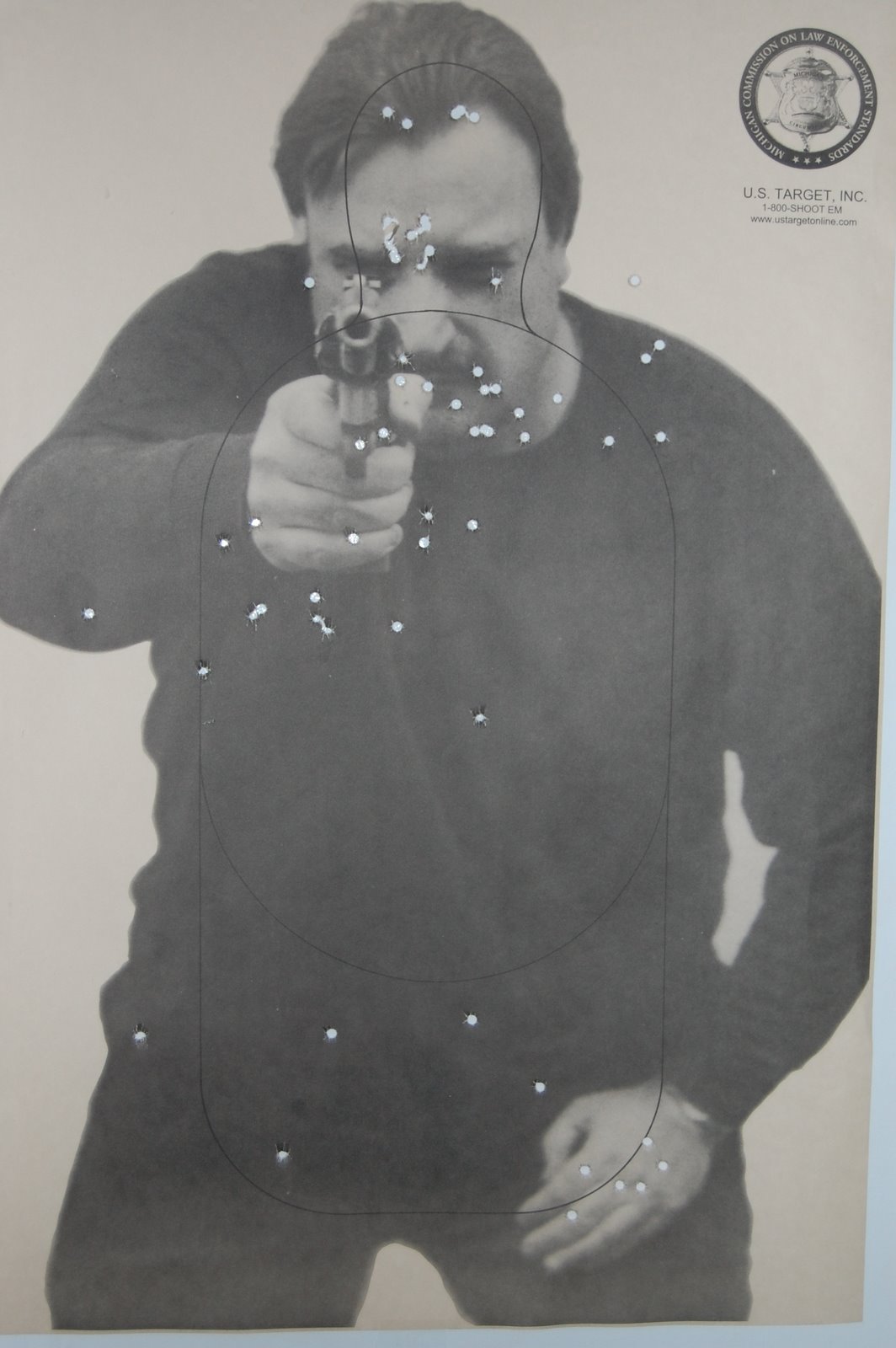
RJ’s birthday present. He went to Don’s Guns and shot a .37 magnum.
He gave me one of the shells.

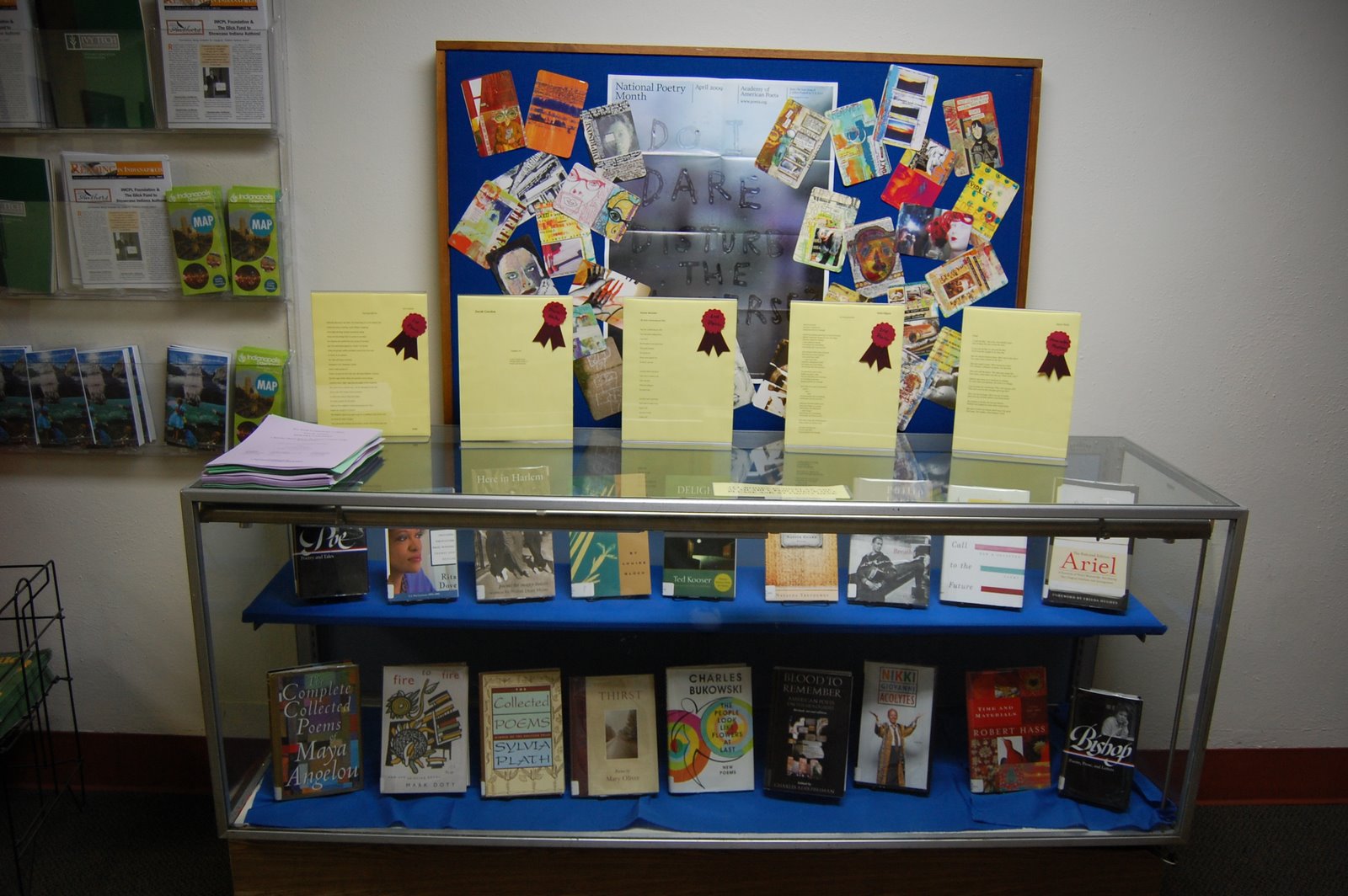
The winners of the 2009 Poetry Contest.

Saturday (Sobel, Sun, and Starbucks) Musings

My community college had the pleasure of hosting Dava Sobel, author of Galileo’s Daughter, Longitude, and The Planets this afternoon. RJ and I went to the reading and it was excellent. We also purchased a copy of Galileo’s Daughter (which I’ve been meaning to read) and had it signed. What I liked most about Sobel’s presentation, was that she incoporated several different poems into her talk. She also stressed the beauty and lyricism that Galileo and his daughter used in their correspondence. Below are some of the poems Sobel mentioned.

____________________________________________________________________
The Star Splitter

‘You know Orion always comes up sideways.
Throwing a leg up over our fence of mountains,
And rising on his hands, he looks in on me
Busy outdoors by lantern-light with something
I should have done by daylight, and indeed,

After the ground is frozen, I should have done
Before it froze, and a gust flings a handful
Of waste leaves at my smoky lantern chimney
To make fun of my way of doing things,
Or else fun of Orion’s having caught me.
Has a man, I should like to ask, no rights
These forces are obliged to pay respect to?’
So Brad McLaughlin mingled reckless talk
Of heavenly stars with hugger-mugger farming,
Till having failed at hugger-mugger farming
He burned his house down for the fire insurance

And spent the proceeds on a telescope
To satisfy a lifelong curiosity
About our place among the infinities.

‘What do you want with one of those blame things?’
I asked him well beforehand. ‘Don’t you get one!’

‘Don’t call it blamed; there isn’t anything
More blameless in the sense of being less

A weapon in our human fight,’ he said.
‘I’ll have one if I sell my farm to buy it.’
There where he moved the rocks to plow the ground
And plowed between the rocks he couldn’t move,

Few farms changed hands; so rather than spend years
Trying to sell his farm and then not selling,
He burned his house down for the fire insurance
And bought the telescope with what it came to.
He had been heard to say by several:

‘The best thing that we’re put here for’s to see;
The strongest thing that’s given us to see with’s
A telescope. Someone in every town
Seems to me owes it to the town to keep one.
In Littleton it might as well be me.’
After such loose talk it was no surprise
When he did what he did and burned his house down.

Mean laughter went about the town that day
To let him know we weren’t the least imposed on,
And he could wait—we’d see to him tomorrow.
But the first thing next morning we reflected
If one by one we counted people out
For the least sin, it wouldn’t take us long
To get so we had no one left to live with.
For to be social is to be forgiving.
Our thief, the one who does our stealing from us,
We don’t cut off from coming to church suppers,
But what we miss we go to him and ask for.
He promptly gives it back, that is if still

Uneaten, unworn out, or undisposed of.
It wouldn’t do to be too hard on Brad
About his telescope. Beyond the age
Of being given one for Christmas gift,
He had to take the best way he knew how
To find himself in one. Well, all we said was
He took a strange thing to be roguish over.
Some sympathy was wasted on the house,
A good old-timer dating back along;

But a house isn’t sentient; the house
Didn’t feel anything. And if it did,
Why not regard it as a sacrifice,
And an old-fashioned sacrifice by fire,
Instead of a new-fashioned one at auction?

Out of a house and so out of a farm
At one stroke (of a match), Brad had to turn

To earn a living on the Concord railroad,
As under-ticket-agent at a station
Where his job, when he wasn’t selling tickets,
Was setting out, up track and down, not plants
As on a farm, but planets, evening stars
That varied in their hue from red to green.

He got a good glass for six hundred dollars.
His new job gave him leisure for stargazing.
Often he bid me come and have a look
Up the brass barrel, velvet black inside,
At a star quaking in the other end.
I recollect a night of broken clouds
And underfoot snow melted down to ice,
And melting further in the wind to mud.

Bradford and I had out the telescope.
We spread our two legs as we spread its three,
Pointed our thoughts the way we pointed it,
And standing at our leisure till the day broke,
Said some of the best things we ever said.
That telescope was christened the Star-Splitt
er,
Because it didn’t do a thing but split
A star in two or three, the way you split
A globule of quicksilver in your hand
With one stroke of your finger in the middle.
It’s a star-splitter if there ever was one,
And ought to do some good if splitting stars
‘Sa thing to be compared with splitting wood.

We’ve looked and looked, but after all where are we?
Do we know any better where we are,

And how it stands between the night tonight
And a man with a smoky lantern chimney?
How different from the way it ever stood?

Robert Frost


The Flight of Apollo

Earth was my home, but even there I was a stranger.
This mineral crust. I walk like a swimmer. What titanic bombardments in
those old astral wars! I know what I know: I shall never escape from
strangeness or complete my journey. Think of me as nostalgic, afraid,
exalted. I am your man on the moon, a speck of megalomania, restless
for the leap toward island universes pulsing beyond where the
constellations set. Infinite space overwhelms the human heart, but in
the middle of nowhere life inexorably calls to
life. Forward my mail to
Mars. What news from the Great Spiral Nebula in Andromeda and the
Magellanic Clouds?
2
I was a stranger on earth.
Stepping on the moon, I begin
the gay pilgrimage to new
Jerusalems
in foreign galaxies.
Heat. Cold. Craters of silence.
The Sea of Tranquility
rolling on the shores of entropy.
And, beyond,
the intelligence of the stars.
Stanley Kunitz
*She also included “We Are Listening” by Diane Ackerman. Unfortunately, I cannot find a decent copy on the web, but I’ll continue to look.


Friday (Writing, Reading, and New Shoes) Musings

I spent most of today reading and writing. I finished Dana Levin’s Wedding (comments to come later), read half of the Translation issue of Poetry, and started leafing through Kim Addonizio’s Ordinary Genius. I also wrote a poem and started on two others. It was a good day.

I picked up Ordinary Genius at AWP, where Addonizio seemed to be all over the place. In retrospect I think I may have seen her in the elevator. I’ve read a smattering of her poems online and in different journals. Her poems have grit and I like how she uses pop culture references. I was also given a cd of hers when I bought the book, and it’s pretty interesting. Anyway. I’m always looking for writing exercises, because unlike some poets, I don’t always sit down with a clear idea of what I want to write about. Also, I’m a teacher, so writing exercises are invaluable to my students. In the first part of the book, Addonizio gives solid, and familiar advice to first time writers. She mentions keeping a “book” (journal) and making time to write and how comittment is vital. She’s absolutely right, so it makes sense that I felt like I was being reprimanded while reading her words. I need to get back to what I was doing a few months ago, which was setting aside half an hour each day to write something. It didn’t matter if the poem failed or was complete crap. I just needed to keep the gears grinding. So beginning this week, I’m getting right back to it.
____________________________________________________________________
This is one of the translated poems (Dutch in this case) from the April issue of Poetry that I really liked:

Last Night

Saved two children last night.
They lay under thin black ice
one gone blue, the other grey.
I laid them out on grass
that snapped under my step
wrung their bodies warm and dry
gave them the gust of my breath.

Then I looked out at the morning
that lay lukewarm on the water
put on a tank top
arranged some grasses in a vase
fished two children out of sleep.
Hester Knibbe