BLOG POSTS

The Process of Withdrawing Poems

Over the past year or so, I’ve had the good fortune of placing several poems in several different publications, which has left me in the position of withdrawing said poems from journals. I have engaged in simultaneous submissions ever since I started sending out work several years ago. With the advent of software like submittable, this process is far more streamlined and efficient than it used to be, and for the most part I’m able to sit down for half hour or so and notify all the necessary journals of my wish to withdraw a poem.

But…

I’ve noticed over the past six months to a year that it is not always as easy to withdraw a poem as it should be, so what follows is a genuine plea to all small literary journals, because I love you and want to support you all day everyday, please be as clear in your guidelines to withdraw as you are in your guidelines to submit. What follows is a short list of easy improvements that could make the process of withdrawing a poem(s) easy as pie:

1. Allow notes in Submittable. I like submittable. I use it all the time and the longer I submit work, the more I notice journals switching over to their software. However, if as a journal or press you allow submissions through Submittable, then take the next step and allow notes so that if a poet submits five poems and only wants to withdraw one, they can just add a note to their submission file.

2. Clear contact information. If a journal does not use the note feature in submittable, then the next step I take as poet is to check out their website to see who I need to email regarding my submission. If you have a paragraph in your submission guidelines that outlines the process an author should take to withdraw a piece, then you should have a link to the email/contact in that paragraph. It is frustrating to read a sentence that states “Simultaneous submissions are encouraged but let us know immediately if your work is accepted elsewhere,” and then have to scour the website for five minutes trying to find that person to contact.

3. Please consider allowing us to withdraw one poem/story instead of the entire packet. I understand from an administrative point of view, it might just be easier to withdraw and entire packet, take out the accepted poem, and then upload the updated packet (although as I type that out, I’m not convinced) but I’ll be honest, the only desire this inspires in me is to just withdraw the entire packet and be done with it.

To be clear, I love literary journals. I appreciate all the hard work that goes in to reading submissions and designing a journal (print and/or online). I want to keep sending my work to as many places as possible, but in the event that someone snags it first, the easier it is to notify other journals, the better.

Discussing writing and werewolves at Ivy Tech

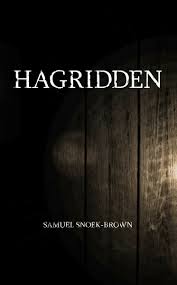
My good friend and talented writer, Sam Snoek-Brown came to visit my classes yesterday and later gave a reading from his debut novel, Hagridden. Thanks, Sam!

Samuel Snoek-Brown's avatarSamuel Snoek-Brown

Today I had the great privilege to visit not one but two creative writing classes taught by my grad school friend, the wonderful poet Brianna Pike. I’ve always loved Bri’s approach to teaching writing as much as I love her poetry (and folks, she’s a hell of a poet!), so I knew I was in for a good time. But what neither of us realized — because Bri had set her syllabus up several weeks ago, and long before we’d finalized my visit — was how easily I slotted into her lessons today.

The classes were addressing setting. Hagridden is heavily dependent on setting, and setting is a subject I’ve written on before. Bri also mentioned the importance of research, including interviews with locals and actual boots-on-the-ground field research, to get a setting right. And, of course, I’ve done all that too. But then it gets weird: the story…

View original post 220 more words

Hagridden

Several months ago I wrote a post about Natalie Giarratano’s debut poetry collection, Leaving Clean. Natalie and I attended the University of North Texas together where we were both working on a Masters Degree. Today, I have the pleasure of writing about another talented writer and friend from my days in Denton, Sam Snoek-Brown.

Sam’s debut novel, Hagridden, came out this summer and I just finished it last weekend. It is a gritty, gripping tale of two women attempting to survive in the Louisiana bayou at the end of the Civil War. There is much to admire in this novel, but what brought me into the story immediately was the characterization of the two women. As is probably true of most women who are avid readers and writers themselves, I am hungry for strong, complex depictions of women in fiction and this novel does not disappoint. From the opening scene where these two protagonists work together to dispatch some soldiers who are unlucky enough to come across them in the swamp, I am awed, intrigued and terrified.

Survival is the primary focus of these two women at the start but as outside forces begin to intrude on the small world they’ve carved out for themselves, that idea of survival begins to shift. It is the dynamic between these two women combined with this theme of survival that creates a series of powerful and damaging conflicts throughout the novel. These two women are carefully sculpted and their motivations are complex. As the younger woman begins to pull away from her older companioimagesn, I felt both triumph in her attempt to move beyond mere survival but also pangs of sympathy for the older mother who has lost her child, her husband, her companion and soon, her mind. It is not difficult to see why holding onto the younger woman is important, but in a starkly vulnerable moment when she rocks her daughter-in-law like a child, we see just how deep her desperation goes.

Once of my favorite passages in the novel is when the older woman is wounded and the description that follows:

The woman woke in the morning with her cheek bright red and a yellow stain like spilled iodine seeping down the skin of her neck from under the blood-crusted rag.

The woman’s neck cords strained like a banjo wire and she bared her gritted teeth as she peeled at the rag, little tears in the scabbing and the rag alike, and when it came away it left fine hairs of cotton stuck in the wound and the two inch cleft seeped a blood gooey and black like tar. (43) 

I’ve never been to the Louisiana bayou but I imagine it to be much like the language that fills the pages of Hagridden, dark, deep and dense.

Hagridden is book grounded in history and myth and the women of the novel spend much of their time examining both through a variety of different lenses. The world they live in is born of violence, but there are also moments of humanity that remind the reader that these characters are indeed human beings who are capable of compassion, and even more importantly, love.

Order your copy of Hagridden here.

21st Century Man, poem by Brianna Pike (Celebrity Free Verse Poetry Series)

I discovered this blog and press through social media and I’ve been reading these poems all month. It’s a really brilliant project and I like the idea of a “found poem.” Anyway. Here’s my take (posted today) featuring the words of Mr. Tom Hiddleston.

silverbirchpress's avatarSilver Birch Press

tom_hiddleston
21st Century Man
by Brianna Pike

Do I like being famous?
It’s sort of inconsequential.
I fear I’m initially quite private.
To be honest about my boundaries
encourages intimacy and intimacy
is really where it’s at. You don’t
get there if you’re pretending to be
anyone else. Why would you do that?

To answer the question: Is it enough?

SOURCE: “Tom Hiddleston: A god Among men?” Elle UK (March 2014).

NOTE FROM THE AUTHOR: A particular area of interest for me as a poet is the push and pull of the private vs. the public self. I think this is especially interesting when it comes to actors because they are constantly stepping into different lives as the characters they inhabit and then they must take those lives into the public sphere. To me, the underlying current in this interview with Tom Hiddleston is the tension of finding balance while living…

View original post 57 more words

Absent Voices: The Responsibility of the Poet

It is not uncommon for people to use social media as a call to arms, especially when looking for a forum that will reach a large amount of people in a short time with little effort. We’ve seen this with the ice bucket challenge as it floods (pun intended) Facebook. In the wake of Ferguson, both my Facebook and Twitter feeds were full of articles, blogs and updates. As is also the case with social media, it is difficult to read and process every piece of information that shows up on each platform, but there was one tweet in a sea of language that caught my eye. I don’t remember who posted it and I don’t remember exactly what the phrasing entailed, but to paraphrase, the author was basically asking, in light of Ferguson and the death of Michael Brown, “Where the hell are the poets? Why are they not speaking out?”

This isn’t a new question and I’m not the first to think/blog/address the question either. I can’t speak for all the poets but I can speak for myself and I have a couple of thoughts.

In an age where we can log into our computers and phones and let people know what we ate for breakfast, how long we were at the gym and how long our commute takes, it seems ridiculous, insulting that we cannot use the same platforms to express how we feel about the events that take place in our society. But this access to constant “updates” and “input” also infuses us with an expectation of immediate reaction. We want to hear what you think right now. Now. Now. Now.

At the time that I read the initial tweet, calling out the poets, I thought well, I have seen some poets speak out on Twitter and FB but had yet to see a poem in response. A physical, tangible artifact written to record all of the feelings that the country was feeling at the time. In the weeks since, I’ve come across a few specific poetic responses (I’m sure there are others): “not an elegy for Mike Brown” by Danez Smith & this young poet’s response

To be clear, I don’t have a problem with question of “Where the hell are the poets?” I think it’s a good question. I feel that poets main responsibility in their writing is to record the world and in that recording to transcribe it, transform it into something new. I believe it is a poet’s responsibility to give voice to the compassion and rage and fear and joy all of the feelings that fall somewhere in between. It is a poet’s responsibility to provide a voice for the voiceless. There is something about hearing language that is far more visceral and tangible than just reading an account online.

However, as is evident by the poetry that has begun to weave its way through cyberspace in the past few weeks, I think the question has been answered: The poets are here. They are listening. They are speaking. They are writing.

Leaving Clean

When I decided to attend graduate school at the University of North Texas in the fall of 2003, I don’t think I really anticipated how challenging the entire experience was going to be. I didn’t know anything about Texas. I also didn’t know anyone in Texas. In retrospect, it’s kind of amazing that I talked myself into going at all. However, I was lucky in many ways while I was at UNT but I think I was most lucky in all the amazing writers I met and became friends with through classes and workshops.

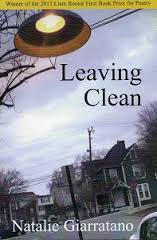
One of my dear friends from those days in Denton, Natalie Giarratano, is the winner of the 2013 Liam Rector First Book Prize for her debut collection Leaving Clean.

Leaving Clean is filled with thick, grit that is both beautiful and haunting. At times, the poems stand up, address the audience candidly, almost daring the reader to continue through a less than hospitable landscape. Other times the poems are quieter, asking you to lean in and listen carefully. These are poems that you return to and that you linger over long after you’ve closed the book.

One of my favorite poems, “Trophy: Photo of a Dead Boy” comes near the end of the first section in the collection. The opening of the poem immediately grounds the reader in the real world, but there is something unsettling just beneath all those concise details: “I was thirteen when I saw your photograph/in my uncle’s study: he told me/you should have been mounted on the wall,/his taxidermist’s masterpiece.” As the poem unravels, the images build and the feeling of unease intensifies to the point where I want to break away from the poem. Away from the photograph. But I can’t. And I’m glad that I don’t when I reach the ending lines “You look strangely fierce with eyes open/staring through my wholeness.”

Leaving Clean is fuimgresll of poems that pull the reader in close, force an intimacy is both uncomfortable and revelatory at the same time. “Armenia at the Dinner Table” is an example of this intimate lens as we find a woman whose hair “had it not been knotted up on her/square head to work the grid of farmland” and “…Her face/is just lazy from the sun and soy beans/ and eight babies, a few who couldn’t outlive her.”

I could keep going about all there is to admire in this collection. I’ve read it a half dozen times and every time I return to it, I find something new to think about. I’m proud to know Natalie and beyond excited that her collection is out in world for people to read and appreciate. I can’t wait to share her poems with my students and I encourage you to go out and buy Leaving Clean. There’s a rumor going around that Natalie will even sign it for you if you.

Every Kiss A War

When you’re a poet sending out work into the universe, it can seem like the literary world is very, very large. But then something happens that reminds you that indeed it is a small world. A small world full of generous, talented writers.

A few weeks ago I was online researching some places to send my poems and I came across Mojave River Press & Review. I was impressed with their site and decided to send some poems. Around the same time I discovered Mojave online, my friend and author, Sam Snoek-Brown put a post up on Facebook about a collection of short stories called Every Kiss A War by Leesa Cross-Smith. Who published Every Kiss A War? Mojave River Press. About two days later, I’m back online and I notice some people I follow on Twitter talking about Whiskey Paper. Whiskey Paper is an online publication that publishes flash fiction. Who runs Whiskey Paper? Leesa Cross-Smith.

At this point, this whole thing is starting to sound like six degrees of Kevin Bacon. So what’s the point?

I took all of this as a sign and ordered Every Kiss A War and man, am I glad I did.
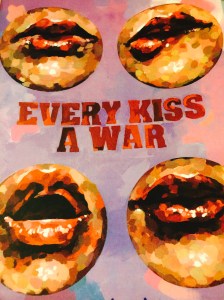
photo-1Every Kiss A War is a collection of twenty-seven stories that focus primarily on relationships and how they are constantly evolving. The characters are flawed and beautiful and I was in love with each and every one of them, even the ones I didn’t like very much. These are real men and women who live in the real world made up of cowboy boots, red lipstick, and wine in mason jars. The details are so thick and vivid, that each story makes me feel like I’m standing inside a bright, colorful painting and I could reach out and touch the brushstrokes. Reading these stories is a visceral experience.

Some of my favorite pieces of fiction contain characters that are layered and with each action, the author peels back another layer, so that my impression of the character changes in a paragraph or even a few sentences. This transformation keeps me on my toes as a reader, especially when it happens in a short story because it happens so quickly. My favorite example of this in Every Kiss A War, occurs in the story “Hem.”

At first, the speaker, Mitchell, struck me as just a sad, pathetic guy who was hung up on his ex-girlfriend. The fact that he sat outside her apartment, waiting for her light to go out, pushed the creep factor up considerably. But when his ex, Bethany, shows up at the bar where he’s playing a gig and proceeds to tell him “You’re right. Like he is a fucking really great dress. And you weren’t for me. You were like…a hem of a really great dress.” Well, I’m not ashamed to say that in that moment, I paused and whispered “bitch” under my breath.

Mitchell, I’m all yours.

It also occurs to me that later, when Mitchell and Merit, his friend from work, are in his house, arranging his books by color, and he confides “…Bethany told me I was the hem of a dress and not the whole dress last night. And that shit can crush a person, y’know?” that like, Mitchell, I am near tears. And by the end, when Merit takes his hand, and Mitchell tells her “she’s more beautiful than the mountains…” I’m a mess.

Every Kiss A War is full of lines that I admire not only as a lover of fiction, but also as a poet. A few examples:

From “What the Fireworks Are For,” “How sometimes your body couldn’t tell the difference between not loving someone enough and loving someone too much.”

From “Like Light,” “And tonight you feel small. You feel okay but you feel like nothing. Like you could float away. Like glitter or ash. Like light.”

And from the title story, “…Sometimes we take bloody knives, carve our initials into thick, tall trees that haven’t been planted yet. His heart is a heavy, loaded gun he hands over to me, lets me spin on my finger. Wait don’t shoot. The overgrown garden of what we don’t say, fecund in our hothouse mouths. Every kiss a war.”

I have a habit of writing down lines or sections of stories I like. The best way I can describe how beautiful this collection is is to say that after the third story, I stopped copying down lines because a). my hand hurt and b). it was slowing me down in my reading.

You can and should purchase Every Kiss A War here.
So I’m Planning A Chapbook

I have this group of poems that I wrote during my pursuit of my MA and then my MFA that I’ve been sending out religiously for the past few years. This past fall/spring must have been my time because after many polite and encouraging rejection letters, I finally managed to find many of these poems homes in a series of lovely journals. This gave me a boost of confidence but it also got me thinking about what to do next (beside write more poems, duh). This group of poems totals between 20-25 and comes to about 20-25 pages. This isn’t enough for a full length book but I feel the weight of having this finished work and wanting to get it out there into the world, so I’m thinking it’s time for a chapbook.

I’ve researched chapbooks and I think it is a good fit for this particular group of poems for the following reasons:

1. The length is right in line with what most contests/publishers are looking for

2. This group of poems definitely has a theme running through it

3. From what I understand, you can publish poems in a chapbook and then if later you want to include these poems in larger piece of work (a book) that’s fine.*

4. There are some really excellent publishers/contests for chapbooks out there in the world

*If this isn’t true, please let me know. I can’t find anything that says otherwise, but I could be wrong.

So I’ve begun working on this manuscript and researching possible places to send it. There are some absolutely gorgeous chapbooks out in the world, and it makes me excited for the possibilities.

Reading Recommendations

I read a lot during the academic year. I read the assigned reading my creative writing and world lit classes read. I read essays, poems, short stories and plays that my students write. I read and comment and read and comment and read and comment some more. This is all to say that I don’t read much outside of my classes during the months of September through April. I do read individual poems that pop in my inbox or online and I may read a handful of short stories. If I’m really lucky, I may get in a novel or two over winter and/or spring break, but that’s about it. Most of the brain I have left after reading and commenting, I try to reserve for writing and revising my poems. Sometimes there isn’t much brain even for that task.

But guess what? It’s summer!

photo (2)

This means that I’ve been reading voraciously for the past few weeks and it’s like a breath of fresh air. While I am teaching summer school, it doesn’t start until June 9th and my summer classes are usually much smaller, which means the whole reading and commenting machine is far less consuming.

So what have I been reading?


A Life in Men by Gina Frangello

This is a brilliant book. I was hooked after the first chapter and by page 50 I was saying things like this to my husband, “You will not believe what has happened in this book! And I’m only on page 50!” Then I would proceed to outline the entire plot thus far complete with color commentary from yours truly. His reaction was underwhelming, but you should read this book. From the opening:

Pretend I’m not already dead. That isn’t important anyway. It’s just that, from here, I can see everything. There we are, see? Or should I say, There they are? Two girls sitting at a cafe off Taxi Square, eating anchovies lined up in a small puddle of oil on a white plate.

I’m on page 245 and I’m completely enraptured with the characters.


 Tree Language by Marion McCready

I blogged about Marion McCready’s poems in an earlier post. I’ve been waiting for her book, Tree Language, since I read her poems in Poetry. This collection is beautifully lyric but also brooding and dark. I like poems that reimagine what we may typically see as beautiful and transfer those objects into something sinister. One of my favorite poems in the book, “Daffodil horns”, accomplishes this task:

star-splayed

mouths from the yellow bellies

of starfish   flat and helpless

mouths   unshuttable though mute

unstoppable   culled from our garden

these lampshade-and-bulb trespasses

periscope from the bottom of a foreign vase

though we listen   we do not hear

though we see     we do not understand

and the daffodils    they spread like cancer


Motherland Fatherland Homosexuals by Patricia Lockwood

I found Patricia Lockwood’s blog several years ago when I was working on a blog project for my MFA. This was before her first book and well before the publication of her poems in Poetry and The New Yorker. She’s blown up on the literary scene as of late with profiles in prestigious magazines and I believe someone called her “Poet laureate of the twitterverse.” I think it’s excellent. I liked her when I first stumbled across her blog and I like her now in her most recent poetry collection. Admittedly, Lockwood probably isn’t everyone’s cup of tea, but that’s probably just because she makes people feel stupid. She’s brilliant. She’s shocking. She pushes her audience. Hard. And isn’t that one of the reasons to read poetry? My favorite poem in this book is “List of Cross Dressing Soldiers:”

Someone thought long and hard how to best/make my brother blend into the sand. He came/back and he was heaped up himself like a dune,/he was twice the size of me, his sight glittered/deeper in the family head, he hid among himself,/and slid, and stormed, and looked the same as the next one, and was hot gold and some-/where else. 

photo 2


The Way Out by Lisa Sewell

I just started this collection and have not finished reading it yet, but the poems wound me. They’re carefully rendered in their composition and at the same time they are so raw in emotion. The opening poem, “Chorale,” I read three times:


Clearly I’m the volitional subject and though not violent

I am haunted. The lost, the never felts and unhinged voices

sing through me these insomniac nights of my own exile,


not theirs, like streaks that bank the rocks

and dirt slopes of disappointment. I thought was day

and every continuous week free, meant precious,


worth guarding. I’ve imagined their sleep, weight

on mattresses in rooms that don’t’ exist and who would protect,

who aid and abet them—but never the texture of their hair


or skin, eye color, limb. Their songs, like chalk

along asphalt, mark the boundaries of inclusion, the games

I won’t play, redrawing the line I stepped over one morning


one July. Blame the selfish gene, the animal planet

I was born to, the twist in my nature that stilled

each voice, and kept them in check, coveted, leashed,


a muffled chorus that accompanies me

along these bland vistas. Imagine, If I had freed

just one and let it carry across the water or alight


among the hawthorn’s strict branches. Imagine gestation

an then I’m someone’s mother, loved, hated or ignored.

If I have been mistaken, giving up life and more life


to safeguard mine, this humming din,

this ghost song of my own and another’s making

must be the all I have left.


In writing this post, I’m aware that all of these authors are female, which I didn’t plan but so it goes. I would encourage everyone to check out all four of these writers. They’re all very different from one another in style and subject but they’re also very talented and they offer up a unique view of the world, which is what good writing should attempt to do.


A Writer’s Workspace: Where Do You Work?

There’s a recent trend in the literary blogosphere toward examining the workspace of writers. I wrote this piece in response to a project CutBank started on their blog called “The Woodshop.”  I submitted but no dice, so I thought I’d post it here. Take a look at the other workspaces on CutBank’s site. Interesting stuff.

Where do you do your work?

I work in the large closet of my guest bedroom. It has a sloped ceiling, white walls, and bare wood floors painted black. All the paint in the room is chipped. The previous owners used this closet as a play area for their two young daughters, so there are remnants of wax crayon on the walls. They also installed a large piece of particleboard that shelved toys and a small TV. This board now serves as my desk.

What do you keep on your desk?

A framed photograph of Elizabeth Bishop sits on my desk. She is my touchstone, and I often pull out her collected works when I am stuck on a poem. I also have an apothecary jar full of “found” objects. My husband calls it my “curiosity jar” and its contents are comprised of seedpods, various bird feathers, stones, leaves and a sun-bleached jaw bone of some unidentified animal found discarded by the side of the road. There is a wireless printer, a ceramic vase full of gel pens and Black Warrior pencils, and often a glass jar full of whatever flowers I’ve collected from my garden. Right now? Zinnias.

What’s your view like?

Directly above my desk, I see nothing but an empty, white, sloping wall. However, to the right there is a small latched window and while I work, I keep that window open, no matter the season. I like the fresh air.

What do you eat/drink while working?

I prefer hot drinks while writing. Even in summer, there is hot tea or coffee in my cup. If it is tea, it always something fruity: lemon, peach, pomegranate or blueberry. I steep the tea bag for several minutes watching the water turn pink, green or deep purple. If it is coffee, it is brewed from my favorite beans from the local food co-op.

Do you have any superstitions about your writing?

I always write out my first drafts by hand. I like the physical motion of writing. There is something familiar and comforting in the action. I am also slightly wary of technology.

Share a recent line/sentence written in this space.

In a letter I wrote to Virginia Woolf after re-reading A Room of One’s Own: “Love even in despair. You taught me that.”