


This summer two wrens built a nest in a bright orange begonia that I hung out on my front porch. I spend a lot of time out on my porch during the summer months, especially in the morning. I like to go out first thing, with my cup of coffee and my laptop and write or grade or watch my neighborhood wake up.
I have a great fondness for birds. Anyone who knows me, knows this love to be deep and true. I write about birds. I collect feathers. I own clothing printed with birds/feathers. I grew up with my grandmother and grandfather pulling me towards windows or sliding glass doors, whispering blue jay, cardinal, sparrow & chickadee. Winters my mother trudged through deep drifts of lake effect snow and filled her feeders with black oil sunflower seeds. She’d come inside, cheeks red from cold and exertion, and immediately curse the fox squirrels who hung precariously from her window feeds, gorging themselves on seeds that speckled the snow below.
This week, as always, The Academy of American Poets shared a bunch of wonderful poems as part of their poem-a-day project. Among this recent batch, “Fledgling” by Traci Brimhall:
…You take down the hanging basketand show it to our son—a nest, secret as a heart,throbbing between flowers. Look, but don’t touch,you instruct our son who has already begunto reach for the black globes of a new bird’s eyes,wanting to touch the world.
Read the rest of “Fledgling” here.
This reminded me of my own poem, also titled “Fledgling,” that I wrote the summer my son was born. I drafted the poem while sitting on my couch in my living room, staring out the large window that looks out onto my front porch. I spent much of the first weeks of my son’s life sitting on the couch, holding this tiny baby (who came three weeks early), wrapped in a fuzzy blanket against the chill of the air conditioning. I knew it was white hot summer outside my window, but I couldn’t feel the warmth. One day, while the baby dozed, I caught a tumble of brown feathers our of the corner of my eye: a baby wren. I watched him teeter on the ledge of my porch, eating worms his mother swooped into his gaping throat. He sat on that ledge for quite awhile before he finally gathered the courage to follow his mother, half falling, half flying out of sight. I sat staring for a few minutes after he’d gone and then I shifted my sleeping baby, picked up a pen and my journal and started to write.

That poem is the only poem I wrote that first summer as a mother. It came quickly and underwent minimal revision before I sent if off into the world. I remember when I got the acceptance from New Madrid I was so happy because, for me, it proved that yes, I could do this. I could keep my poetry and be a mother. Intellectually, I’d known this to be possible, but when you’re in the weeds of no sleep and bottles and crying and diapers and formula, it’s hard to be rational. It’s hard not to be one raw, gaping wound.
It hardly seems possible that it was two years ago (my son turned two this past May) that I sat on my couch, exhausted and freezing, watching a fledgling waiting for his mother to show him how to fly.


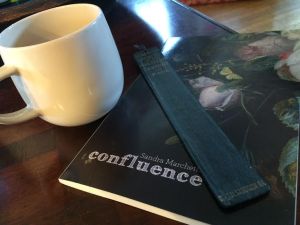 oems that take on domestic tasks like washing the dishes or eating lunch or walking through a room are some of my favorites in the collection because while they are interesting and lyrical and new in language and line, they are also subjects that I relate to and write about. In other words, reading this book was like finding my tribe. It’s similar to how I felt when I read Elizabeth Bishop for the first time. Incidentally, the epigraph for Confluence is from Bishop’s “At the Fishhouses.”
 t limited, but when I read poetry collections I often wonder if there are poems I could share with my students and these are poems they would love to read.
 Brianna Pike