Happy New Year!

The past few weeks I’ve been trekking around the northeast visiting family and friends for the holidays. It was fun but exhausting and I’m glad to be home. 

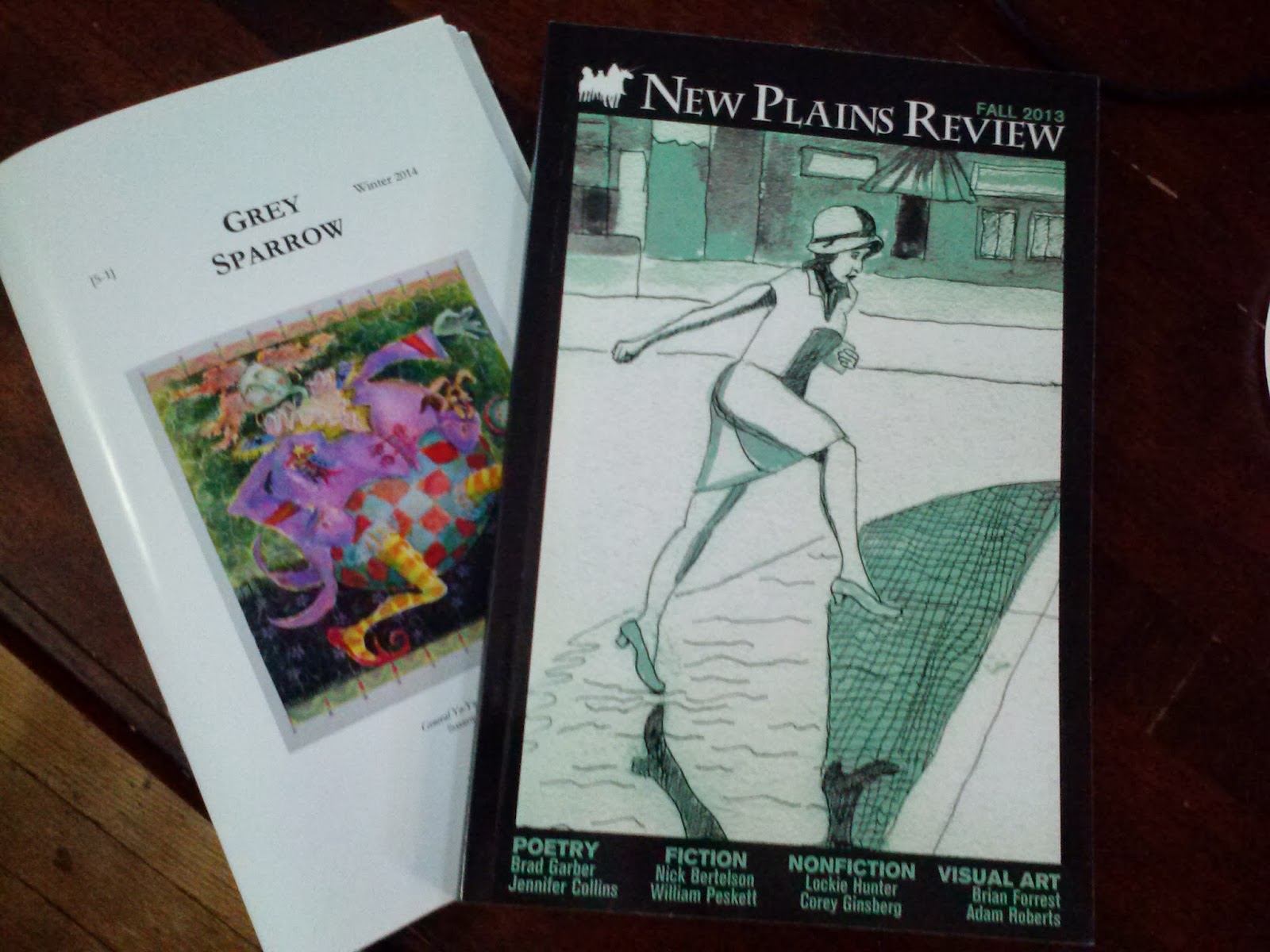
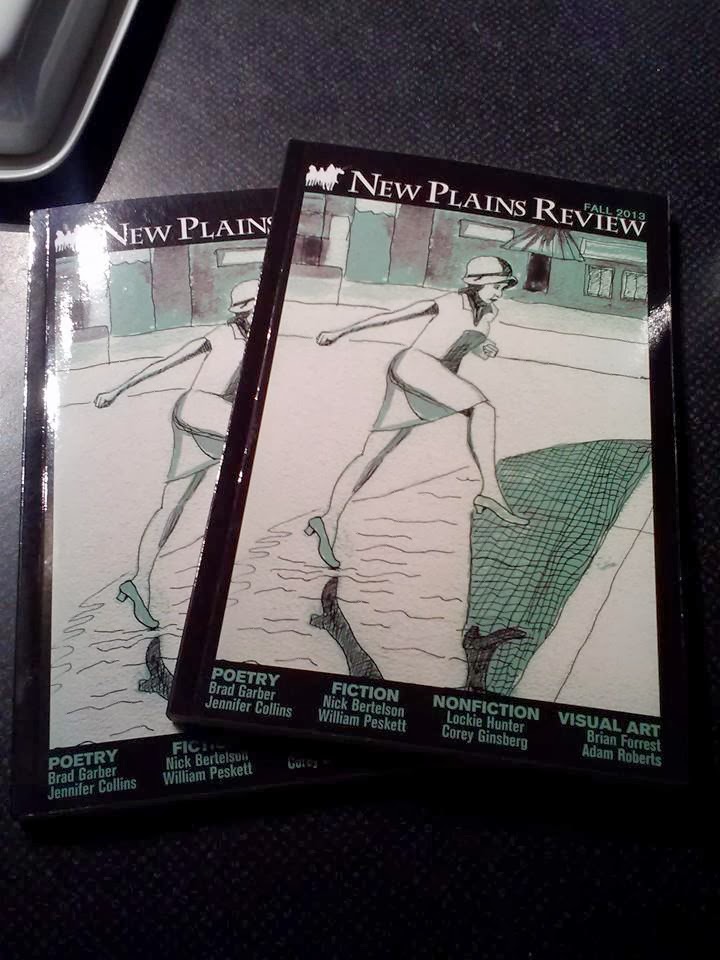
When I returned home I discovered that my two contributor copies of the New Plains Review arrived in the mail. My poem “Starling” appears in this issue and I’m thankful to be included in such a solid publication with so many great writers. 
2013 was a beautiful year and I’m grateful for all peaks and valleys and everything in between. 
It’s all I have to bring today

It’s all I have to bring today–
This, and my heart beside–
This, and my heart, and all the fields–
And all the meadows wide–
Be sure you count–should I forget
Some one the sum could tell–
This, and my heart, and all the Bees
Which in the Clover dwell.

~Emily Dickinson*

*Courtesy of The Academy of American Poets 


A Few Notes From Weeks Gone By

I learned this past week that two more of my poems, “Crossing Ompompanoosuc” & “The Pond” were accepted for publication by The Meadow for the 2014 summer edition.

The end of the semester is approaching quickly and crunch time is officially here. I have some posts marinating in my head, but have not had time to get them out into the blogosphere. Soon I’ll be back to a regular schedule.
In the meantime, my family is arriving from Pennsylvania and I am cooking Thanksgiving dinner.
Enjoy!

Pittsburgh: Poetry & Place

During a meeting of our student creative writing group today, I had the pleasure of rediscovering this poem:

Pittsburgh

Pittsburgh is a fat lady jabbering at the bus stop.
She mistakes me for someone who gives a damn,
For a native son of her gray industrial breast.
She blesses her Bucs, her Steelers,
Her father, God rest his soul, was a Hornets fan.
She mistakes me for someone who gives a damn,
Her blue scarf twisting like the broad
Monongahela,
Her blue face lined like a jitney’s street map.
I’d tell her I’m not from this place:
These severed tired neighborhoods,
These ruthless winter tantrums,
But her long winded stories numb me.
She is persistent as snow, as boot slush &
Thinsulate,
As buses rumbling like giant metallic caterpillars .
She lights a Marlboro and it means
Spring will burn quick and furious as a match,
Summer will blaze.
When she tells me No one is a stranger in
Pittsburgh,
do I believe her,
My frosty fairy foster-Mamma,
My stout rambling metaphor?

~Terrance Hayes

This poem was given out to the group by my colleague and fellow advisor, Emily Watson. The theme of her exercise was the idea of place and how it could work in creative writing. She encouraged the group to write either replacement poems or just to write about places they knew or had strong connections to. She also included “A Primer” by Bob Hicok and Three Yards by Michael Dorris. It was a really great exercise and I think I’m going to steal it to use later in my creative writing class.

I love “Pittsburgh” because I’ve spent a lot of time in that city and I think the poem captures the complexity of the place. My husband’s hometown, I admittedly had complicated feelings about it. It’s impossible to drive in. On certain days, in a certain light it still looks like a steel town. A bit dingy. A bit dirty. The houses are carved out of the hillsides and look like the might fall into the river at any minute. At the same time, the grace of the bridges arching over the water of the rivers and the view of the city from the top of Mt. Washington are beautiful. You can’t beat a sandwich from Primanti Brothers and I like the hills.

My biggest personal struggle with Pittsburgh is something I think Hayes touches on his poem: the feeling of being an outsider. Pittsburgh is a big city but the people who live there are deeply loyal and that loyalty binds them. There is always a sense of displacement when you find yourself in a new place, but some places are easier to break into than others. I recognize I may be projecting a bit onto the poem considering that sometimes when I think about my early encounters with the city, my chest still tightens. I also recognize that some of the trouble I have with Pittsburgh is that gut deep loyalty to a place is somewhat alien to me. I didn’t grow up in the same place and I have several different houses that I associate with my childhood. I think it’s important to get out and live in other places. You never know what’s out there until you leave and it’s not like your hometown is going anywhere. This is a direct result of the way I was raised because my parents left their hometowns and never went back.

I have tried writing about Pittsburgh several times, but each time ends in frustration. I think it is because I’m trying to balance past and present feelings, which is tricky. I think this is also why I admire the poem Hayes wrote so much. He manages that balance.

Questions Surrounding Creative Nonfiction

Over the past few weeks in my creative writing course we’ve been examining the genre of creative nonfiction. I became interested in the genre when I took an intro level course my senior year in college. We read books like Cherry by Mary Karr, The Woman Warrior by Maxine Hong Kingston, The Black Notebooks by Toi Derricote and The Invention of Solitude by Paul Auster. I really loved the class and I quickly became enamored with the idea of creative nonfiction. When I was a graduate student, I signed up to take a creative nonfiction workshop and in addition to trying to write some of my own pieces (not quite sure where all that work went) I was discovered Annie Dillard, David Sedaris and Patricia Hampl. When I continued on with my MFA, I sat in on a discussion surrounding James Frey’s controversial book A Million Little Pieces and later the discussion turned to Consider the Lobster by David Foster Wallace.

Flash forward several years, and I find myself standing in front of a creative writing class trying to explain to my students what creative nonfiction is exactly. It’s not the easiest genre to discuss with new writers. The line between “creative” and “nonfiction” is blurry and it causes, understandably, some anxiety among my students in terms of trying to find a subject. 
One of the pieces we discuss is David Sedaris’s essay “What I Learned,” the commencement address he shared with a captive audience of Princeton grads. The essay details his admission to Princeton and his parents, especially his father’s, sheer joy at the prospect of their son’s admission into a prestigious university. The essay also describes their disappointment when he eventually settles on a major in comparative literature. That disappointment turns to despair and embarrassment when he eventually gives them a first edition of his first book of essays and they realize they are the main characters. 
My students love Sedaris. It’s hard not to. He’s witty and smart and astute. His stories are hilarious and endearing and easy to relate to. However, because he writes so much about his family, there are inevitably certain questions that arise about his choice of subject matter.  There are not easy answers to these questions. Does his family mind that he’s constantly writing about them? Some of his work suggests that they do. Does that keep him from writing about them? Not at all.
I was reminded of this conversation again this week when my new issue of The New Yorker arrived with a piece written by Sedaris. The essay, “Now We Are Five”, deals with death of Sedaris’s youngest sister, Tiffany, who committed suicide in May. He reveals in the essay that at the time of her death he and Tiffany had not spoken in eight years and that when his sister, Amy, had gone to Tiffany’s home in Massachusetts, among the few things found were some shredded family photographs. It is a sad piece, poignant in its loss but also injected with Sedaris’s quick wit. However, it returns to the same initial question: When do you draw the line? Is anything off limits? 

What I’m Reading

This quote from Stephen King came across my Twitter feed the other day, “If you don’t have the time to read, you don’t the time (or the tools) to write. Simple as that.” I’ve seen this quote many times and it got me to thinking about what I am currently reading. Recently I’ve tried to let go of my habit of finishing one book before starting another. While this is a good habit in the respect that it keeps me specifically focused on one text, it also limits the amount of books I  can read during the course of a semester or even a year. While it can be confusing to read several books at one time, I tend to have a wide variety of tastes in terms of books, so it isn’t proving to be a problem at the moment. Mr. King would be happy with the fact that out of the four books I’m reading right now, his work occupies two slots:


1. 11/22/63, Stephen King
2. Dr. Sleep, Stephen King
3. The Lowland, Jhumpa Lahiri
4. Fire to Fire: New & Selected Poems, Mark Doty 

In addition to these four, I also have Men We Reaped by Jesmyn Ward lined up and ready to go. These books are in addition to the articles and blog posts I read on the internet and the copies of The New Yorker & The Atlantic that come in the mail. Admittedly, I’m currently involved in a complicated relationship with my subscription to The New Yorker. I love the articles but at the end of the month, I usually find myself buried in issues and I hate when that happens. 

I know it is important to read work that interests you, work that you love and work that you don’t love because you learn from all three. In addition to trying to read multiple books at the same time, I’m also trying to get over the fact that if I start a book and don’t like it, I don’t necessarily have to finish it.  This happens often with book club selections that I’m less than enthralled with, but then I feel obligated to finish because we will eventually discuss the book in a group setting. I continue to feel this way, despite the fact that many of the people in said book club don’t ever finish the book, so I should probably get over it.

I do run into the problem of reading for “leisure” during the academic year. It isn’t a lack desire, but more an issue of stamina. I teach writing courses, which means I spend a lot of time reading the essays, poems, stories, plays and research papers of my students. It is interesting work but it is also labor intensive. Sometimes I just don’t have the brain power to pick up a novel or poetry collection after an afternoon of reading composition essays, but I also think I know what Mr. King would say to that complaint: “Suck it up.” 

I’m trying. 

Poems & A Cup of Coffee

First,a quick update from my last post on Wednesday. My student decided to drop the class she was currently enrolled in and enroll in my 8 week online course. I am pleased about her decision for two reasons: 1). She made it 2). It was a positive choice. Hopefully, this will give her more flexibility and allow her to successfully complete the course. 

This afternoon I spent several hours at Calvin Fletcher’s Coffee Company. If you live in Indy and have not visited this gem of a coffee shop located on Virginia Ave, you’re missing out. 
The front window @ Calvin Fletcher’s Coffee Company
Lunch. Noms.

Bus shelter on Virginia Ave. 

Teaching Lessons: Compromise

There are times in teaching where it is important to hold a hard line. When you are enrolled in one my courses you are learning about fiction and poetry and nonfiction. You are also learning about grammar and sentence structure and style. In addition to all the academic material, you are also learning organization, responsibility and accountability. You will come to class prepared. You will participate. You will complete the in-class and out of class assignments. You chose to be here, so it is up to you to make it work. I will do everything in my power to help you succeed, but at the end of the day, you have to do the work. And it is hard work.

That being said, sometimes compromise is necessary. This morning I opened my email to find a message from a student who has not attended class since October 1st. Before October 1st, her attendance had also not been the best. When she was in class, she participated and completed her work, but upon reviewing my attendance records I found that out of the 17 class sessions we’ve had so far, she’s attended 8. In her email she provided an in depth explanation of her absences, but assured me that she would not allow these setbacks to keep her from achieving what she set out to do. 
Well, here’s the bad news, that’s already happened. 
I am sympathetic to all of her problems (too numerous and personal to detail in this post), but at the end of the day it is your responsibility to do the work and you’re not doing it. That being said, I’m constantly looking for ways to work around a students issues. If there is a way to make it work for them, I’d much rather at least try to solve the problem. In response to this student, I shared her situation with my chair and asked for her advice. We both agreed that she had missed far too much work to pass the class she was currently enrolled in, but we decided she could enroll (late) in the 8 week section of creative writing that I just started teaching (this week) online. I emailed the student and explained the situation to her, so we’ll see what she decides to do.
I feel good about this plan because it provides the student with another option that will hopefully allow her the end result that she wants. It also allows the student to make a choice that is right for her, so the responsibility is still in her hands. I’ll admit that sometimes I am forced to make decisions for my students when they are unable or unwilling to do it, but I’d rather they make the choices themselves because that’s how the real world works. 
I am hopeful that no matter what this student decides in respect to my course, that she is successful in her future endeavors and that she is able to overcome the obstacles that currently plague her. 

Revise, Revise and Revise…

I’ve been working on revising several poems that I drafted about a year ago. This is pretty typical for me. I think of an idea, I write a first draft, sometime a second or third and then I let it sit for “awhile.” Sometimes it’s just a few days, sometimes a few weeks or months and sometimes it’s a year. The good news is that I have a lot of ideas. The bad news is that finished drafts can be slow in coming to fruition. 

I am reminded of my slowness by three of my poems  that appeared today in Rust + Moth. I wrote all three of these poems while I was a graduate student at the University of North Texas. They were drafted and revised and eventually included in my thesis. I finished that program in December 2005. I returned to one of the poems, “Song,” while enrolled in my MFA program at Murray State University. I think this was one of the first poems I brought to workshop (maybe?), so it was sometime in 2007-2008. This month, October 2013, these three poems finally found a home.
Rust + Moth Autumn 2013 
When I think back to the time that I was writing these poems, it was a turbulent period for me. I had graduated from Allegheny College, packed a U-Haul and moved down to Texas to enroll in a graduate program. I didn’t know anything about Texas. I didn’t know anyone in Texas. By the middle of my first semester of graduate school, I was also convinced I didn’t know anything about poetry, literature or being a scholar. In fact, I was pretty sure that it was only a matter of time before I called it quits and went home. However, I’m a stubborn soul (I think it might be that “Yankee” in me that everyone in Texas kept referring to whenever I opened my mouth) and I refused to give up. I knew I was homesick and I also knew that I had to suck it up and move on. I met my friends Natalie and Sam and Michael and Crystal and Terry. I soon realized that half the people I was in class with (people just mentioned excluded) didn’t really know what they were doing either, so we were all in the same boat and that made it less lonely. I started exploring my surroundings more and I found that I liked Denton. I remember walking across campus one night and pausing beneath a tree and hearing a chorus of birds. It was comforting and it was beautiful, so I went home and and wrote the first draft of “Song.” I remember reading Anna Akhmatova in workshop and being so intrigued by her work, and “Stargazer” came as a result of that interest.  Finally, sitting out on the stone steps during a break from class, surrounded by cigarette smoke, I looked up to see huge seed pods hanging from the trees. Obviously, the ideas in all three poems evolved and deepened from the first image, but I feel a certain a sense of completion to know that they are finished and out in the world for other people to read.