Love is feathered like a bird

My interest in tattoos began in college when my fellow peers started showing up with various images and/or text etched into their skin. Admittedly some of the tattoos fell into the cool/interesting/quirky category (a typewriter on the back on a calf , a song lyric winding around an ankle or flower blooming over the bicep) and some of them fell into the “what the hell?” category (Chinese characters or anything involving a rose). I began to seriously consider getting my own ink towards the end of my senior year in college, but the road toward my own tattoo had some detours.

Tattoos cost money and I was a student for about 7 1/2 years straight (BA, MA & MFA), so that proved to be a bit of a challenge during my 20’s. The bigger challenge was deciding what tattoo I was going to get and where. As I do with most of my major life decisions, I turned to my younger sister for advice. She produced a detailed rendition of a goldfish, complete with hundreds of scales, that her friend had sketched out for her. We thought it was a cool picture but at the end of the day, we didn’t like it enough to follow through. In the following years I considered the image of sweet peas. These were to commemorate my aunt who passed away from ovarian cancer. They were her favorite flower. Then I thought about the greek muses and the idea of lyric poetry. My favorite response to this idea came from my mother, who when I presented the idea/image to her said, “I think that would make beautiful stationery.” While this didn’t deter my desire to get a tattoo, it did convince me this wasn’t my best idea.

Eventually two things happened to inspire me: my sister got her own tattoo. A music note tucked neatly behind her ear. And I discovered the website The Word Made Flesh. Why it didn’t occur to me to think about “literary” tattoos in the first place I don’t know, but the images on this site made me realize that the only tattoo that made sense for me was something to do with poetry. This focused the whole brainstorming process quite a bit because once I realized a line of poetry was the way to go, there was really only one poet that I could look to: Elizabeth Bishop.

Bishop is my touchstone. She’s the first poet I discovered in college that I really love. I’ve read all her poetry. I’ve read her letters. I’ve read her essays. I’ve looked at her paintings. I read the fictional story based on her love affair with Lota de Macedo Soares. I’ve heard it rumored they might be making a movie based on that book (The More I Owe You) and I’ll be one of the first in line if that happens. If you follow my blog, you know I write about her a lot. I love her.

This is all to say, that when I was thinking about lines of poetry that would be permanently pierced into my skin, it didn’t take long to locate a line from Bishop. The line is chose is from her poem “Three Valentines” and reads “…love is feathered like a bird.” “Three Valentines” is from Bishop’s uncollected poems and it is written in three sections, hence the three valentines. The entire first stanza where this line appears reads:

Love is feathered like a bird/To keep him warm,/To keep him safe from harm,/And by what winds or drafts his nest is stirred/They chill not Love./Warm lives he:/No warmth gives off,/Or none to me.

As for my tattoo, it contains that line of poetry and five birds: one for my husband, one for my sister, one for parents, one for my grandparents and one for my aunt (the one I mentioned above). It begins on my left shoulder, continuing towards the middle of my back. I love it.
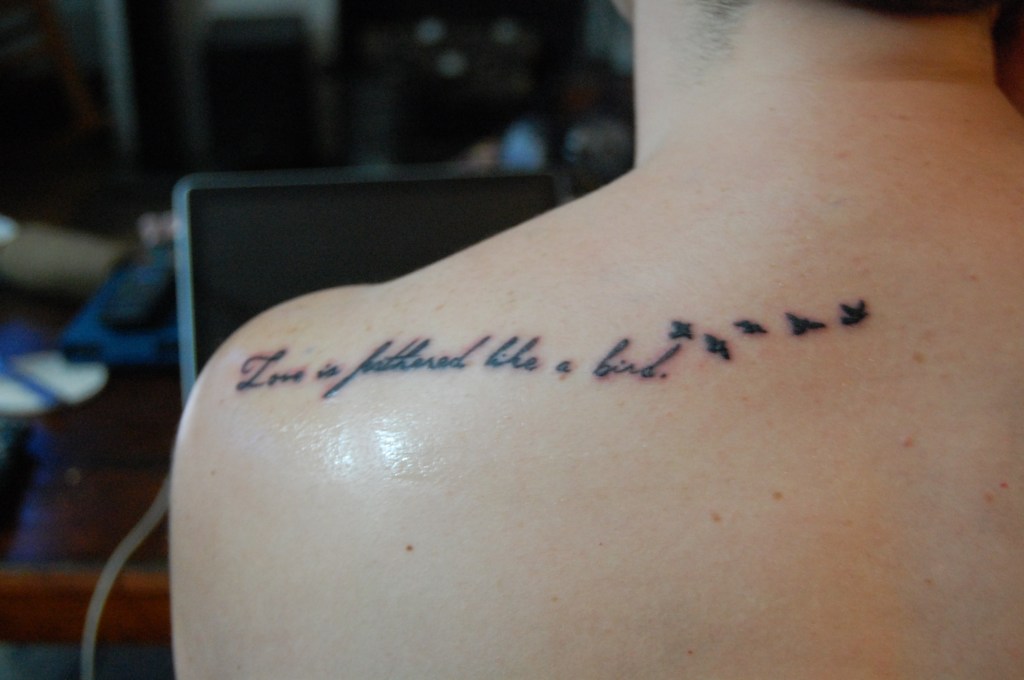
DSC_6848
Taken about an hour after my appointment.

The actual act of being tattooed isn’t as interesting as the tattoos themselves. I went to a reputable studio here in Indy, Metamorphosis and scheduled an appointment. The appointment wound up coming a few days after my 33rd birthday, and the whole process from start to finish took about 20 minutes. It didn’t hurt that much. The tattoo wasn’t very red or irritated nor was the skin surrounding it. I followed the aftercare instructions and it healed well.

Will I get another one?

Never say never but for now, I am more than happy to have a piece of Miss. Bishop permanently pressed to my left shoulder.


Borrowing From PCHH: Things That Are Making Me Happy (Poetry Edition)

I love podcasts and one of my favorite podcasts I discovered through my friend and colleague (Thanks, Janet!). It is called Pop Culture Happy Hour (PCHH) and it’s an NPR podcast about all things pop culture. At the end of every podcast, the lovely host, Linda Holmes, asks the panel “What is making you happy this week?” The answers are always varied and interesting. I decided to take a cue from them and give you “Things That Making Me Happy” (Poetry Edition).

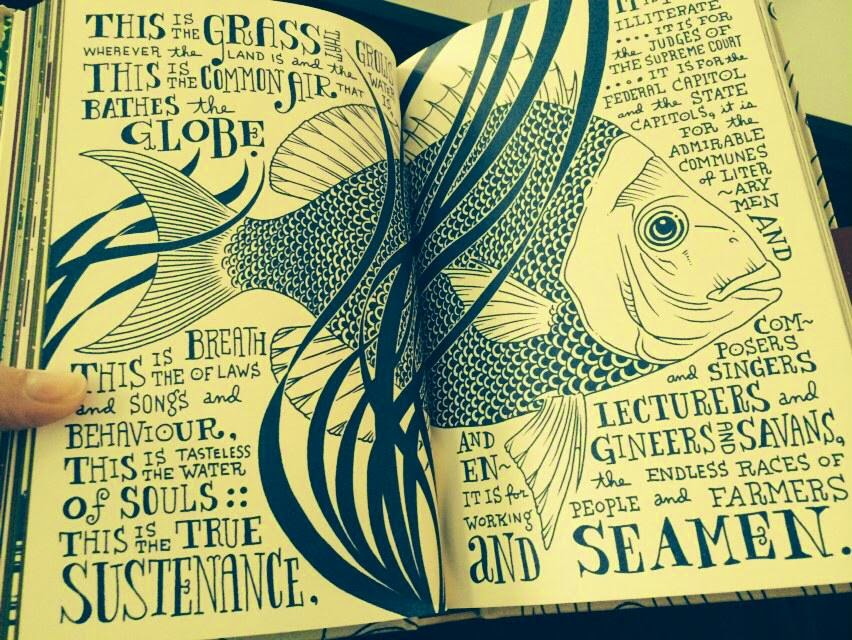
1. Whitman Illuminated: Song of Myself by Allen Crawford. If you love Whitman, you must buy this book. If you love books, you must buy this book. If you love beautiful art, you must buy this book. If you love Tin House, then you must buy this book. In short? You must buy this book. As I said in my Facebook post, “look at all the beautiful! I could take a picture of every page!” Seriously. I’ve shown this book to everyone I know. I’ve tweeted about it. I’ve posted on FB. Now I am blogging about it. Buy this book. Right now.
One of my favorite illustrations from Whitman Illuminated: Song of Myself by Allen Crawford

2. Twitter. This is in reference to my rediscovered love for networking with poets and lit journals on Twitter. There is so much interesting, inspiring and downright cool stuff going on in the poetry/literary world and I think Twitter is a fine forum to take in all that coolness. Come find me @BriPike

 3. Poetry Online. I love that when I open up my email in the morning I have poems waiting from The Academy of American Poetry, Poetry Daily & Linebreak. Access to new poets and the ability to revisit established poets is one of my favorite things about the point where poetry and the internet converge.

4. My recent order of Marion McCready’s Tree Language. I’ve been looking forward to this book since I read some of her work in Poetry. Can’t wait for it to get here.

5. A new round of submissions out for the summer and a chance to spend some time on New Pages and read their excellent lit mag reviews.

Rediscovering Sylvia Among the Tulips

In the January 2014 issue of Poetry there is a poem entitled “Sylvia Plath’s Elegy for Sylvia Plath” by Sina Queyras I don’t know why the poem hit me so hard. It might be because Plath died at the age of thirty and this March I’ll be thirty-three. It might be because by the time she died she had two children, a book of poems and was embroiled in a tumultuous marriage with Ted Hughes. It might be because as I read Sina Queyras’s beautiful poem I was immediately, shockingly sad. The sadness was heavy. It pressed on my chest as I sat at my desk in my office at school. It pressed so hard that I felt my eyes water for a woman who has been dead for over fifty years. 
I have always found Plath’s story heartbreaking. Partially it is because we will never know the poems she could have written. Also, as a thirty some year old woman who is thinking about starting a family and who is also a poet and a professor, I find myself empathizing with her loneliness and her isolation. It is upsetting that that she couldn’t overcome her illness and I suppose now I find myself identifying with her more as a woman rather than an enigma. She was not just this brilliant, tragic poet. She was, as it turns out, a woman made of blood and bone.

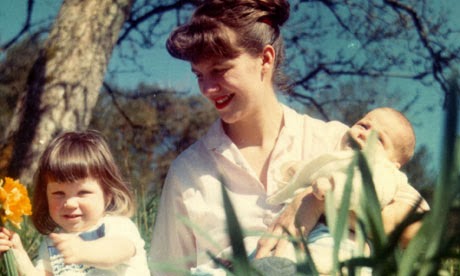
Sylvia Plath with her two children, Nicolas and Frieda, in 1963.
Immediately upon finishing this elegy I went back and read the poem “Tulips.” and was reminded of how gorgeous and devastating that poem truly is. There is such isolation: “There smiles catch onto my skin, little smiling hooks. Even love hurts. What must it be like to live this way? That flowers give you pain and that health is a far away place you know you cannot reach. At the same time, the poem is so beautiful and carefully rendered. So precise in it’s language. That such beauty can come from such pain is hopeful. I just wish it could have kept her alive.
After reading “Tulips,” I wanted to revisit more of Plath’s work, so I pulled out my copy of Ariel. My copy is the restored version which contains a foreword by Plath’s daughter, Frieda. This edition also contains notes and drafts that Plath left behind after her death. I had forgotten, until I opened the book, that it was a gift from a friend. At the time I was given this edition of Ariel, my friend was studying Philosophy and I was studying English at Allegheny College. My friend had a flare for the dramatic and included two quotes at the front of the book: “All, everything that I understand, I only understand because I love” ~Leo Tolstoy & “One word frees us of all the weight and pain of life; that word is love.”~Sophocles.

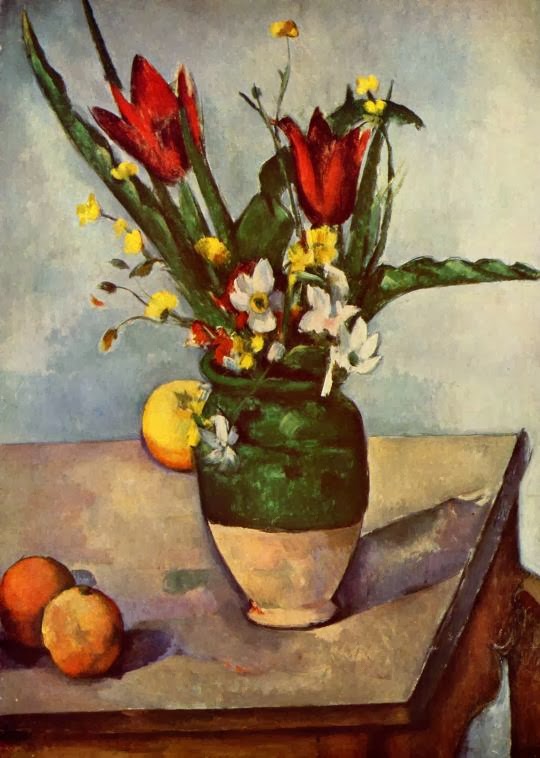
Still life with flowers by Paul Cezanne.

Unfortunately, my friend and I are no longer in contact. I don’t know why. 

And yet as I read his inscription, I am briefly sad about our lost friendship but the sadness is quickly replaced by anger. These quotes have no business in this book. Love couldn’t free Plath. Love fought bravely, but in the end her disease was stronger. This is especially arresting given that Ariel is dedicated to Plath’s two children, Nicholas & Frieda, and Nicholas Hughes committed suicide in 2009. It is difficult because love gave us so many of Plath’s wonderful poems but so did despair. 
I feel like there’s probably a poem in here somewhere. Maybe several poems.

The Art of Losing…

I’ve been keeping journals since I was about eight or nine years old. When I was younger, through my teenage years, I was fairly consistent in starting a journal, writing in it until it was full and then moving onto the next set of empty pages. However, especially as I got older and my writing became a bit more focused and I started to mine it for poems, I started to keep better track of these little books full of scribbling. I didn’t seem to have trouble hanging onto them until fairly recently.

I wouldn’t say I’m a forgetful person and I don’t think I really fall into the “scatterbrain” category either. I’m relatively organized and I don’t lose things easily, but in the last couple of years I seem to be constantly losing journals. For example, a few semesters ago I started writing in a yellow, faux leather journal that my sister gave me for Christmas. I really liked the size of the journal, the bright yellow cover and the strip of leather on the front that buckled to keep the journal closed. I wrote in it all semester and then one day, I couldn’t find it. I tore my house apart. I looked in my office and in the lost and found at school. I couldn’t find it. I was annoyed. Mostly because I liked the journal and also, who knows what was in there that I could potentially have used for a poem or two?

Today I have the day off and I’ve finally had some time to sit and think about some ideas I had for poems over the holidays. However, when I went up to my office space to look for my writing journal, I couldn’t find it. I have looked all over my house and it doesn’t seem to be here. Now it is possible it’s at work, seeing as how I often take my journal to work if I have a spare moment or two and think of something I want to write down. However, if it doesn’t turn out to be in a desk drawer at school, well, I don’t have the first clue where it might be.

This idea of losing potential ideas for poems or even drafts of poems themselves, reminds me of a story I heard once when I was an undergraduate. A visiting writer came to campus to give a reading and I’m sorry to say, I can’t remember who it was but I do remember he was a fiction writer and he primarily wrote short stories. He was in his fifties and this was probably somewhere around 2000 or 2001. He was talking about how he used to only keep one type written copy of all his drafts/stories but one days his car was broken into and they took everything in it, including the folio that contained all of his work. After this incident, he started keeping multiple copies. He also started using a computer in addition to his type writer.

Of course anyone who uses computers and has suffered through the loss of a hard drive or external hard drive, knows that technology does not completely solve this “art of losing.” In fact, I suffered this exact problem a few months ago when our external hard drive failed and all my poetry was lost. Luckily, my husband who is a determined and brilliant soul, was able to recover the data, but now we both consistently use Dropbox.

While it is frustrating to lose these journals and the material that they hold, there is also something freeing about it. Also, while I seem to become slightly forgetful in the material sense, I’m still lucky to have a good memory, so if an idea or image or line for a poem is particularly interesting to me I am often able to circle back around to it at some point.

All this being said, I’m still going to be on the look out for that journal…

Poetry in Print & The Beginning of Spring

Three of my poems, “Song,” “Seed” and “Stargazer” appeared in the Fall 2013 issue of Rust + Moth and now that issue is available in print.

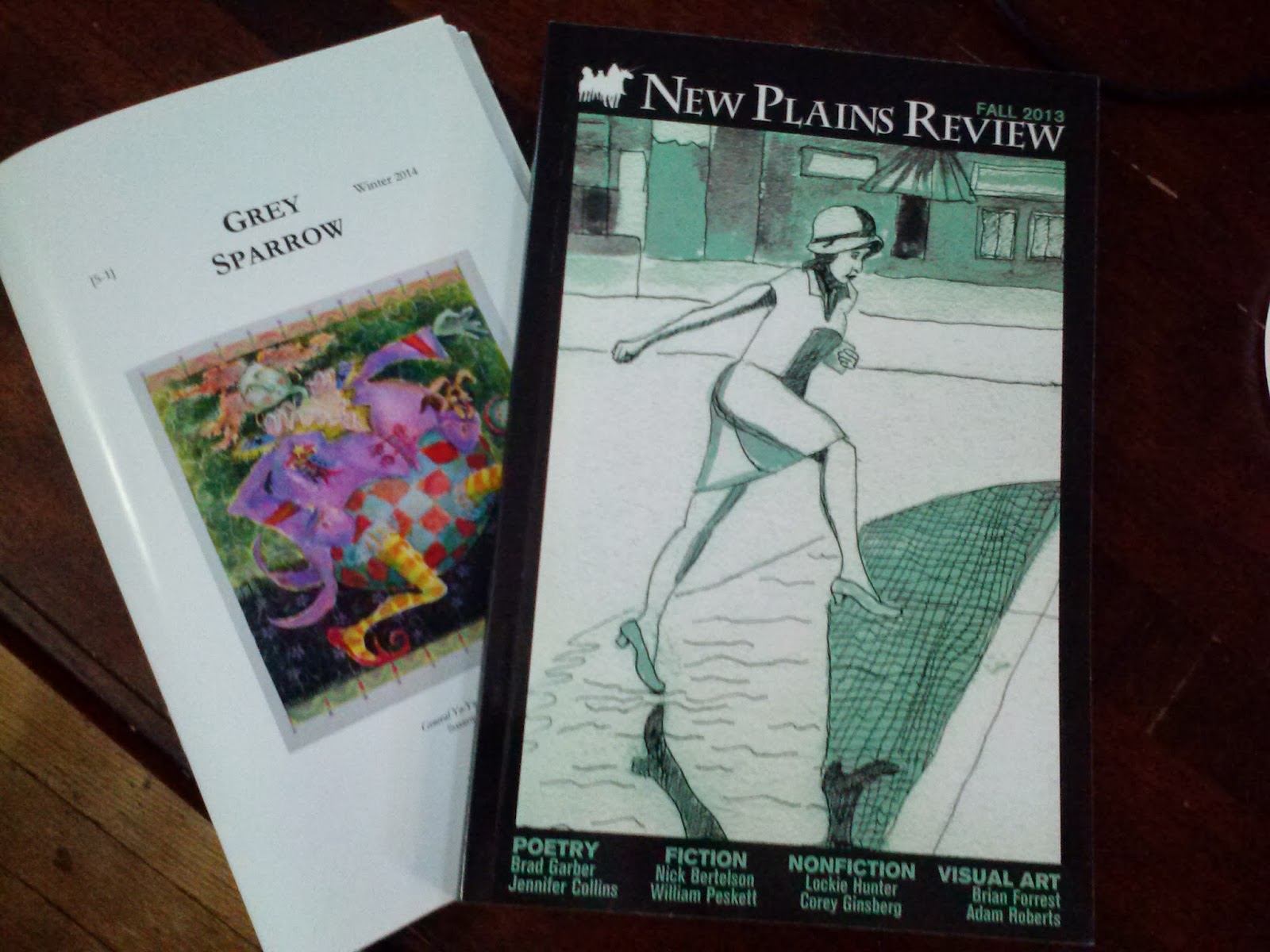
My physical copies of New Plains Review & Grey Sparrow arrived this week.

After surviving the polar vortex, classes began this week with rain and milder temperatures. I met with my creative writing class yesterday and out of twenty-five enrolled students, twenty-two showed up. I am am still somewhat surprised by these numbers even though they been steadily rising for several semesters now. When I first started teach this class, I was lucky to have ten students enrolled.

I’m embarking on a few new teaching adventures this semester, including working with some new technology and teaching a new section of World Literature for our fledgling Honors College.

I took some time off of writing over the holidays, which isn’t abnormal. I still journal and write down ideas, but I didn’t have a chance to formally draft anything as we were traveling for much of our holiday. I am looking forward to sitting down to write some new poems and start revising some work from last fall.

A Few Notes From Weeks Gone By

I learned this past week that two more of my poems, “Crossing Ompompanoosuc” & “The Pond” were accepted for publication by The Meadow for the 2014 summer edition.

The end of the semester is approaching quickly and crunch time is officially here. I have some posts marinating in my head, but have not had time to get them out into the blogosphere. Soon I’ll be back to a regular schedule.
In the meantime, my family is arriving from Pennsylvania and I am cooking Thanksgiving dinner.
Enjoy!

Pittsburgh: Poetry & Place

During a meeting of our student creative writing group today, I had the pleasure of rediscovering this poem:

Pittsburgh

Pittsburgh is a fat lady jabbering at the bus stop.
She mistakes me for someone who gives a damn,
For a native son of her gray industrial breast.
She blesses her Bucs, her Steelers,
Her father, God rest his soul, was a Hornets fan.
She mistakes me for someone who gives a damn,
Her blue scarf twisting like the broad
Monongahela,
Her blue face lined like a jitney’s street map.
I’d tell her I’m not from this place:
These severed tired neighborhoods,
These ruthless winter tantrums,
But her long winded stories numb me.
She is persistent as snow, as boot slush &
Thinsulate,
As buses rumbling like giant metallic caterpillars .
She lights a Marlboro and it means
Spring will burn quick and furious as a match,
Summer will blaze.
When she tells me No one is a stranger in
Pittsburgh,
do I believe her,
My frosty fairy foster-Mamma,
My stout rambling metaphor?

~Terrance Hayes

This poem was given out to the group by my colleague and fellow advisor, Emily Watson. The theme of her exercise was the idea of place and how it could work in creative writing. She encouraged the group to write either replacement poems or just to write about places they knew or had strong connections to. She also included “A Primer” by Bob Hicok and Three Yards by Michael Dorris. It was a really great exercise and I think I’m going to steal it to use later in my creative writing class.

I love “Pittsburgh” because I’ve spent a lot of time in that city and I think the poem captures the complexity of the place. My husband’s hometown, I admittedly had complicated feelings about it. It’s impossible to drive in. On certain days, in a certain light it still looks like a steel town. A bit dingy. A bit dirty. The houses are carved out of the hillsides and look like the might fall into the river at any minute. At the same time, the grace of the bridges arching over the water of the rivers and the view of the city from the top of Mt. Washington are beautiful. You can’t beat a sandwich from Primanti Brothers and I like the hills.

My biggest personal struggle with Pittsburgh is something I think Hayes touches on his poem: the feeling of being an outsider. Pittsburgh is a big city but the people who live there are deeply loyal and that loyalty binds them. There is always a sense of displacement when you find yourself in a new place, but some places are easier to break into than others. I recognize I may be projecting a bit onto the poem considering that sometimes when I think about my early encounters with the city, my chest still tightens. I also recognize that some of the trouble I have with Pittsburgh is that gut deep loyalty to a place is somewhat alien to me. I didn’t grow up in the same place and I have several different houses that I associate with my childhood. I think it’s important to get out and live in other places. You never know what’s out there until you leave and it’s not like your hometown is going anywhere. This is a direct result of the way I was raised because my parents left their hometowns and never went back.

I have tried writing about Pittsburgh several times, but each time ends in frustration. I think it is because I’m trying to balance past and present feelings, which is tricky. I think this is also why I admire the poem Hayes wrote so much. He manages that balance.

Revise, Revise and Revise…

I’ve been working on revising several poems that I drafted about a year ago. This is pretty typical for me. I think of an idea, I write a first draft, sometime a second or third and then I let it sit for “awhile.” Sometimes it’s just a few days, sometimes a few weeks or months and sometimes it’s a year. The good news is that I have a lot of ideas. The bad news is that finished drafts can be slow in coming to fruition. 

I am reminded of my slowness by three of my poems  that appeared today in Rust + Moth. I wrote all three of these poems while I was a graduate student at the University of North Texas. They were drafted and revised and eventually included in my thesis. I finished that program in December 2005. I returned to one of the poems, “Song,” while enrolled in my MFA program at Murray State University. I think this was one of the first poems I brought to workshop (maybe?), so it was sometime in 2007-2008. This month, October 2013, these three poems finally found a home.
Rust + Moth Autumn 2013 
When I think back to the time that I was writing these poems, it was a turbulent period for me. I had graduated from Allegheny College, packed a U-Haul and moved down to Texas to enroll in a graduate program. I didn’t know anything about Texas. I didn’t know anyone in Texas. By the middle of my first semester of graduate school, I was also convinced I didn’t know anything about poetry, literature or being a scholar. In fact, I was pretty sure that it was only a matter of time before I called it quits and went home. However, I’m a stubborn soul (I think it might be that “Yankee” in me that everyone in Texas kept referring to whenever I opened my mouth) and I refused to give up. I knew I was homesick and I also knew that I had to suck it up and move on. I met my friends Natalie and Sam and Michael and Crystal and Terry. I soon realized that half the people I was in class with (people just mentioned excluded) didn’t really know what they were doing either, so we were all in the same boat and that made it less lonely. I started exploring my surroundings more and I found that I liked Denton. I remember walking across campus one night and pausing beneath a tree and hearing a chorus of birds. It was comforting and it was beautiful, so I went home and and wrote the first draft of “Song.” I remember reading Anna Akhmatova in workshop and being so intrigued by her work, and “Stargazer” came as a result of that interest.  Finally, sitting out on the stone steps during a break from class, surrounded by cigarette smoke, I looked up to see huge seed pods hanging from the trees. Obviously, the ideas in all three poems evolved and deepened from the first image, but I feel a certain a sense of completion to know that they are finished and out in the world for other people to read. 

Poetry About Loss

The Academy of American Poets defines the elegy as follows:

The elegy began as an ancient Greek metrical form and is traditionally written in response to the death of a person or group. Though similar in function, the elegy is distinct from the epitaph, ode, and eulogy: the epitaph is very brief; the ode solely exalts; and the eulogy is most often written in formal prose. The elements of a traditional elegy mirror three stages of loss. First, there is a lament, where the speaker expresses grief and sorrow, then praise and admiration of the idealized dead, and finally consolation and solace.  

I’ve never written a formal elegy but I think it is definitely something some of my poems work towards. I began writing poetry, consistently, after the death of my aunt and her death, as a subject, followed me through the rest of my undergraduate coursework and into my graduate studies in Texas. It never occurred to me to sit down and try and write a formal elegy because the ideas for the poems just seem to keep coming and coming. I was in mourning and the writing was how I got through it. It was a long process and I still return to her sometimes, although in later poems it seems to be more of a celebration. 
Weeping Woman, Pablo Picasso 1937

I know that many poets use words to work through loss and difficult times. Confessionalism, which I discovered through the poetry of Sylvia Plath and Anne Sexton, emerged from the idea of writing as a coping mechanism. Of course the poems of Plath and Sexton are more than just therapy, but I guess I never really realized how much I used my poetry to process loss until fairly recently. I’ve written about the loss of family, animals, and even bigger losses like Costa Concordia. 

In fact, one of my favorite poems by my favorite poet, Elizabeth Bishop, is about loss. I use this poem as an example of revision in my creative writing class. The poem, “One Art”, shows a tremendous change from the first draft to the final draft, and our textbook, Imaginative Writing by Janet Burroway, includes both drafts, so students can see the journey the poem took. Admittedly, this poem is a villanelle and not necessarily in the traditional form of an elegy, but the list that Bishop crafts in her poem definitely lament and grieve but she does not find solace at the end:

—Even losing you (the joking voice, a gesture
 I love) I shan’t have lied. It’s evident 
the art of losing’s not too hard to master 
though it may look like (Write it!) like disaster. 

This particular class enjoyed the poem quite a bit and we had a good discussion about the revision process the poem went through. More about this poem and the revisions it went through can be found in Ellen Bryant Voigt’s excellent book of essays entitled The Flexible Lyric. 

Writing about loss can be problematic in the way that all subjects that a poet returns to over and over again can be problematic. I definitely felt like I was in a rut for a certain period of time, but I also feel like I had to write those poems (successful and unsuccessful) just to work them out of my system. I remember being so relieved after reading some poetry by Anna Akhmatova in a graduate class and being inspired to write my poem “Vigil.” It was felt like the beginning of a departure into something new, and at that point, I was ready. 


A Day Spent At Home Writing

I’ve spent the entire day at home revising poems, reading poetry and occasionally asking my fuzzy pup, Kweli, if he thinks a certain line or word sounds right. He has very discerning taste. My two Zebra Finches, Humphrey & Pip, just chirp at me whenever I speak to them.

What a lovely day it has been to stay in my house and work. Actually, this week overall has been pretty great. Two fellow poets from Murray had work published this week: Karissa Knox Sorrell & Pamela Johnson Parker. These are wonderful poems and you should read them.