My poem “Wigs” went live this morning at Hamilton Stone Review. Thanks to Roger Mitchell for giving this poem a home. Take a look and make sure to read the other fine writers featured in this issue.
Category: poetry
The Poetry of Sunken Ships
Today’s poetry post begins with more good news on the publication front. My poem “Wake” will appear in the Fall 2013 issue of Scapegoat Review and my other poem, “Starling,” will appear in the Winter 2013 issue of The New Plains Review. I’m very pleased that these poems found homes in these fine publications.
____________________________________________________________
I completed MFA at Murray State University in 2009 and this past week Murray made the news. Currently Murray’s low-residency program is ranked seventh in the nation by Poets & Writers Magazine. My time at Murray was an incredibly positive and valuable experience for me as a writer, a student and a professor. I meant talented, dedicated and hard working writers who I’ve had the pleasure of keeping in touch with long after I stopped making my twice annual treks to Kentucky.
Speaking of talented poets, my good friend Natalie Giarrantano recently released her debut collection of poetry, Leaving Clean. The poems in this book are haunting, unsettlingly memorable to the point where the lines linger in your heart long after the poem is finished and you’ve moved on out into the world. I plan to write more about this book in a later post, but you should buy it. It’s beautiful work.
______________________________________________________________
In the past few weeks the Costa Concordia has been back in the news. When the cruise ship originally wrecked off the Italian coast in January, there was talk of blasting it apart with dynamite. However, instead the authorities elected to leave her on her side until recently when they righted her giant white body in a 19 hour process called parbuckling. I began writing a poem about the ship when the story originally broke last winter, but then the draft sat quiet for several months. This week I took it out again and started to revise. It’s basically turned into an elegy, which isn’t particularly surprising. Many of my poems are elegies of sorts. I seem to gravitate towards them. I don’t think I’ve quite figured the structure of the poem yet, but these are the opening lines I’m currently working with: “When she punctured her smooth, white belly on the sharp/reef, I was driving to the pool hearing that Concordialay trapped/in the Tyrrhenian, soon to be drained and blown to pieces.”
I’m going to keep working on it. We’ll see where it goes.
Odds and Ends
Fall is here at that means that it’s time to send my poems out into the literary universe once again. I’ve blogged about this process before but to sum it up, I compare it to my experiences riding horses growing up: it was fun, sometimes rewarding and often painful. However, I loved riding and I love writing, so I press on.
A bit of good news on the submission front is that I’ve had my poem, “Wigs,” picked up for publication by Hamilton Stone Review. The poem will appear in their October 2013 issue online. I’ll post a link when it becomes available, but until then take some time and read through their previous issues. There are some wonderful poems including work by my friend, poet Larry O’Dean.
Otherwise, the fall is slowly making it’s way into Indiana. This morning is overcast and the temperature has finally begun to come down from the 90’s to the 60’s. This weekend we went to the orchard and yesterday afternoon, I dumped my impatiens,well past wilted, and replaced them with spicy scented mums. I’m pleased to report that I’ve been writing frequently and I’m happy with how some of the drafts are starting to shape up.
I’ve thought about putting myself on a bit of “schedule” to blog, as part of my absence as of late has been because I am easily distracted and sometimes I just can’t think of much to write about, so I’ve devised a “plan” to hopefully keep me posting more:
Monday– posts should be poetry related
Wednesday– posts should be teaching/job related
Friday– posts should be photography related
These are all topics I write about anyway, but I want to get back to making time to take pictures during the week and to reflect on my teaching. It’s good for me, so I should do it more. I’ll try it out for a week or two and see how it goes.
A Letter to Virginia Woolf
Dear Ms. Woolf,
I have a room of my own and it is crowded. Crowded with books, furniture, pictures, pencils and paper. My room is full of ideas. I guard my room closely, carefully. I fill it with peonies, poetry and photographs. My room is small: an old closet in my old house. Chipped paint on the walls and a bare, warped wooden floor. A sloped ceiling and a small latched window. I sit in my room and read. And listen. And think. And write. My shelves are full of women: Bishop, Moore, Dove and Hull. You. I open them, breathe them in, admire their genius. They are alive. Waiting.
But my room is lonely, as I’m sure you always knew. I cannot stay here forever, alone crafting, scratching out words beneath your watchful gaze. The silence presses down. Hard. At times, I am not worthy of this room. At times I am not worthy of the women that line my shelves.
At times, I am ashamed.
I am ashamed of my lack of focus. I am ashamed of the time spent away from my room. Ashamed of what I cannot write. Ashamed that I cannot write. But I am trying.
And at last, your final note, your last note to Leonard before you walked into the river, pockets full of stones, always brings me to tears. Love even in despair. You taught me that.
_________________________________________________________________________________
Virginia Woolf’s final note to her husband before her suicide on March 28, 1941:
Dearest, I feel certain that I am going mad again. I feel we can’t go through another of those terrible times. And I shan’t recover this time. I begin to hear voices, and I can’t concentrate. So I am doing what seems the best thing to do. You have given me the greatest possible happiness. You have been in every way all that anyone could be. I don’t think two people could have been happier ’till this terrible disease came. I can’t fight any longer. I know that I am spoiling your life, that without me you could work. And you will I know. You see I cannot even write this properly. I can’t read. What I want to say is that I owe you all the happiness of my life to you. You have been entirely patient with me and incredibly good. I want to say that–everybody knows it. If anybody could have saved me it would have been you. Everything has gone from me but the certainty of your goodness. I can’t go on spoiling you life any longer. I don’t think two people could have been happier than we have been. V.
A clip from the 2002 film The Hours based off of the 1998 novel of the same name by Michael Cunningham.
Inaugural Poem 2013
Four years ago I watched live streaming coverage of the Inauguration from my office at school. I was interested in President Obama’s speech, but I was as equally interested in hearing the inaugural poem by Elizabeth Alexander. Today, I sit in my living room listening to NPR’s coverage and watching live streaming (on mute). Once again, I anticipate the President’s speech but I also anticipate the inaugural poem, this year written by poet Richard Blanco.
 |
| Richard Blanco. Photo courtesy of ABC News. |
Richard Blanco will be the first Hispanic inaugural poet and the first openly gay one. He is also the fourth inaugural poet; the first being Robert Frost at JFK’s inauguration in 1961. Writing an inaugural poem seems an almost impossible task. Frost himself penned the poem linked above for the occasion, but could not read it and ended up reciting The Gift Outright. Elizabeth Alexander was criticized heavily for her interpretation of the task, but how many poets could possibly please everyone when it comes to this assignment? Past Presidents seem to agree, as this article from The Christian Science Monitor observes:
But when second-generation Cuban Richard Blanco steps to the podium during President Obama’s Jan. 21 second-term inaugural ceremonies, he’ll be only the fourth poet to participate in such proceedings. Robert Frost, who read at John Kennedy’s 1961 swearing-in, was the first, as near as we can tell. Bill Clinton had two: Maya Angelou, in 1993, and Miller Williams, in 1997. In 2009 Elizabeth Alexander read her poem “Praise Song for the Day” at Mr. Obama’s first inaugural. Now Mr. Blanco will follow her. That’s it.
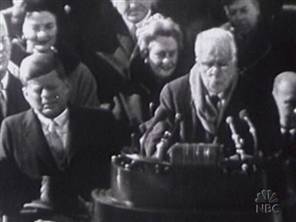 |
| JFK and Robert Frost. Photo courtesy of The New Yorker. |
The article goes on to speculate that the reason for this may be that the President doesn’t want to be overshadowed by the poet. The article refers to a story about JFK and Robert Frost, but I think it also has to do with the previously mentioned difficulty of the task. I mean, you sit down and write a poem about America in a month that will be read to millions of people. Not to mention it will live on in annals of history and you see if that doesn’t give you reason to pause.
Blanco is said to have been inspired by Walt Whitman and commented in an NPR interview:
This whole idea of place and identity and what’s home and what’s not home, and which is in some ways such an American question that we’ve been asking since, you know, since [Walt] Whitman, trying to put that finger on America.
I think Whitman would agree with Blanco and he would also agree that we are a long way from “putting our finger on America” but maybe that is just what makes America great?
|
I Hear America Singing
|
||
| by Walt Whitman | ||
| I hear America singing, the varied carols I hear, Those of mechanics, each one singing his as it should be blithe and strong, The carpenter singing his as he measures his plank or beam, The mason singing his as he makes ready for work, or leaves off work, The boatman singing what belongs to him in his boat, the deckhand singing on the steamboat deck, The shoemaker singing as he sits on his bench, the hatter singing as he stands, The wood-cutter’s song, the ploughboy’s on his way in the morning, or at noon intermission or at sundown, The delicious singing of the mother, or of the young wife at work, or of the girl sewing or washing, Each singing what belongs to him or her and to none else, The day what belongs to the day—at night the party of young fellows, robust, friendly, Singing with open mouths their strong melodious songs.
One Today “One Today” My face, your face, millions of faces in morning’s mirrors, All of us as vital as the one light we move through, One ground. Our ground, rooting us to every stalk The dust of farms and deserts, cities and plains Hear: squeaky playground swings, trains whistling, One sky: since the Appalachians and Sierras claimed One sky, toward which we sometimes lift our eyes We head home: through the gloss of rain or weight |
||
Modern Medea: Rhianna & Chris Brown?
This semester I am teaching a World Lit class for our burgeoning Honors Program. It’s a new experience for me and it’s proving to be very enjoyable. I am familiar with much of the reading, but I still spent the end of the spring semester and the entire summer prepping the course. My class is small (seven students) but they have proven to be an enthusiastic and dynamic group, which is great for discussion.
This week (the class meets once a week for three hours) we read and discussed Medea, so I spent much of last week/end re-reading the play and preparing for discussion. If you’re not familiar with the play by the Greek playwright Euripedes, you should read it. It is my favorite of the Greek plays and I prefer it over Oedipus Rex and Antigone.
While re-reading Medea, I started thinking about connections/references that a modern day audience could make to the play. This is something that I always think about when teaching literature to students who are not familiar with the work already. Currently, my class is split almost in half in terms of students who have at least heard about some of this reading and students who thought I was talking about Tyler Perry when I assigned Medea. No matter what the level of familiarity is with the reading, the students still need an entry point to the story. They need to find a reason to connect to the plot and the characters because once that connection is made, then they can begin to discuss why the piece is relevant to a modern day audience. In other words, they can begin to answer the age old question: “Why are we still reading this stuff?”
*While I was reading Medea and thinking about modern connections, I happened to come across a story about Chris Brown on Facebook. As most of you know, Chris Brown is a popular pop singer who made headlines for a physical altercation with then girlfriend, pop superstar Rhianna. Her bruised and beaten face made all the news outlets and many radio stations temporarily banned his music from the airwaves. The story has raised it’s head several times in the past year, partly due to celebrity involvement in helping Rhianna and Chris “reconcile,” her decision to publicly forgive him and most recently, because of the tattoo that Chris Brown has on his neck. I’m not particularly interested in whether or not the tattoo depicted on his neck is a battered woman, a zombie or Osiris (all speculation on the internet). My opinion of Chris Brown wasn’t good even before his altercation with Rhianna, so that’s a closed case in my mind. However, Rhianna’s public response to the incident and in turn, the impact it has on young women and how they view physical abuse is something I care about.
How does this relate to Medea? When Jason (Medea’s husband and hero of golden fleece fame) decides to leave his wife for the younger, more powerful Corinthian princess, Medea’s rage knows no bounds. She is what the phrase “hell hath no fury like a woman scorned” epitomizes. In the end her rage and desire for vengeance leads not only to her murder of the princess and her father, King Creon of Corinth, but also the murder of her two young sons. She was a powerful woman, a queen, and the daughter of the sun god, Apollo. To say that she was not a woman to cross, is an understatement.
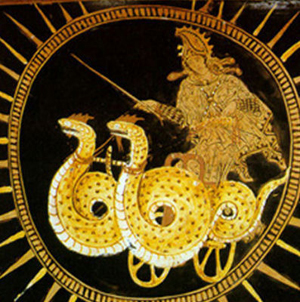
Clearly, I am not advocating murder as revenge and the tale penned by Euripedes was meant to scandalize and tantalize Greek audiences. However, the play Medea is also about power and control and when Jason tried to take that power and control, the consequences were devastating. In the case of Chris Brown and Rhianna, where is the rage? Where is the power? Who has the control? It seems to fall with the same individual. His rage. His power. His control.
A final thought, in the introduction to Medea, the textbook makes this observation:
For the Greeks, a hero was not necessarily a good, kind person, but rather a strong, larger than life figure whose deeds were somehow performed on a grand scale (The Bedford Anthology of World Literature, 1003).
At the conclusion of the play, Medea flies off in a chariot pulled by dragons, leaving Jason in misery. Many Greeks could have considered her hero. Can we say the same of Rhianna?
* A few disclaimers: 1). I understand Chris Brown and Rhianna are public figures, so I am basing my thoughts on the information I have as a public consumer. 2). I am in no way, shape or form blaming Rhianna for what happened to her. 3). This is what happens when a bunch of different thoughts converge in my head. At the end of the day, it’s just my opinion.
Words from Walt
My first memories of Walt Whitman’s poetry are of when I took an American Lit class as an undergraduate. We spent the latter half of the course reading and discussing Whitman and Dickinson. I remember being underwhelmed by Dickinson (my appreciation and admiration of her work was slower to come) but I loved Whitman right from the start. I didn’t always know what was going on and I struggled through an analysis of “Scented Herbage of My Breast” for my final paper, but I loved his language, his long lines, his joy and I mean honestly, the guy had a killer look.
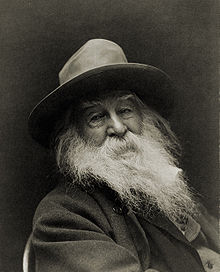 |
| My favorite picture of Walt. |
As I type these words, I realize that I am wrong about my memories of Whitman. When I was in sixth grade, I had to memorize “O’ Captain, My Captain” and then later I saw Dead Poets Society. I can’t recite the poem anymore. I was never good with memorization and I found that while I could memorize a poem or Shakespearean sonnet for an assignment, as soon as the pressure was off, the words vanished. However, I liked the poem and maybe that reinforced my enthusiasm nearly seven years later when we dove into Leaves of Grass in my American Lit class.
As an adult, a poet and an educator, what I love about Whitman, is that he’s still relevant. He still translates to America and he’s still pretty much got it nailed. I often tell my students that Whitman would be in love with the idea of community college because of its diversity, its opportunity and the idea that education and community are inextricably linked. Of course, they always adore him. I give them an assignment early on to go out and find Whitman in contemporary culture. They don’t have to look too hard. He’s in Levis commercials, candy boxes, interstate signs, whiskey, tobacco and the list goes on. But more important than his marketability, is the staying power of his poetry.
Another assignment I give my students is to rewrite Whitman’s “I Hear America Singing.” We look at Langston Hugh’s “I, Too, Sing America” as an example and talk about the relevance of the message that both Hughes and Whitman were trying to give voice to. They always love the poem and it always generates good discussion because it still speaks to the larger population.
I Hear America Singing
I hear America singing, the varied carols I hear,
Those of mechanics, each one singing his as it should be blithe and strong,
The carpenter singing his as he measures his plank or beam,
The mason singing his as he makes ready for work, or leaves off work,
The boatman singing what belongs to him in his boat, the deckhand singing on the steamboat deck, The shoemaker singing as he sits on his bench, the hatter singing as he stands,
The wood-cutter’s song, the ploughboy’s on his way in the morning, or at noon intermission or at sundown, The delicious singing of the mother, or of the young wife at work, or of the girl sewing or washing, Each singing what belongs to him or her and to none else,
The day what belongs to the day—at night the party of young fellows, robust, friendly,
Singing with open mouths their strong melodious songs.
I, Too Sing America
I, too, sing America.
I am the darker brother.
They send me to eat in the kitchen
When company comes,
But I laugh,
And eat well,
And grow strong.
Tomorrow, I’ll be at the table
When company comes.
Nobody’ll dare Say to me,
“Eat in the kitchen,”
Then.
Besides, They’ll see how beautiful I am
And be ashamed–
I, too, am America.
Happy birthday Walt. For all you said and all you continue to say.
Poetry Stuff
This afternoon I sat down to write and the first thing I wrote was a rather scathing free write addressed to myself. In this free write the words “shame,” “fraud,” “lazy,” “unfocused,” and “cowardly” came up. I didn’t realize how pissed off I was at myself until I started writing about pissed off I was. The simple truth of the matter is that I have not written anything that remotely resembles a poem in about 5 months. It’s despicable. I internalized my feelings about this lack of productivity but whenever I would stand in front of my creative writing students and talk about revision and the only way to get better is to keep writing, well, I felt like a jerk. Because was I doing any of that? No. I was reading a lot and I did have a lot of ideas for poems floating around in my head, but who cares? Nothing was making it to paper.
It felt good to get it out on paper, and once that was out of the way, I felt renewed. I always feel better after working on a poem for a few hours, even if it isn’t any good and even if it doesn’t go anywhere, so I turned the page from my angry free write and started to draft a poem.
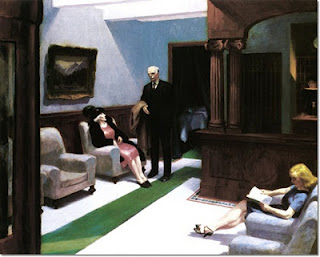
Last fall (sigh) I took my creative writing students to the IMA and found myself meditating on the painting Hotel Lobby by Edward Hopper. I blogged about the experience here, but here’s another look at the painting:
And here are the notes I made:
Oil on canvas. “Though this looks like a scene from a story, it’s not clear there really is one.” Two women and two men. Two older and two younger. Point of view seems to be from the doorway. Hopper’s paintings are always “busy” in terms of people but they are so lonely because the people always seem to be ignoring each other. Even in conversation they are lonely. Women are always young, blonde. There is a darkness in terms of color that seeps into the atmosphere as if something horrible is just below the surface.
I’ve done a little more reading since then about Hopper and the painting:
* Robert Henri, Hopper’s mentor/teacher, once told him “It isn’t the subject that matters but how you feel about it.”
* Hopper placed his characters as if they were captured just before or just after the climax of a scene. The characters in this painting could be based on Hopper and his wife, Josephine. There is a contrast between the two older individuals in the painting and the two younger people.
I wrote out a couple of drafts of this poem and then thought about maybe working it into a villanelle but after about an hour it occurred to me that the villanelle wasn’t the form for this poem. Mostly because as Strand and Boland say in The Making of a Poem:
“…the form refuses to tell a story. It circles around and around refusing to go forward in a any kind of linear development, and so suggesting at the deepest level, powerful recurrences of mood and emotion and memory.”
My poem was trying to tell a story, so the villanelle wasn’t going to work. I’d already put myself well into the narrative. Anyway. This is what I came up with after about three hours:
Draft #5
His brown wool overcoat drapes
heavily over his one arm, close
enough so that the hem brushes
the green brocade armchair. She looks
up, the peacock feather on her hat whispering
against the mahogany molding at her back.
Together they arrived with their monogrammed
luggage packed with diner dress. This lobby is known
familiar in its overstuffed chairs, rich wood and shadow.
It is empty, save one golden haired girl reading
a book. She is oblivious to the young clerk, who stares
at her long legs from behind his desk.
The dining room is now dark, deserted. It is late.
The lobby cast in shadow and the young clerk’s face
illuminated by one lone lamp.
It is 1943 and the war is on. Yet hotels still
run, guests still dine, clerks still stare at young girls
who still read. He still stands up and she still
looks to him in question.
I’m not in love with it because it doesn’t work towards that final stanza like I want it to. As per usual, I’ve got too much going on in my brain and it didn’t quite make it all onto the page, but I think it might be worth working on it some more to see where it goes.
The Elevated Envelope
A few months ago I signed up for the Elevated Envelope project. I found information about the project on the LWA website and I thought it looked like fun. I’ve spent the last few months making my envelopes and they are finally ready to go in the mail (ahead of the May 15 deadline).
I decided to do use a theme for my design but I wanted to make each envelope unique, so because it is National Poetry month and I’m a poet, I decided to use poetry as my theme. I picked 10 of my favorite poems and designed each envelope around that poem. I enclosed a copy of the poem and a brief note inside the envelope. Hopefully, my recipients will enjoy them.
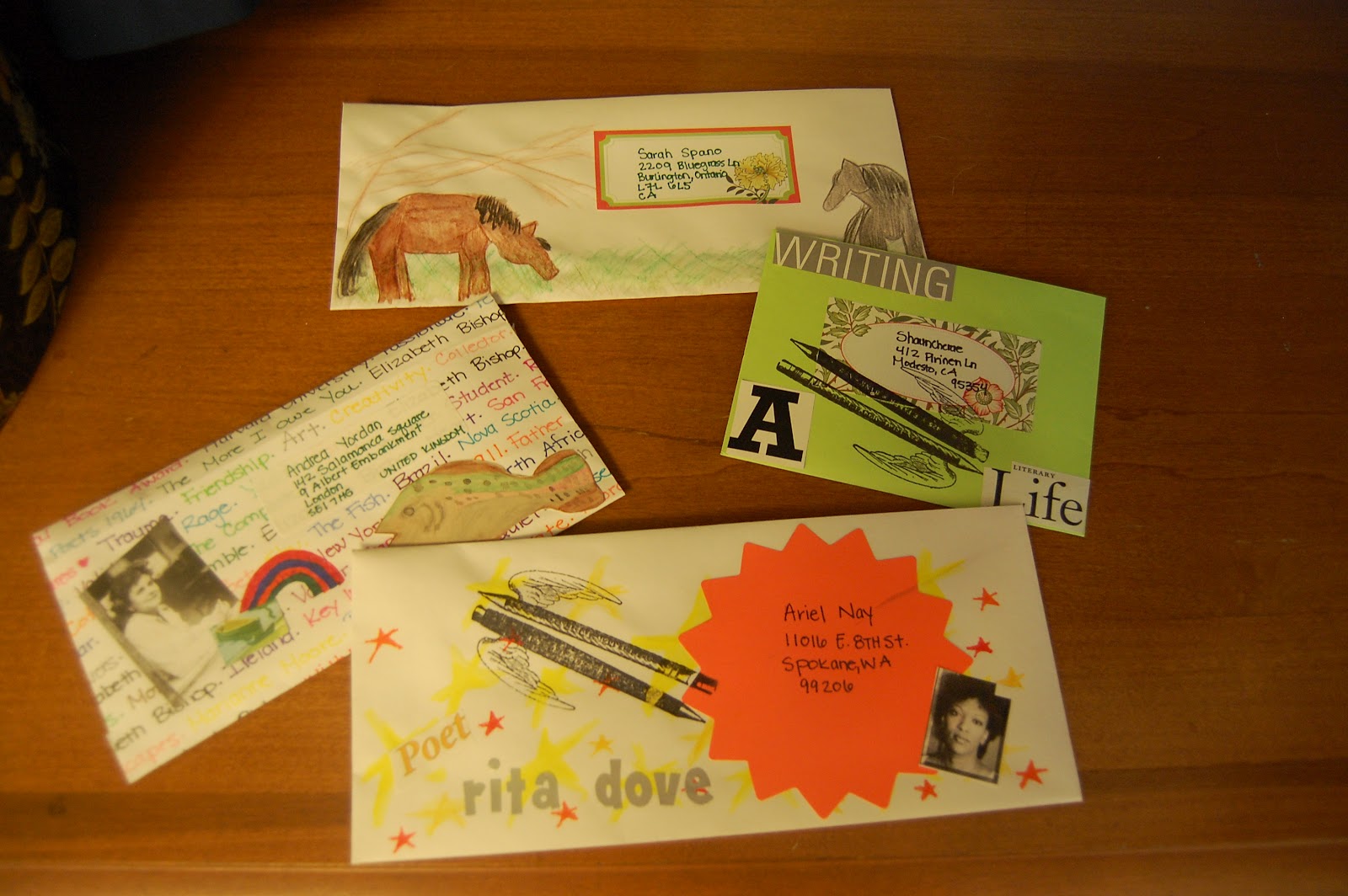 |
| Elizabeth Bishop “The Fish,” Rita Dove “Daystar,” Robert Hayden “Those Winter Sundays”& James Wright “A Blessing.” |
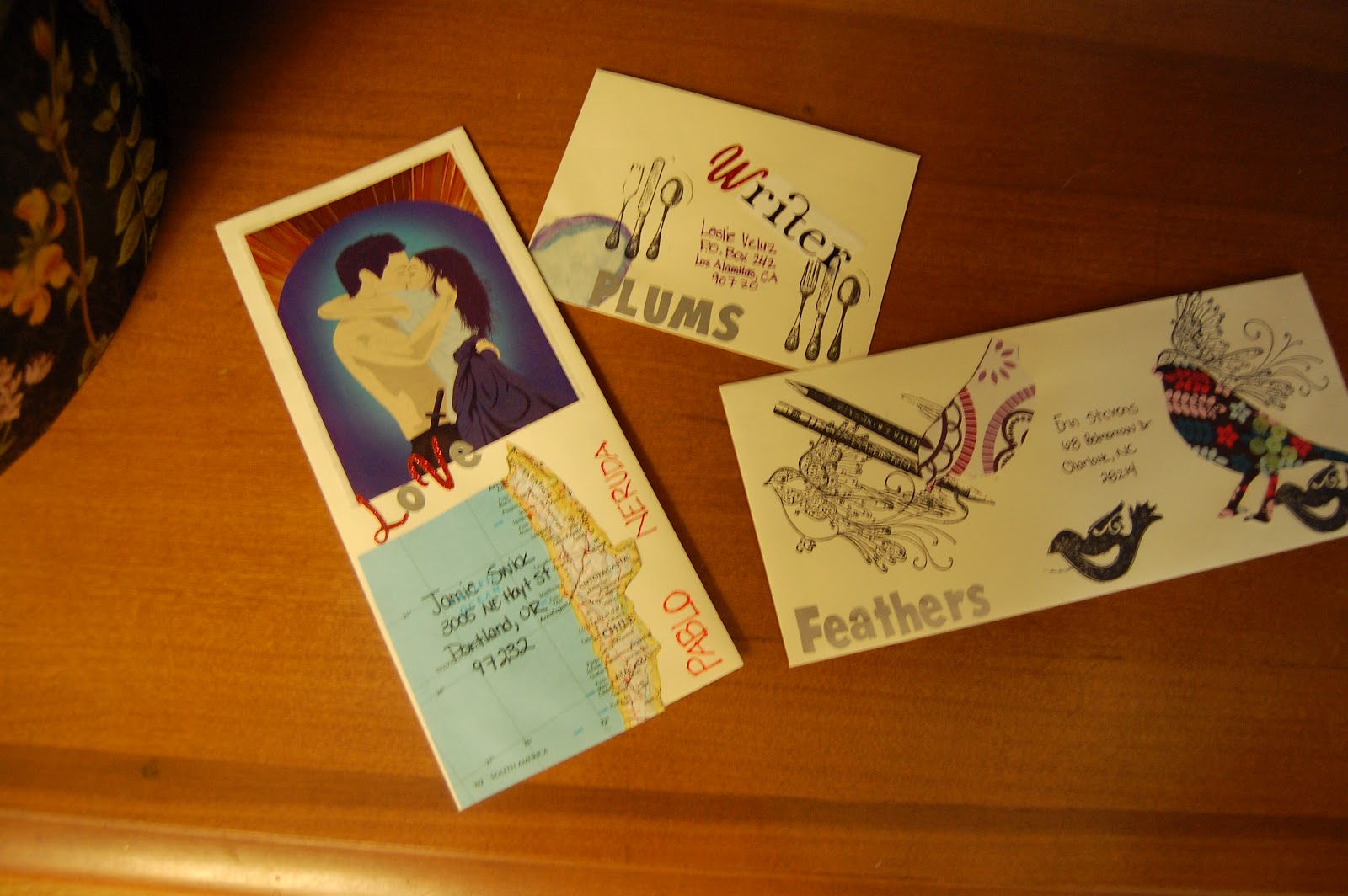 |
| Pablo Neruda “Sonnet XVII,” Wallace Stevens “Sunday Morning” & Emily Dickinson “#254.” |
 |
| Mark Strand “Eating Poetry,” Mary Oliver “Sleeping in the Forest” & Frank O’Hara “Why I Am Not a Painter.” |
Happy National Poetry Month!
April is National Poetry Month and I’m involved in several events though my community college that celebrate the crafting and speaking of the written word. I participated in a panel discussion yesterday about Why Art Matters and the student creative writing group that I advise will be hosting an open mic event in a few weeks.
In the spirit of National Poetry Month and all that we do to celebrate it, I give you my top five favorite poems. These are poems I remember, these are poems I share in my classes and these are poems that are important to me not only because of their language and subject but because they stir up memories.
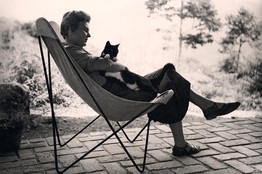
1. The Fish~ Elizabeth Bishop
I caught a tremendous fish
and held him beside the boat
half out of water, with my hook
fast in a corner of his mouth.
He didn’t fight.
He hadn’t fought at all.
He hung a grunting weight,
battered and venerable
and homely. Here and there
his brown skin hung in strips
like ancient wallpaper,
and its pattern of darker brown
was like wallpaper:
shapes like full-blown roses
stained and lost through age.
He was speckled and barnacles,
fine rosettes of lime,
and infested
with tiny white sea-lice,
and underneath two or three
rags of green weed hung down.
While his gills were breathing in
the terrible oxygen
–the frightening gills,
fresh and crisp with blood,
that can cut so badly–
I thought of the coarse white flesh
packed in like feathers,
the big bones and the little bones,
the dramatic reds and blacks
of his shiny entrails,
and the pink swim-bladder
like a big peony.
I looked into his eyes
which were far larger than mine
but shallower, and yellowed,
the irises backed and packed
with tarnished tinfoil
seen through the lenses
of old scratched isinglass.
They shifted a little, but not
to return my stare.
–It was more like the tipping
of an object toward the light.
I admired his sullen face,
the mechanism of his jaw,
and then I saw
that from his lower lip
–if you could call it a lip
grim, wet, and weaponlike,
hung five old pieces of fish-line,
or four and a wire leader
with the swivel still attached,
with all their five big hooks
grown firmly in his mouth.
A green line, frayed at the end
where he broke it, two heavier lines,
and a fine black thread
still crimped from the strain and snap
when it broke and he got away.
Like medals with their ribbons
frayed and wavering,
a five-haired beard of wisdom
trailing from his aching jaw.
I stared and stared
and victory filled up
the little rented boat,
from the pool of bilge
where oil had spread a rainbow
around the rusted engine
to the bailer rusted orange,
the sun-cracked thwarts,
the oarlocks on their strings,
the gunnels–until everything
was rainbow, rainbow, rainbow!
And I let the fish go.
This is the first Elizabeth Bishop poem I ever read and it started my love affair with her and her work. If you read my blog at all, you know how much I love her. This poem introduced me to the idea of poetry making the ordinary extraordinary and it also made me realize how important observation and image are to making successful poetry.
2. Those Winter Sundays~Robert Hayden 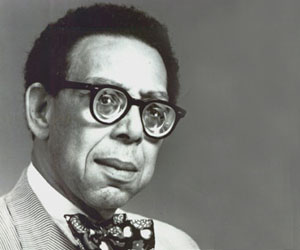
Sundays too my father got up early
and put his clothes on in the blueblack cold,
then with cracked hands that ached
from labor in the weekday weather made
banked fires blaze. No one ever thanked him.
I’d wake and hear the cold splintering, breaking.
When the rooms were warm, he’d call,
and slowly I would rise and dress,
fearing the chronic angers of that house,
Speaking indifferently to him,
who had driven out the cold
and polished my good shoes as well.
What did I know, what did I know
of love’s austere and lonely offices?
I love this poem because it reminds me of my father and my grandfather and all the men I’ve met in my life that work hard for their families. It is a sad poem but also a celebratory poem. I think it speaks a truth that many of us can relate to.
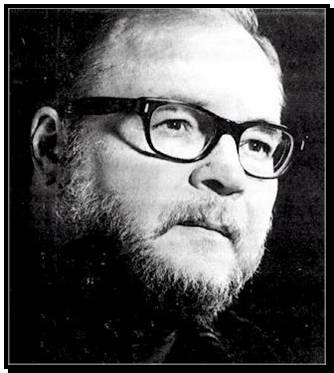
3. A Blessing~James Wright
Just off the highway to Rochester, Minnesota,
Twilight bounds softly forth on the grass.
And the eyes of those two Indian ponies
Darken with kindness.
They have come gladly out of the willows
To welcome my friend and me.
We step over the barbed wire into the pasture
Where they have been grazing all day, alone.
They ripple tensely, they can hardly contain their happiness
That we have come.
They bow shyly as wet swans. They love each other.
There is no loneliness like theirs.
At home once more,
They begin munching the young tufts of spring in the darkness.
I would like to hold the slenderer one in my arms,
For she has walked over to me
And nuzzled my left hand.
She is black and white,
Her mane falls wild on her forehead,
And the light breeze moves me to caress her long ear
That is delicate as the skin over a girl's wrist.
Suddenly I realize
That if I stepped out of my body I would break
Into blossom.
I chose this poem to be read at my wedding, so if that’s isn’t a testament to how much I love it, I don’t know what is. I had horses growing up and I think what attracted me to this poem at first was how perfectly Wright captured their mannerisms. Later, I admired the final lines of the poem and the subtle way in which Wright wrote a poem about love without all the bells and whistles.
4. What the Living Do~Marie Howe

Johnny, the kitchen sink has been clogged for days, some utensil probably fell down there.
And the Drano won't work but smells dangerous, and the crusty dishes have piled up

waiting for the plumber I still haven't called. This is the everyday we spoke of.
It's winter again: the sky's a deep, headstrong blue, and the sunlight pours through

the open living-room windows because the heat's on too high in here and I can't turn it off.
For weeks now, driving, or dropping a bag of groceries in the street, the bag breaking,

I've been thinking: This is what the living do. And yesterday, hurrying along those
wobbly bricks in the Cambridge sidewalk, spilling my coffee down my wrist and sleeve,

I thought it again, and again later, when buying a hairbrush: This is it.
Parking. Slamming the car door shut in the cold. What you called that yearning.

What you finally gave up. We want the spring to come and the winter to pass. We want
whoever to call or not call, a letter, a kiss—we want more and more and then more of it.

But there are moments, walking, when I catch a glimpse of myself in the window glass,
say, the window of the corner video store, and I'm gripped by a cherishing so deep

for my own blowing hair, chapped face, and unbuttoned coat that I'm speechless:
I am living. I remember you.
I am naturally attracted to poets who write about grief. I think it is because I wrote many of my first poems while I was grieving, so Marie Howe’s poetry resonates with me very strongly. If I were to be honest, I would just list her book What the Living Do, because it is one of my favorites.
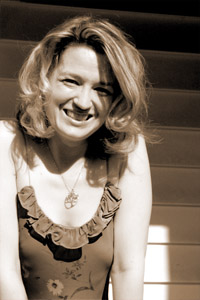
5. The Floating~ Katrina Vandenberg
When he was dying, she stayed with him all night,
but one night, restless. she walked around a corner
and found a dim hall full of children's breathing
rising from small white beds. She had drifted into
the flating, the children's hospital boat
being rocked to sleep in the harbor again
the way it was a hundred summers ago.
The horizon of her life had vanished--traffic
lights, students with Chinese food takeout boxes
stories down. Now bustled dresses drooped
over the backs of chairs: now immigrant mothers
in flimsy shifts bent over beds and whispered,
tendrils of their hair escaping their tidy knots,
their feet unsteady on the pitch of breath.
This poem is from Vandenberg’s book Atlas. I love this book and this is my favorite poem from the the collection. It is haunting and beautiful and a little bit like a dream.
 Brianna Pike