Sharing the Love

It’s not uncommon for lists of writing advice to pop on my Facebook and/or twitter feed. I follow a lot of writers and they have much wisdom to share. This week’s offering came in a list from Sherman Alexie via Tin House.

Alexie’s poem, Avian Nights, is one of my all time favorites:

The starlings mourn for three nights and three days.

They fly away, only to carry back

Insects like talismans, as if to say

They could bring back the dead with bird magic.

I have a slight obsession with birds and I find Starlings particularly interesting. I wrote a poem, aptly titled Starling, that appeared in The New Plains Review and was recorded by the lovely Katie Woodzick.

Anyway. Back to the Alexie’s list of advice.

There’s a lot of solid common sense mixed with wry humor. For instance, #10: Don’t google search yourself, followed closely by #9: When you’ve finished Google searching yourself, don’t do it again. But when I got to #1 I felt myself nodding and muttering, “yes, I need to do that more:

When you read a piece of writing that you admire, send a note of thanks to the author. Be effusive with your praise. Writing is a lonely business. Do your best to make it a little less lonely.

I read a lot of poetry online and often I find myself saving links or printing poems or sharing the piece on the seemingly endless number of social media platforms that I’m currently trying to juggle (I caved the other day and created a tumblr page. I know. I’ve got a problem). But what I don’t always do is reach out to the author through email or Facebook or Twitter and tell them how much I loved their poem(s).

images
Indianapolis Museum of Art

My students and I talk a lot about community as it relates to writing, especially in the context of a workshop. I tell them the importance of being honest and candid in their critiques and feedback to their fellow writers. Writing is extremely personal. Every time a student brings a draft of a poem or a short story or an essay to class, they are bringing a piece of themselves, so while it is important to be candid, it is also important to be kind and respectful.

It’s also vital to praise a piece of writing that knocks the wind right out of you.

I’m not big into New Year’s resolutions and seeing how it’s February, I’m a bit late to the party anyway, but February is the month of love, so what better time to up my efforts and take Alexie’s advice?

One of the best parts of social media and the internet in general is that I have access to so much brilliant work, and guys, there is a lot of brilliant work out there, so the next time you read a poem you love, let the poet know. Writing doesn’t have to be a lonely business.


Poetry Has Value

I’m embarking on a new venture starting this month over at Poetry Has Value (PHV) If you have not checked out Jessica Piazza’s excellent project, please take some time to read through her posts and familiarize yourself with her journey over the past year.

Jessica poses the question: What is your poetry worth?

As you can tell from the blog, there are a lot of possible answers to that question.

Where do I come in?

Well, thanks to Jessica’s idea to expand the project in 2016, I’ll be adding my stats (along with many other poets from all walks of life) and ideas to the mix. I plan to track venues where I send my poetry (individual poems and a chapbook manuscript), rejections and acceptances, fees I’ve paid to submit and any payment I’ve received for my work.  In the spirit of being a good literary citizen, I also plan to track how I heard about a publication.

I’ll be sharing this information via monthly posts on the PHV blog.

My intro post is up, so please check it out along with all other brave poets who are contributing their voices to this discussion. It’s an important one.

Poetry Has Value
WHAT IS YOUR POETRY WORTH?


Ekphrastic Poem in Progress

I’m in a serious relationship with a painting. It’s very one sided. I go to the Indianapolis Museum of Art (IMA) at least once a month to visit. My “visit” consists of me riding the escalator up to the third floor, walking past the guest services desk, through the sliding glass doors and cutting a direct path to the Robert H. and Ina M. Mohlman Gallery. In the second room of the gallery, on the far wall hangs my love. I sit down on one of the padded benches (thoughtfully provided by the IMA) and well, I stare. Sometimes I take notes, but most of the time I just look. Visiting time can vary, but today I stayed for about an hour.

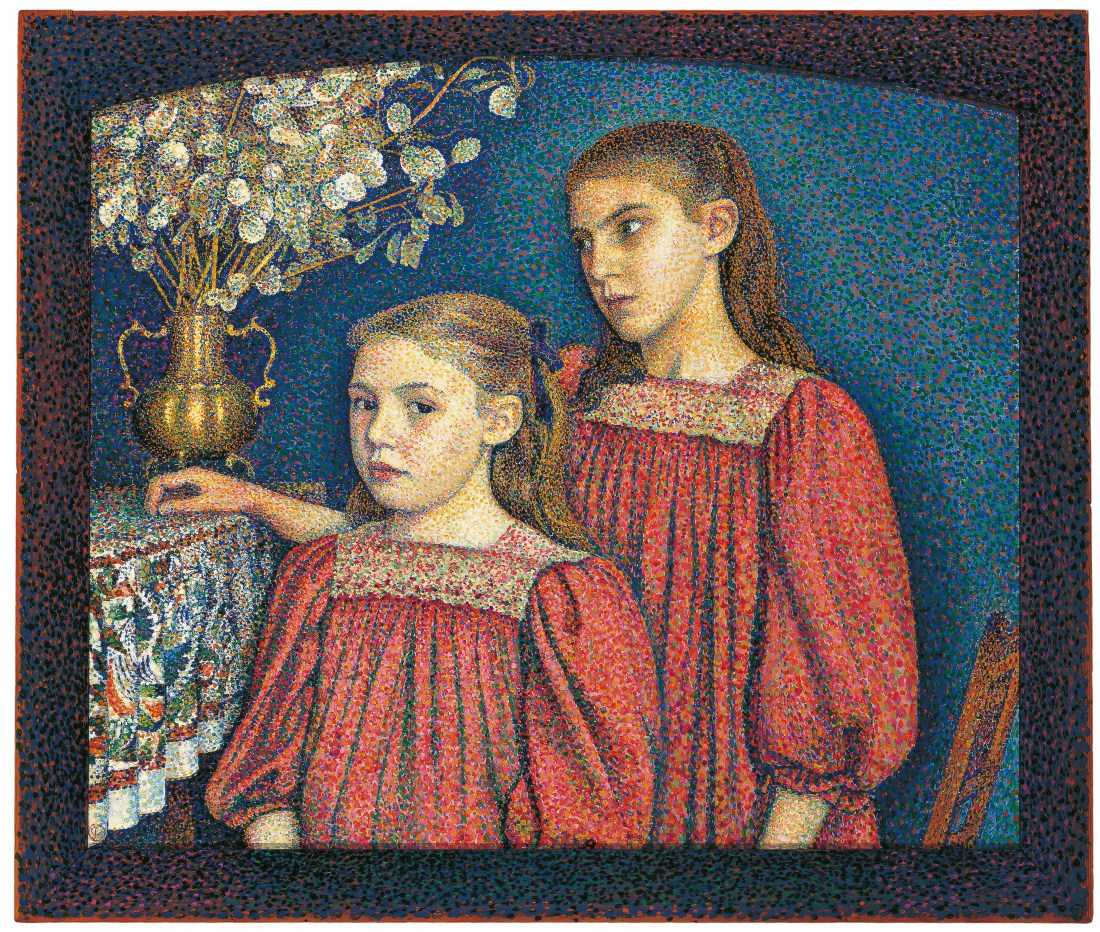
The object of my affection? Two Sisters by George Lemmen.

0_download.jpg

I’ve wanted to write a poem about this painting since the very first time I saw it. I bought a print for my home and I have a postcard version hanging on the wall of my office at school. Yes, I’m a little obsessive. Anyway. The poem. I’ve written several drafts. They’re floating around in my different journals and it was only a few months ago that I felt I could finally sit down and try to commit some sort of structured draft to the page. As is the case with a lot of my poems, I wrote the draft, messed with it for about a week and then left it alone for a month.

Today, a cold, blustery January day, I realized that I didn’t have anywhere I really needed to be, so I took myself over to the museum, pulled out my old draft and started scribbling.

It’s the dark haired girl, Berthe, that I find fascinating. In fact, she trumps everything else in the painting for me. The younger sister, Jenny seems small, inconsequential and not nearly as interesting, which is perhaps odd given that she’s in the forefront of the portrait. The fact that Jenny looks directly toward you while Berthe averts her eyes is especially intriguing because it is because of her looking away that we can’t stop looking at her. Or at least I can’t.

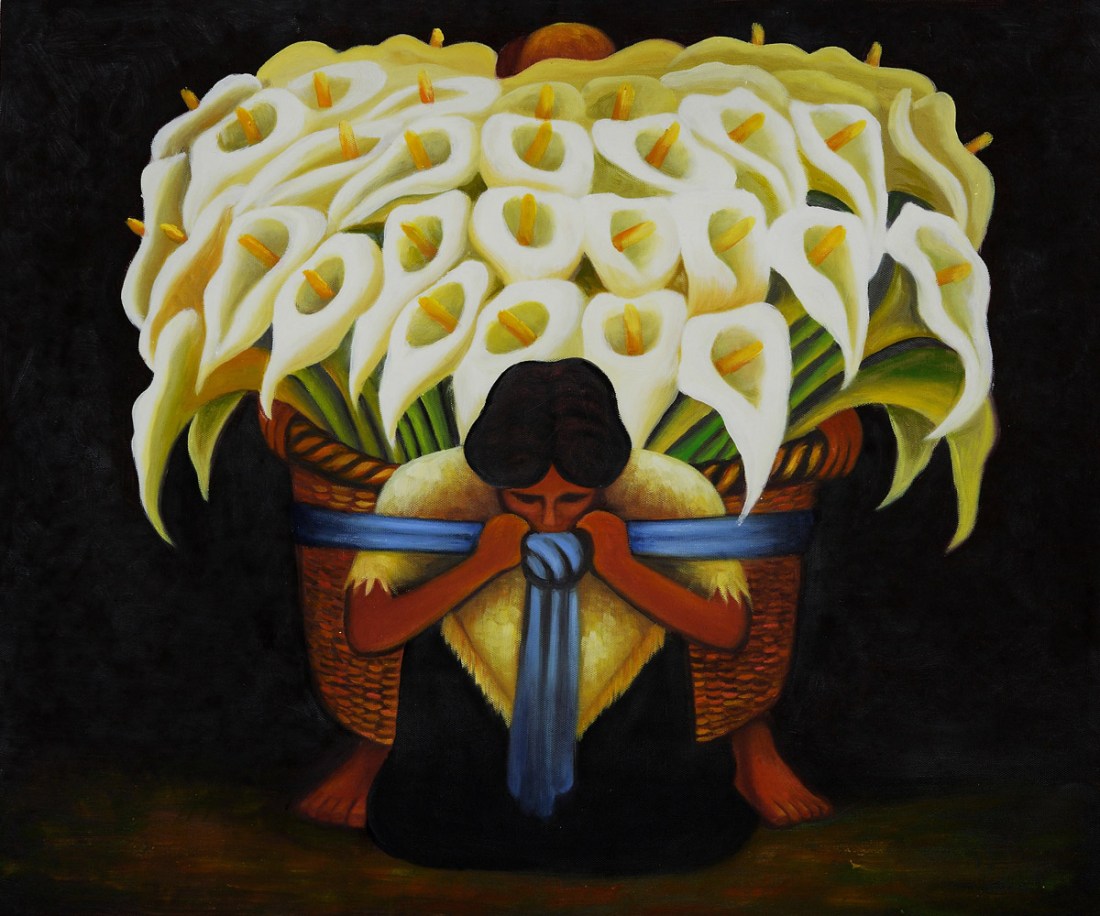
I was first introduced to ekphrastic writing as an undergraduate in my first poetry workshop. I loved the idea immediately and my first subject was this piece by Diego Rivera:

El Vendedor de Alcatraces by Diego Rivera OSA116
The Flower Carrier 


According to the Academy of American poets and the introduction they offer concerning ekphrasis, John Hollander wrote in his book, Gazer’s Spirit, that there are a number of ways to approach this type of poem ““include addressing the image, making it speak, speaking of it interpretively, meditating upon the moment of viewing it, and so forth.” The poem I’m working on regrading Two Sisters is a mix of of address and meditation, which seems to be the approach that gravitate towards. When I introduce ekphrasis to my students, I always start by showing them a variety of examples and I think that’s one of the many reasons I’m drawn to this type of poetry. The possibilities are seemingly endless.

A personal favorite of mine is Starry Night by Anne Sexton. The painting in question is of course, The Starry Night by Vincent Van Gogh and the opening stanza reads:

The town does not exist

except where one black-haired tree slips

up like a drowned woman into the hot sky.

The town is silent. The night boils with eleven stars.

Oh starry starry night! This is how I want to die.

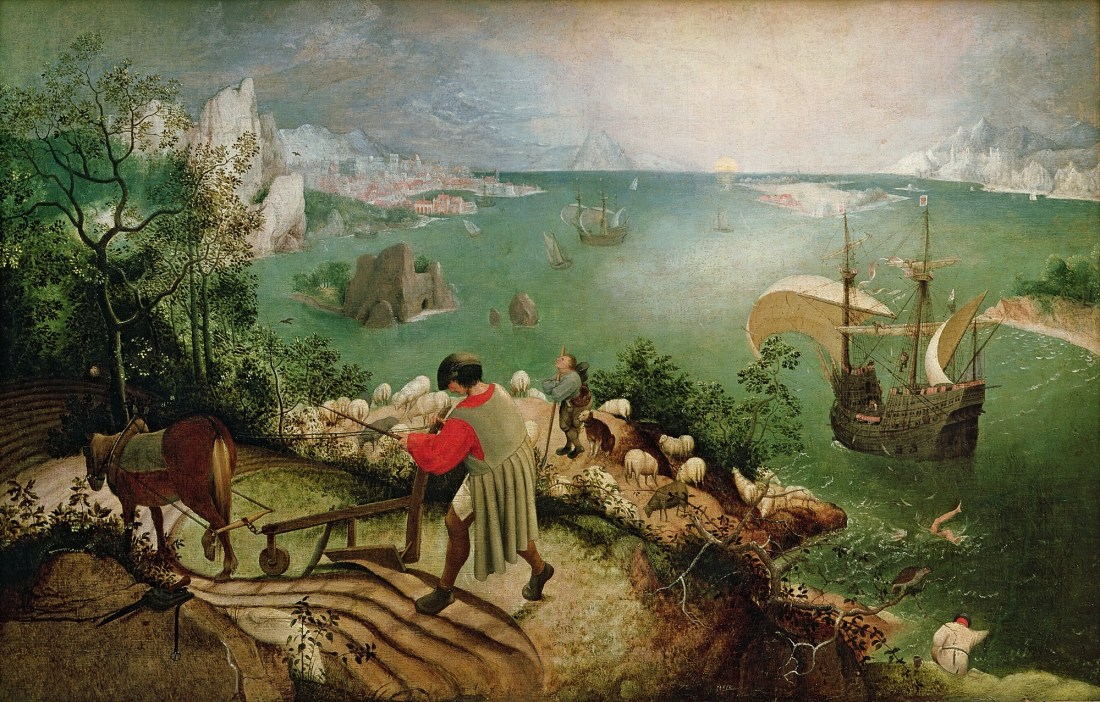
Another favorite is Landscape With the Fall of Icarus by William Carlos Williams after Pieter Bruegel’sLandscape with the Fall of Icarus:

XIR3675

From the poem:

unsignificantly
off the coast
there was

a splash quite unnoticed
this was
Icarus drowning

I particularly like discussing this poem/painting combination in my creative writing classes because it always takes my students a minute to find Icarus in Bruegel’s landscape and then when they do it’s always like they’ve won the lottery. I suppose this illuminates an added benefit of teaching ekphrasis, which is that in addition to exposure to a new set of poems, you’re also learning about art, which is an area I’ve always been interested in as a writer. I never took an art history course in college (a fact that surprises me more and more as I get older) but I feel like ekphrasis provides a wonderful entry point for newcomers. In fact, a successful poem, whether ekphrastic or otherwise, elevates its subject into a new space, sharing something with the reader that they had not considered before. Going back to Sexton’s “The Starry Night,” many of my students remark that they never thought of the painting as “ominous” or “physical” but Sexton’s poem offers a new perspective.

As an extension of this idea, when I get to the ekphrastic unit in my classes, I usually arrange for a trip to the IMA. They usually love getting into the galleries and writing poems of their own. I’m always amazed at how many of them live in the city but have never been to the museum.

While I was visiting my painting, I became aware, for probably the first time, that I am not the only one fascinated by Berthe. In the time that I sat, perched on my bench watching, several patrons stepped close to the painting. One couple stepped so close that the cord of their earbuds brushed perilously close to the frame. They whispered, they looked, but their eyes always centered on Berthe.

Because, really, where else would you look?

Time never stops, but does it end?

January 11th, 2016 and it finally snowed in Indianapolis. I could hear the snow blowing off the trees when I got up to feed Cam at 5 this morning, and it was while I was scrolling through my phone, baby resting against my chest, eyes closed, eating in slow measured swallows that I learned David Bowie died.

I remembered Tracy K. Smith’s poem, Don’t You Wonder, this morning while prepping for my intro poetry class that meets this afternoon. The title of this post comes from third stanza of the second section, and I plan on bringing copies to class today.

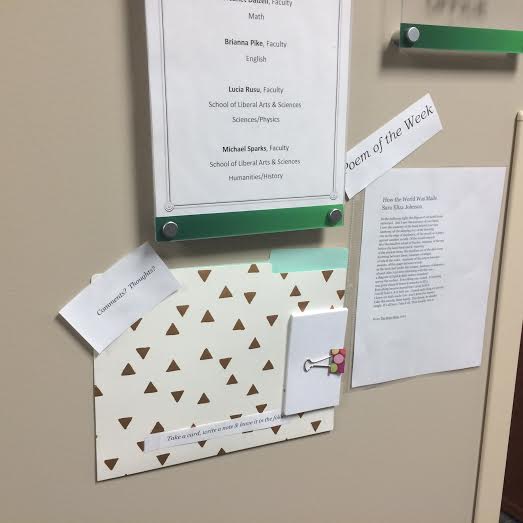
I’m also starting a new little project this semester where I share a poem a week outside my office door. I’ve tied it into the course work for two of my classes, but I really just wanted to share poems with people, because that’s the best part of my job.

4d78c95a-2855-4f76-84e3-83e8a60d626d


Pittsburgh Poetry Houses

I’m always intrigued and inspired by people who think outside the box in terms of how to distribute poetry to a larger audience, so I was really excited when I learned about the Pittsburgh Poetry Houses project.

1489246_10152116078605791_256288830_n
Phipps Conservatory & Botanical Gardens. One of my favorite places in Pittsburgh.


My family moved to Erie, PA when I was about eight years old, and when I graduated from high school, I attended Allegheny College, which is a mere 45 minutes down the road in Meadville, PA. My husband is from the South Hills and I my sister currently lives on the South side of Pittsburgh, so we visit the city several times a year.

This is all to say that I was thrilled to receive notification that one of my poems (a 30/30 poem no less!) was accepted for publication through this fantastic project. More details to come soon, but what a great way to kick of 2016.

Poetry Summer Reading List Book #2: Confluence

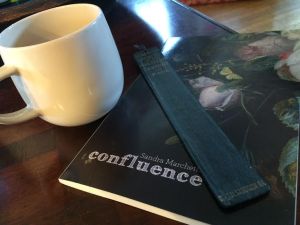
Book: Confluence 

Poet: Sandra Marchetti

Publisher/Date: Sundress Publications, 2015

Why I bought the book: I became familiar with Sandy’s work through a FB group I’m part of and then was lucky enough to meet her at AWP. I attended the panel she was a member of and then was able to meet her face to face while she was signing books at the book fair. Sandy is a lovely person and an intelligent, talented poet. She also has a beautiful voice. If you get a chance to hear her read her work, you should definitely check it out.

What I admire about this collection: For me, reading Confluence, feels like slipping into a beautiful, loved piece of clothing. These poems are carefully crafted artifacts that examine memory, emotion and experience through a unique lens but at the same time there is something wonderfully familiar about the way that the poems come together. The pbookoems that take on domestic tasks like washing the dishes or eating lunch or walking through a room are some of my favorites in the collection because while they are interesting and lyrical and new in language and line, they are also subjects that I relate to and write about. In other words, reading this book was like finding my tribe. It’s similar to how I felt when I read Elizabeth Bishop for the first time. Incidentally, the epigraph for Confluence is from Bishop’s “At the Fishhouses.”
I also love the recurring imagery & themes of birds, water, light and skin; love, identity, landscape and memory.

Favorite lines: “We rub eyes until/we’ve made owls/of each other:/under the lurching/fur of eyebrows,/of blue and green/of our slight glows,/flicks out and open” (20).  “Curved like nautilus shells,/milk-white with golden ribbing,/our spines slope to the sink;/we bow over the warmed water” (51).

Favorite poems: “Blue-Black,” “Skyward,” “Music,” “Hollow,” “Saints,” “Pilgrims,” “Fissures” & “Walk Through.”

Links: When I read the epigraph for Confluence, I was a reminded of a line from another Bishop poem, “Sandpiper” that I used as an epigraph for my poem “Snail Shell.” The line reads “The world is a mist. And then the world is/ minute and vast and clear.” The poems in Confluence bring a clarity to the subjects they examine. They allow the reader to fully immerse themselves in the experience, so you finish the poem feeling like you’ve unearthed a treasure that you can slip in your pocket and carry with you.

Previous: Octopus Game by Nicky Beer

Next: Streaming by Allison Adelle Hedge Coke

Poetry Summer Reading List Book #1: The Octopus Game

Book: The Octopus Game

Poet: Nicky Beer

Publisher/Date: Carnegie Mellon University Press, 2015

Why I bought the book: I met Nicky Beer while I was working on my MFA at Murray State University. In fact, if I remember correctly, I think she shared a poem or two from this manuscript during one of the residencies I attended toward the end of my degree. Nicky is brilliant and kind and she was also at AWP this year, so I got to see her again, which was delightful.

What I admire about this collection: There is so much to admire in Octopus Game, but I think what I like best about all of these poems is they way Nicky uses language to craft thick, layered images that feel like paintings. When I read these poems I feel like I’m reading art. The poems are ornate, weighty and beautiful. I’m not ashamed to say that I had to look up many words while reading these poems. Just a sample: polygot, mesalliance, chromaphores, epicenes, penury, labella, petioles, diastoles, cicatrix & guywires. So I should also thank Nicky for inadvertently making me smarter. I also appreciate that while Nicky’s poetry is meticulously executed and extremely intelligent, it is also accessible and humorous. It may seem somewhaunnamedt limited, but when I read poetry collections I often wonder if there are poems I could share with my students and these are poems they would love to read.
Favorite lines: “Today, love will be like starlight:/when it arrives, whatever it comes from will have already collapsed,” “Black Hole Itinerary” & “A poem like being born/behind a dead bird’s heart,/eating your way into the light,” Oblation.”

I could just list the entire book, but that’s silly, so just take my word for it and buy it so you can immerse yourself in all the gorgeousness.

Favorite poems: ” Octopus Vulgaris,” “Boys in Dresses,”Pescados De Pesadillas,”Nature Film, Directed by Martin Scorsese,” & “Harvard Med Field Trip.”

Again, I loved the whole book. See above.

Links: When I read Octopus Game I was reminded of the poem “Cephalata” by Anna George Meeks in her chapbook Engraved. I’m also a big fan of nature documentaries. I have been since I was five years old sitting on my grandfather’s lap and watching Nature on PBS. Recently, I’ve revisited two of my favorite nature documentary series Life & Planet Earth, and while reading Octopus Game I was reminded of this clip:

As a new mother, I’d also mention watching this clip while feeding a screaming newborn gives it a whole new meaning.

Next: Confluence by Sandra Marchetti

Poetry Books: A Summer Reading List

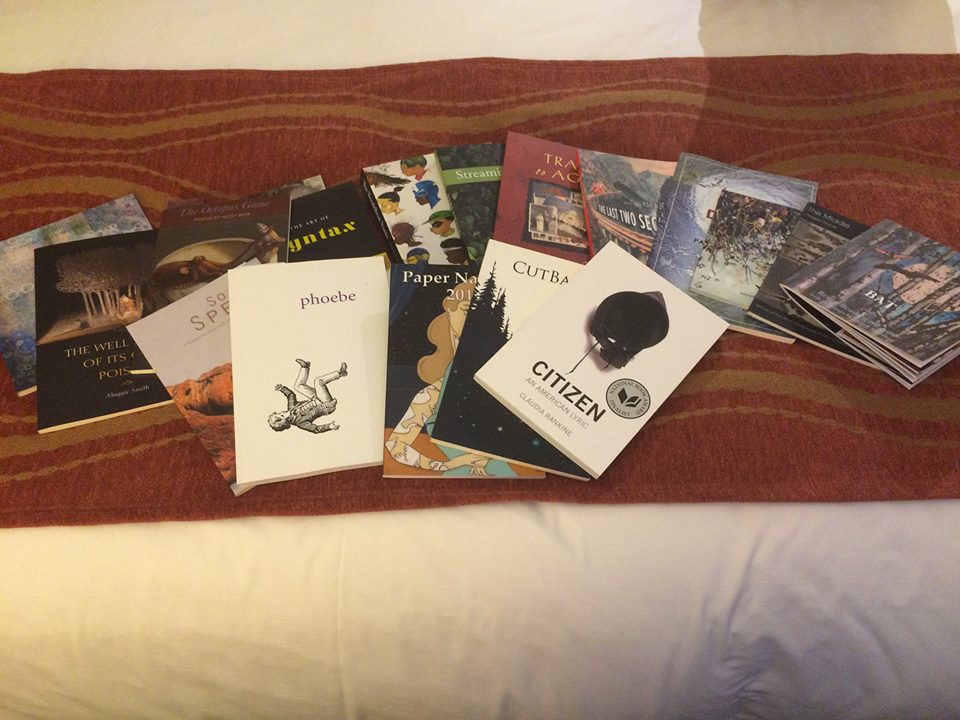
I came back from AWP with a massive amount of poetry collections. When it comes to books, I have poor impulse control (understatement of the year) but there were a lot of poets at AWP that “I knew” either through previous interactions (MA, MFA, readings, etc.) or who “I met” through Twitter, FB and Binders, so again, I had to buy their books and get them signed. I had to.

My intentions after returning from AWP were good. I would finish out the spring semester and then bury myself in the lovely pile of books that I stacked on my dining room table. Guess what? It’s June 17th and the pile is still there. Untouched. The major reason for this literary neglect is that I thought I had a solid three weeks of reading time from the end of the spring term, May 11th, to June 4th when my son, Cameron, was supposed to be born.

Let me reiterate: his due date was June 4th. When did he show up? May 16th.

So, yeah.

Anyway. I’ve found that mornings, after Cam eats and goes back to sleep, are prime time for poem drafting/ revising/reading, so I am finally prepared to tackle that stack of books that is taunting me from across the room. I’ll be posting about each book (I’m hoping to average a book/chapbook a week) because I know that most of the time I come to poetry collections through recommendations from other poets.

Stay tuned.

11149352_10153149134695791_7562234780810747246_n