BLOG POSTS

Saturday (Dickinson and Galileo) Musings

This afternoon I went to our first Speaker Series event at school, An Afternoon with Galileo and Emily Dickinson. It was an interesting program. The play was based of the PBS series that Steven Allen put on. I’ve never seen the television episodes (they’ve long since gone off the air) but I like the idea of a “meeting of the minds.” I’m not sure that Emily Dickinson would have come off as forceful as the woman who portrayed her, but it was a nice way to spend a few hours on a Saturday afternoon.
____________________________________________________________________

I discovered the website Wordle and I’m slightly obsessed with it. Try it out. Below are a few of my poems…
Here’s my blog:

Friday Musings

It’s been a stressful couple of days. One of our good friends was in a terrible car accident, so RJ has been on the phone a lot the past 48 hours. So far, the updates have been positive.
____________________________________________________________________

I couldn’t have said this better myself. Thank you.

But where is this personal venom coming from against our inaugural poet and poem? Are people in the music industry bitching that Obama should have picked Patti Labelle or Faith Hill or that guy from Coldplay? Are they up in arms at the selection of Yo Yo Ma? I kinda doubt it. This grotesque pettiness goes back to poets fighting over that tiny crumb of a pie. Poets, forget the fucking pie already! I promise you, it’s stale and flavorless. If you ever get a bite, you’ll still be as empty as your are now.

As for all this nonsense about this being Poetry’s big chance — um, no it wasn’t, it wasn’t supposed to be and get over your self-centered, personal profiteering selves. Elizabeth Alexander did not go up there to be a representative of poets. She accepted an invitation, a daunting and frightening honor that I cannot conceive of having the bravery to accept. Putting oneself and one’s poem out there, knowing full well the scrutiny both you and your poem will endure, most would shirk. When Alexander took the podium, momentarily paused before she read, when she looked out at that massive (departing) crowd, I wanted nothing more that to jump into my television and give her a hug.

I heard several different poets bemoan “Oh gee, now everyone is going to think that contemporary poetry is boring.” Well I hate to break it to you, everybody already thinks that and no poem or poet, no million dollar poetry foundation or advertisement in Good Housekeeping is ever going to change general opinion. People come to poetry, not the other way around. If you want to reach more people, study filmmaking or write TV sitcom scripts. When Diane Feinstein announced that next up was a poem, 1.5 million of the 2 million audience started high stepping it out of there, before Alexander spoke a single word. If the classical music came after the swearing in, most of those same people would have left then too. More probably would have stuck around to hear Aretha, cause she’s a celebrity and she sings songs you can dance to.

I apologize for posting such a huge link, but I really love this. Click on it to check out Reb Livingston’s blog.
___________________________________________________________________

Wednesday Musings

This is how I feel and what I’d like to be doing. For those of you who don’t know, that’s my dog, Kweli, and yes, he sleeps like a cat.

__________________________________________________________________

I’m sure when Elizabeth Alexander agreed to be the inaugural poet, she knew she’d be up for some criticism. Well, buck up Liz, because the claws have come out:

From the Seattle Post:

The problem is, by no stretch is her poem a poem at all. While as a stilted monologue it had a suggestion of lean appeal, far better than the greeting card goo Maya Angelou cranks out and insists on calling poetry, Alexander’s effort is the product of a limited imagination, an academic approach to rhythm and an anorexic understanding of imagery.

From The Guardian:

Even when writing for a public occasion and a vast audience, the poet should be able to renew language by being precise, surprising, unhackneyed. Otherwise, what is the point of such a commission? Alexander is a true people’s poet, but she has written better poems for the people than this one.

From the Baltimore Sun:

Elizabeth Alexander’s inauguration day poem, “Praise Song for the Day”, has drawn praise — and sharp criticism — from Read Street readers. But there’s no denying it got everyone’s attention. Funny how a poet can live in relative obscurity and be launched to stardom by a few minutes in front of TV cameras.

From Times Online (UK):

Praise Song for the Day was unmemorable. How do I know that for sure? Why, because I can’t remember it. Two minutes after it was spoken I couldn’t remember it. Our columnist, David Baddiel, wondered whether he couldn’t spot the Secret Service agents hastily removing the bullet-proof screens as she spoke; oh, I suppose that’s going a little far. But only just.

If you missed Alexander’s reading yesterday, here it is.

Do I think it is the greatest poem ever written? No. But I would like to point out that prior to Alexander’s reading, many critics remarked at how impossible the task of of writing an inaugural poem is. I’m not making excuses for for Alexander, but it seems to me that people are criticizing the poem for the very same reason that a lot of Americans are going to embrace it. It was simplistic, it was prosy, but it was also image driven and easy to understand. For those who thought Alexander should have written a more formal verse, well, a majority of the American public isn’t going to know what a spondee or a ceasura is. Is this a separate problem? Perhaps. Am I slamming forms? No. I like forms. I try to do my best by them, but imagine you’re writing a poem that will be heard by 1 million plus people? I’m not sure any contemporary poet can imagine that, so while I feel some of the criticism is warranted, I honestly think some of it is sour grapes.

Has Alexander written better poems? Of course she has. Who said this was supposed to be the crowning jewel in her career? Remember, she was chosen. It isn’t like she raised her hand and said “Oooo! Pick me!” In fact, I think most poets would be flattered and then horrified at the prospect of what Alexander was asked to do. As far as I know poets don’t sit down and say, “Now I’m going to write the poem that I will be known for for the rest of my life.” Yet, for some reason people expect that Alexander was supposed to do this with her inaugural poem. This doesn’t seem fair.

Also, the comment about remembering an inaugural poem? I’d be surprised if many American’s remembered an inaugural poem. I’m a poet and I don’t remember any. The focus of the inauguration is not poetry, nor is it music, or worship. These are all mere vehicles for celebration, and what I think is more important is that poetry is still part of that celebration.

I think Frost said it best when he responded to JFK’s request to read at his inauguration:

“I MAY NOT BE EQUAL TO IT BUT I CAN ACCEPT IT FOR MY CAUSE—THE ARTS, POETRY, NOW FOR THE FIRST TIME TAKEN INTO THE AFFAIRS OF STATESMEN.

Delicious Lamb

Another recipe that’s worth a try if you like lamb:

Herbed Lamb Meatballs

Ingredients

  • 1 1/2 pounds lean ground lamb
  • 1/2 cup dry breadcrumbs
  • 1/2 cup (2 ounces) crumbled feta cheese
  • 3 tablespoons chopped fresh parsley
  • 1 teaspoon dried mint flakes
  • 1/4 teaspoon salt
  • 1/4 teaspoon pepper
  • 2 garlic cloves, crushed
  • Cooking spray
Preheat oven to 400°.
Combine all ingredients except cooking spray in a large bowl, and stir well. Shape mixture into 30 (1 1/2-inch) meatballs. Place meatballs on a broiler pan coated with cooking spray. Bake at 400° for 15 minutes or until meatballs are done.
Serving size is about 5 meatballs. This recipe yields about 30, but it depends on how big you like your meatballs.

Tuesday (Inauguration) Musings

Inaugural Poem January 20, 2009
Praise song for the day.
Each day we go about our business, walking past each other, catching each others’ eyes or not, about to speak or speaking. All about us is noise. All about us is noise and bramble, thorn and din, each one of our ancestors on our tongues. Someone is stitching up a hem, darning a hole in a uniform, patching a tire, repairing the things in need of repair.
Someone is trying to make music somewhere with a pair of wooden spoons on an oil drum with cello, boom box, harmonica, voice.
A woman and her son wait for the bus.
A farmer considers the changing sky; A teacher says, “Take out your pencils. Begin.”
We encounter each other in words, words spiny or smooth, whispered or declaimed; words to consider, reconsider.
We cross dirt roads and highways that mark the will of someone and then others who said, “I need to see what’s on the other side; I know there’s something better down the road.”
We need to find a place where we are safe; We walk into that which we cannot yet see.
Say it plain, that many have died for this day. Sing the names of the dead who brought us here, who laid the train tracks, raised the bridges, picked the cotton and the lettuce, built brick by brick the glittering edifices they would then keep clean and work inside of.
Praise song for struggle; praise song for the day. Praise song for every hand-lettered sign; The figuring it out at kitchen tables.
Some live by “Love thy neighbor as thy self.”
Others by first do no harm, or take no more than you need.
What if the mightiest word is love, love beyond marital, filial, national. Love that casts a widening pool of light. Love with no need to preempt grievance.
In today’s sharp sparkle, this winter air, anything can be made, any sentence begun.
On the brink, on the brim, on the cusp — praise song for walking forward in that light.

Elizabeth Alexander
________________________________________________________________

I watched coverage (courtesy of streaming feed from the NY Times website) after my 9:30 class was over. I was lucky enough to catch Obama’s speech and Alexander’s reading, among other ceremonial proceedings. I am inspired and hopeful. I am also glad to see the end of George W. It is time for change.

“We have duties to ourselves, our nation and the world,
duties that we do not grudgingly accept but rather seize gladly.”

This is a pretty neat feature.
__________________________________________________________________

Sunday (sprouts, potatoes, broccoli oh my!) Musings

The title of the post indicates what we bought at the farmer’s market this morning. Because our brussel sprout experiment was such a success, we went back for more. It’s fun picking out your own produce. I’ve also decided to start buying cage free/organic eggs with at the farmer’s market or the store.
____________________________________________________________________

In my continuing love affair with Animal, Vegetable, Miracle, I was amused to discover that Barbra Kingsolver is listed as the 74th most dangerous person in America. As my sister would say, wtf? Obviously, it is highly to dangerous to promote public awareness when it comes to our own food consumption. Kingsolver addresses her dangerousness in her book, which is how I found out about it. Intrigued I did what every good investigator does, I googled it.

Apparently the book was written by Bernard Goldberg, who seems to be a well respected journalist at CBS. His book, Bias, won some critical support but the customer reviews on Amazon for 110 People Who Are Screwing Up America, seem lackluster at most. It appears to me that Goldberg is criticizing trends that are screwing up America, which is all well and good but Kingsolver isn’t responsible for people misinterpreting her message or making the information a trend. To be frank, it seems like a throw away book to make money. Speaking of trends, books like this are very trendy. Maybe Bernie should look in the mirror.

I continue to love her book and while I agree that we’re not all going to live our lives the way she has chosen to live hers, there is nothing wrong with thinking about what food we put in our mouths and knowing where that food comes from.
____________________________________________________________________

I’m still chipping away at last weeks New Yorker. There was segment in the Talk of the Town section entitled “Family Jewels” and it was about Bernie Madoff’s victims and how they’re all selling valuable family jewelry to CIRCA. CIRCA is a jewelry buying firm located in New York. The little snippet goes on to introduce Tracy Sherman, the company’s Palm Beach director, who had been going around to homes scoping out the jewels for sale. One of her quotes really got me. In regards to the people who are selling these jewels, Sherman advises “Be glad you had these things, and be glad you had great taste, so now you can sell it in order to continue.”

Whoa. Back up a second.

First of all, these are not mere trinkets. We’re talking about family heirloom pieces that can be worth upwards of $50,000. Second, the past tense disturbs me. Be glad you had great taste, because even if you sell this diamond pin from Cartier, you’re not ever going to be able to afford jewels like this again. Also, what does this word “continue” imply? But by far the more disturbing aspect of this little snippet is, what about the people who don’t have Cartier to sell?
___________________________________________________________________

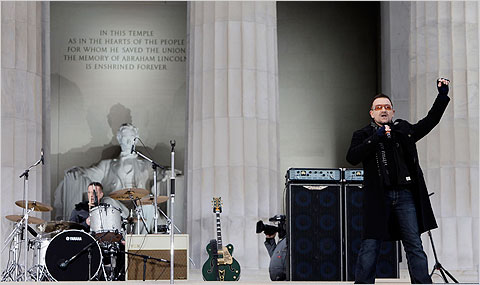
Hundreds of thousands of people are expected to gather at the Lincoln Memorial today for the “We Are One: Opening Inaugural Celebration.” Times reporters are at the event and will regularly update this post throughout the day.

I won’t lie. Bono gets on my nerves. I know this is shameful considering I am a child of the U2 generation. I like some of the music (older is better) and I embrace Bono fully as a musical icon. However, I can’t quite swallow Bono the diplomat/government activist. I have similar problems with Angelina Jolie going to Africa. What frustrates me about celebrities and political and cultural issues is that they make it trendy to care about the world, and that irritates me to no end. I was not impressed with Live Aid, mostly because Africa has been a place of concern for decades. It will continue to be a place of concern long after all the teenagers have abandoned their Live Aid t-shirts for Greenpeace or Habitat for Humanity or whatever Miley Cyrus happens to think is cool at the time.

I know people who are less jaded and judgmental will say that these celebs are just “wetting the interest” and then evenutally, these teens will become interested in these issues and want to help regardless if it’s Hilary Duff or Hilary Clinton speaking. While this could be the case with young adults (17-20), I’m skeptical about 16 and below. Their whole being is wrapped up in being fickle.
____________________________________________________________________

I really liked this play when I read it in college, and I’d forgotten what a disturbed woman Hedda Gabler is.

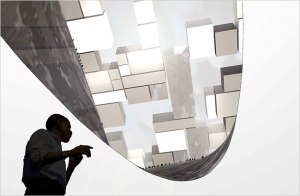
Imagine a White House where the Oval Office faces an interactive media wall filled with live commentary from citizens and visitors. Or a White House that is raised and lowered according to poll results, with an unpopular president brought down to the level of disgruntled constituents. How about one that changes colors according to the Homeland Security Advisory System? Or that has been emptied of human content and made into a central server for United States democracy?
Saturday (20 degrees!) Musings

You know it has been cold when it gets to 20 degrees and you feel like you can go outside without a coat on.
________________________________________________________________________

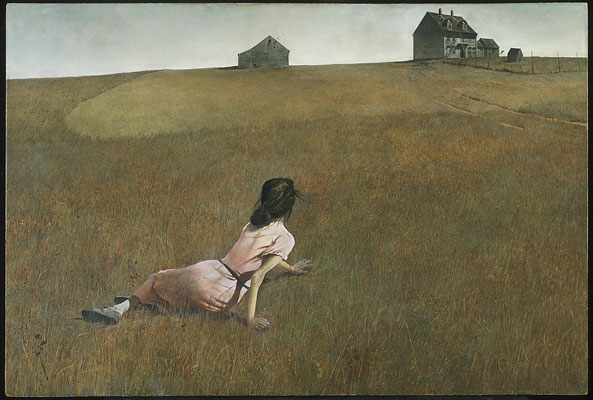
I was sad to see this today in the NY Times. My grandparents have a copy of Christina’s World hanging in the guest room where I used sleep as a kid. I always liked the painting and even incorporated it into one of my poems, Wigs.

Wyeth gave America a prim and flinty view of Puritan rectitude, starchily sentimental, through parched gray and brown pictures of spooky frame houses, desiccated fields, deserted beaches, circling buzzards and craggy-faced New Englanders. A virtual Rorschach test for American culture during the better part of the last century, Wyeth split public opinion as vigorously as, and probably even more so than, any other American painter including the other modern Andy, Warhol, whose milieu was as urban as Wyeth’s was rural.

____________________________________________________________________

Friday Musings

My class last night was excellent. There are about fifteen students and they all have a really good energy. They asked lots of questions and the three hours moved quickly. I’m both pleased and relieved. A three hour block for a class can be painful if the students are not involved, so hopefully this trend will continue.

My meeting with the librarian also went well. I secured the display case for our novel display for March. I wanted to get this display up last semester, but I’m glad that the posters will be displayed along with the student reviews. I also found out about the newly revamped poetry contest that the library is sponsoring and I may end up being a judge, which is neat.
_____________________________________________________________________

In the January issue of Poetry, there is an interesting essay by Clive James. He spends a lot of time talking about Stephen Edgar, and I wish he’d spent more time talking about the concept I’m going to excerpt here:

When reacting to a poem, the word “perfect” is inadequate for the same reason that the word “wow” would be. But it isn’t inadequate because it says nothing. It is inadequate because it is trying to say everything. On a second reading, we begin to deduce that our first reading was complex, even if it seemed simple. Scores of judgments were going on, too quickly for us to catch but adding up to a conviction—first formed early in the piece and then becoming more and more detailed—that this object’s mass of material is held together by a binding force. Such a binding force seems to operate within all successful works of art in any medium, like a singularity in space that takes us in with it, so that we can’t pay attention to anything else, and least of all to all the other works of art that might be just as powerful. We get to pay attention to them only when we recover.

I think this gets at the larger question of how do we talk about poetry? This is a very important question to me as a poet and a teacher. How do we find the language to talk about what moves us? What we respond to? I think that many students are intimidated by poetry because they don’t know how to talk about it, and is there a right and wrong way? Also, this essay addresses the issue of moving beyond the first reading of a poem. I know I’ve read poems the first time and been completely taken with them, only to find more to like upon a second reading. This also can have the reverse effect.

Thursday (Winding down…) Musings

It is the end of my week. Unfortunately, I’ve made myself work for the end of my week. I have office hours till 3, then I have a meeting with one of the librarians, then I have our first blank page meeting of the semester, and last but not least I have to come back at 7 and teach my creative writing class. The first week back is always difficult. It takes me awhile to teach my body that 6 am is a reasonable time to get up in the morning. However, I feel all this is worth it in order to not come in at all on Fridays. Also, Monday is MLK day, so I have a four day weekend. I’m ashamed to say I’m looking forward to it.

A colleague introduced me to theradio.com and I’ve been listening to it at the office. Good stuff.
___________________________________________________________________

Nikki Giovanni has a new book out all about love. It’s called Bicycles: Love Poems and this poem appears in it:

We Are Virginia Tech

We are Virginia Tech
We are sad today, and we will be sad for quite a while. We are not moving on, we are embracing our mourning
We are Virginia Tech
We are strong enough to stand tall tearlessly, we are brave enough to bend to cry, and we are sad enough to know that we must laugh again
We are Virginia Tech
We do not understand this tragedy. We know we did nothing to deserve it, but neither does a child in Africa dying of AIDS, neither do the invisible children walking the night away to avoid being captured by the rogue army, neither does the baby elephant watching his community being devastated for ivory, neither does the Mexican child looking for fresh water, neither does the Appalachian infant killed in the middle of the night in his crib in the home his father built with his own hands being run over by a boulder because the land was destabilized. No one deserves a tragedy
We are Virginia Tech
The Hokie Nation embraces our own and reaches out with open heart and hands to those who offer their hearts and minds. We are strong, and brave, and innocent, and unafraid. We are better than we think and not quite what we want to be. We are alive to the imaginations and the possibilities. We will continue to invent the future through our blood and tears and through all this sadness
We are the Hokies
We will prevail
We will prevail
We will prevail
We are Virginia Tech

This poem interests me because in my thesis defense we briefly talked about handling social and political issues in poetry and how important it is. I admire what this poem is trying to do, but I’m not sure it does it. The language doesn’t seem strong or lyrical. Also, the entire poem seems expected. I understand the form and I understand the intention, but I think it could be more.

W. D. Snodgrass, who found the stuff of poetry in the raw material of his emotional life and from it helped forge a bold, self-analytical poetic style in postwar America, winning a Pulitzer Prize for his debut book, died on Tuesday at his home in Erieville, N.Y., in rural Madison County. He was 83.

Wednesday (Holy sh*t it’s cold!) Musings

It is very cold. Everywhere. After watching the weather and a few morning shows today before heading to school, I’ve made one important decision: I am never moving to Minnesota, North Dakota, South Dakota, or Montana. I know snow. I grew up in New England before moving to Erie. However, the temperatures in Fargo are just not right. Hell, the temperatures in Chicago right now are just not right. Thank goodness for all things fleece.

We had some weather here this morning, so I received the usual onslaught of emails about poor road conditions. I don’t know if the road conditions were poor. I live six blocks from school;however, I also know that Hoosiers are notorious for over reacting to snow, ice, or any combination thereof. The fact of the matter is, missing the second day of class is not a smart move.
___________________________________________________________________

Marxist principles have been dripping steadily into the minds of American youth for more than a century. This isn’t altogether surprising. After all, most parents want their children to be far left in their early years — to share toys, to eschew the torture of siblings, to leave a clean environment behind them, to refrain from causing the extinction of the dog, to rise above coveting and hoarding, and to view the blandishments of corporate America through a lens of harsh skepticism.